ban-risk-entry
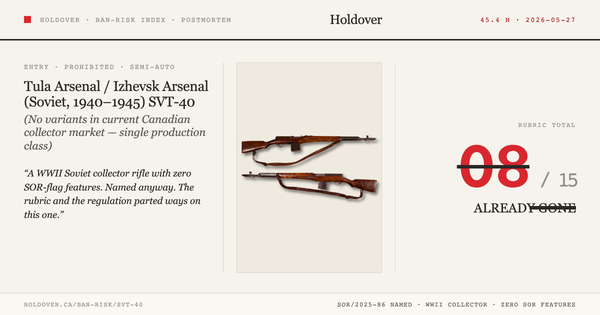
Soviet SVT-40 (Самозарядная винтовка Токарева образца 1940)
A WWII Soviet collector rifle with zero SOR-flag features. Named anyway. The rubric and the regulation parted ways on this one.

ban-risk-entry
A WWII Soviet collector rifle with zero SOR-flag features. Named anyway. The rubric and the regulation parted ways on this one.
ban-risk-entry
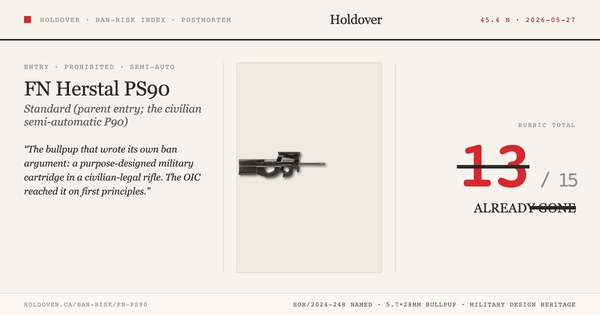
The bullpup that wrote its own ban argument: a purpose-designed military cartridge in a civilian-legal rifle. The OIC reached it on first principles.
ban-risk-entry
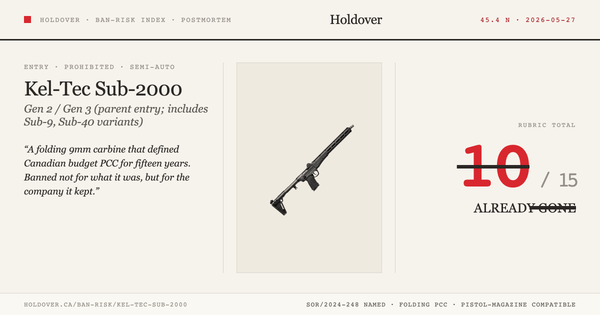
A folding 9mm carbine that defined Canadian budget PCC for fifteen years. Banned not for what it was, but for the company it kept.
ban-risk-entry
The Canadian-made AR alternative that the OIC reached anyway. A domestic manufacturing story shut down by a regulation that named what it looked like.
ban-risk-entry
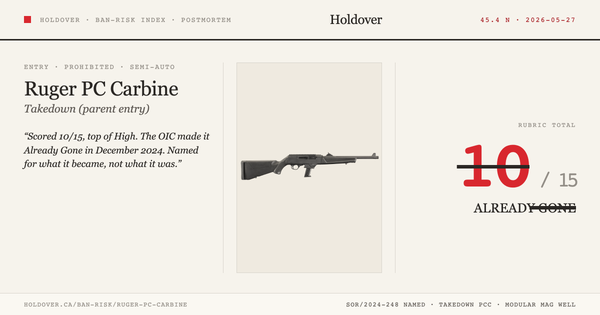
Scored 10/15, top of High. The OIC made it Already Gone in December 2024. Named for what it became, not what it was.
ban-risk-entry
The platform around which the entire OIC pathway was built. The rubric's only perfect 15/15 — every dimension at the ceiling.
ban-risk-entry
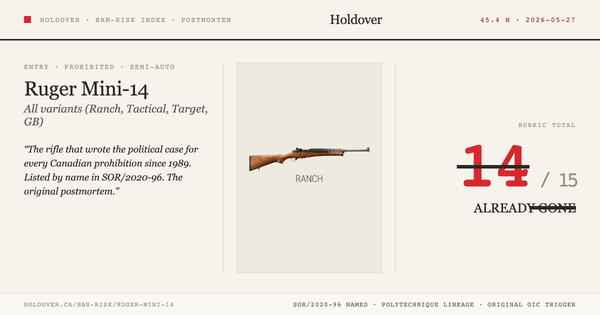
The rifle that wrote the political case for every Canadian prohibition since 1989. Listed by name in SOR/2020-96. The original postmortem.
ban-risk-entry
Prohibited by RCMP FRT reclassification, not Order in Council. A more concerning legal pathway — the how matters as much as the what.
ban-risk-entry
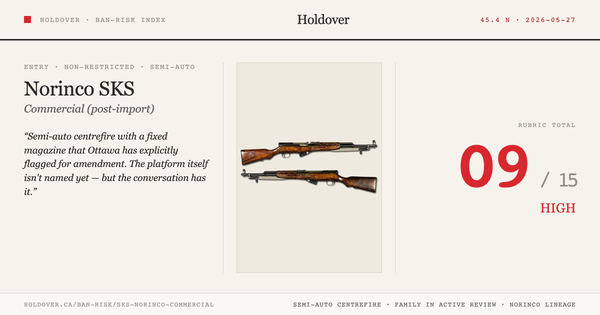
Semi-auto centrefire with a fixed magazine that Ottawa has explicitly flagged for amendment. The platform itself isn't named yet — but the conversation has it.
ban-risk-entry
Low on the rubric, but the platform has been touched once already. The 2016 magazine reinterpretation is the only reason this isn't a confident Low.
ban-risk-entry
Bolt-action precision chassis with hunting bones. Sits well outside any reasonable reading of the current criterion.
ban-risk-entry
Bolt-action, classic hunting profile, no semi-auto lineage — Ottawa would have to reinvent the criterion to reach this one.