Your turret, measured across thirty MOA
A closed box confirms return-to-zero. The tall-target test measures the turret scale and gives the owner a correction factor for every ballistic solution.

Scope adjustment Open the MOA/MIL calculator
Thirty MOA at 100 yards should move a group 31.41 inches. A clean 30 inches looks close on paper. It means the turret delivered about 4.5 per cent less movement than its markings promised.
That error can survive a box test. Dial up, right, down, and left by equal amounts and the group can return to its starting point because the same scale error cancels on the return legs. A parallelogram closes too. Coming home establishes repeatability; it leaves the scale as a separate measurement.
Holdover has recommended a closed box as proof of tracking in three earlier scope pieces. That advice was incomplete. The useful correction is a tall target, a tape measure, and enough turret travel to make a small percentage visible.
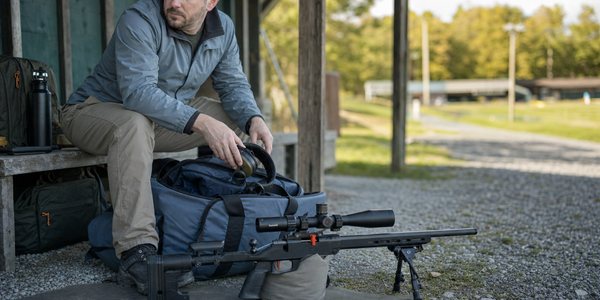
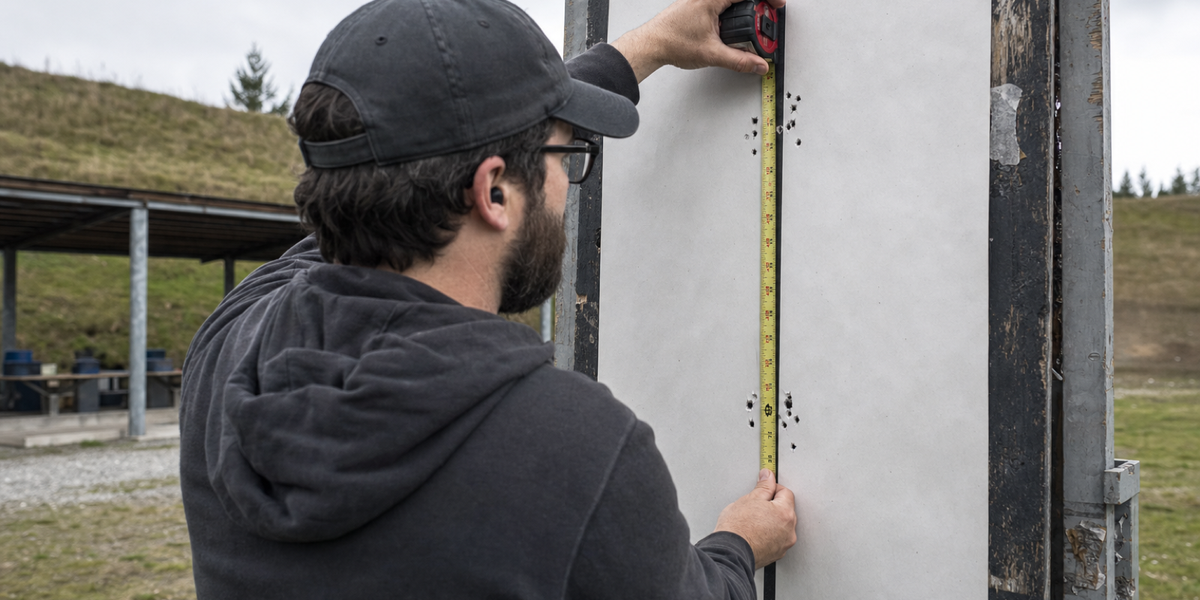
Holdover produced the feature as a fictional range-calibration scene. The person, target, range, shot groups, and measurement represent no named shooter, location, firearm, scope, or recorded result.
The box still has a job
Return-to-zero matters. A scope that wanders after an excursion can erase a range session in a few turns, and the ordinary box test exposes that failure.
Better box targets also mark the intended corner positions. Comparing every group with its marked point can test the scale as well as the return. The limitation is leverage. A five-MOA leg at 100 yards should measure 5.235 inches. A five per cent error changes that by about a quarter-inch, which can disappear inside the group.
Thirty MOA turns the same percentage into more than an inch and a half. The tape has something useful to read.
Run the long measurement
Applied Ballistics' tall-target worksheet keeps the procedure compact:
- Confirm the target sits at 100 yards and hang a straight vertical line with a level or plumb bob.
- Aim near the bottom of the line and fire a group to confirm the starting point.
- Dial at least 30 MOA or 10 mils of elevation and fire a second group.
- Measure between the two group centres.
- Divide the expected shift by the measured shift to get the correction factor.
The constants depend on the units:
- yards and MOA:
0.01047 - yards and mils:
0.03599 - metres and MOA:
0.01145 - metres and mils:
0.03936
Expected shift equals the amount dialled, multiplied by range, multiplied by the matching constant. At 100 yards, 30 MOA becomes 30 x 100 x 0.01047, or 31.41 inches. Ten mils becomes almost exactly 36 inches.
Applied Ballistics uses a 102-yard example. Thirty MOA should move 32.04 inches. A measured shift of 29.8 inches produces a correction factor of 32.04 / 29.8, or 1.075. A ballistic solution calling for 30 MOA then becomes 32.25 MOA on that scope.
Measure between group centres rather than the nearest holes. Rifle, ammunition, and shooter dispersion still sit inside both groups, so five-shot groups give the centres more evidence than a convenient pair of impacts.
That factor belongs beside the ballistic profile. Treating it as memory adds a new place for a miss to hide.
Repeatable and calibrated are different properties
Cal Zant published a useful separation of those properties in a 2014 PrecisionRifleBlog field test. He clamped 18 scopes in fixed mounts and read their reticles against tall Horus calibration targets. Most used mils, a few used MOA, and he tested roughly equivalent travel in repeated increments.
Four scopes were perfect through the full calibration range. Several individual samples showed enough error that Zant obtained replacement units, and the replacements performed better. The study tested one or two copies of each model twelve years ago, so it cannot rank the current market. It makes the owner-level point well: a model reputation cannot supply the number for the particular scope in front of you.
His separate return-to-zero results found all 18 scopes maintained zero through repeated excursions. Every sample came home. Fourteen still delivered some amount other than the marked adjustment during calibration.
Three per cent grows with distance
Three per cent sounds like a rounding error near the zero bench. Distance gives it room to work.
Dial 10 MOA for a 400-yard shot and three per cent is about 1.3 inches. Dial 20 MOA at 800 yards and it becomes about five inches. Dial 10 mils at 1,000 yards and the difference reaches 10.8 inches.
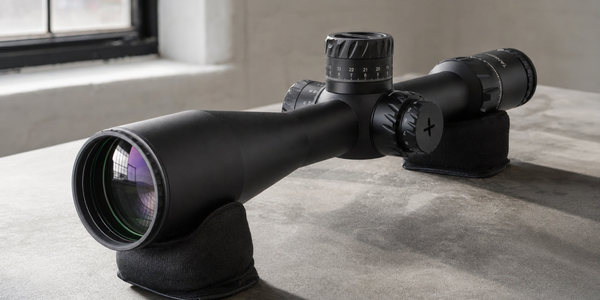
The Vortex Diamondback Tactical on my .30-06 has exposed turrets. That is the only personal result I can claim here: I own a scope designed to be dialled. I have no recorded tracking factor for it. The gap belongs on the range list rather than inside an assumption.
Ontario's confirmed 2026 Hunting Regulations Summary opens resident deer and moose gun seasons in several northern WMUs on September 19. Most owners will use August to confirm zeros, check mounts, and put familiar ammunition back on paper. Adding two measured groups turns one of those trips into an equipment check.
Know when to skip it
A hunter who keeps a capped turret at zero and stays inside a short, familiar envelope gains little from a correction factor that will never be dialled. Field-position practice can make better use of the rounds.
Exposed turrets change the decision. The owner bought access to the adjustment scale. Two five-shot groups, a straight line, and a tape measure can establish whether that scale deserves confidence.
Record the range, expected shift, measured shift, and factor beside the rifle's ballistic profile. A scope you have measured deserves more trust than one wearing a confident label.
Sources
- Ontario, 2026 Ontario Hunting Regulations Summary: https://www.ontario.ca/files/2026-03/mnr-2026-ontario-hunting-regulations-summary-en-2026-03-05_0.pdf
- Applied Ballistics, Tall Target Test Worksheet: https://appliedballisticsllc.com/wp-content/uploads/2021/06/Tall-Target.pdf
- PrecisionRifleBlog, Tactical Scopes: Mechanical Performance Part 1: https://precisionrifleblog.com/2014/08/13/tactical-scopes-mechanical-performance-part-1/
- PrecisionRifleBlog, Tactical Scopes: Mechanical Performance Part 2: https://precisionrifleblog.com/2014/08/22/tactical-scopes-mechanical-performance-part-2/
- Box to Bench Precision, Scope Tracking Target Instructions: https://www.boxtobenchprecision.com/target-instructions-2
- Vortex Optics, Diamondback Tactical 4-16x44 FFP: https://vortexoptics.com/vortex-diamondback-tactical-4-16x44-ffp-riflescope.html
Keep the range notes worth reading later.
If this piece has you thinking about range time, keep the notes useful enough to read later.
Use the Holdover Range Bench Log Card to record rifle, optic, ammunition, distance, weather, zero, group notes, correction, and next test without turning a range trip into a memory test.
Safety note: the card is a note-taking worksheet, not shooting instruction, load data, legal advice, or a substitute for range rules, official guidance, manufacturer manuals, or qualified instruction.