The Dispatch: the buyback file has receipts
This week: the buyback tracker gets the lead, Public Safety has a fresh progress page, Holdover Armory is now on Android, and the useful precision links are about rimfire lots and 64x glass.

The Dispatch: the buyback file has receipts
Forwarded this by someone with better taste than average? Subscribe to The Dispatch.
The buyback file did the thing it does best this week: it made one more page necessary.
That is annoying, but useful. Public Safety now has a progress page with actual program totals, and the collection stage is no longer just a future-tense paragraph hiding inside a release. If you have been trying to keep the file straight without turning your browser into a hostage situation, this is exactly why the tracker exists.
The Main Shot
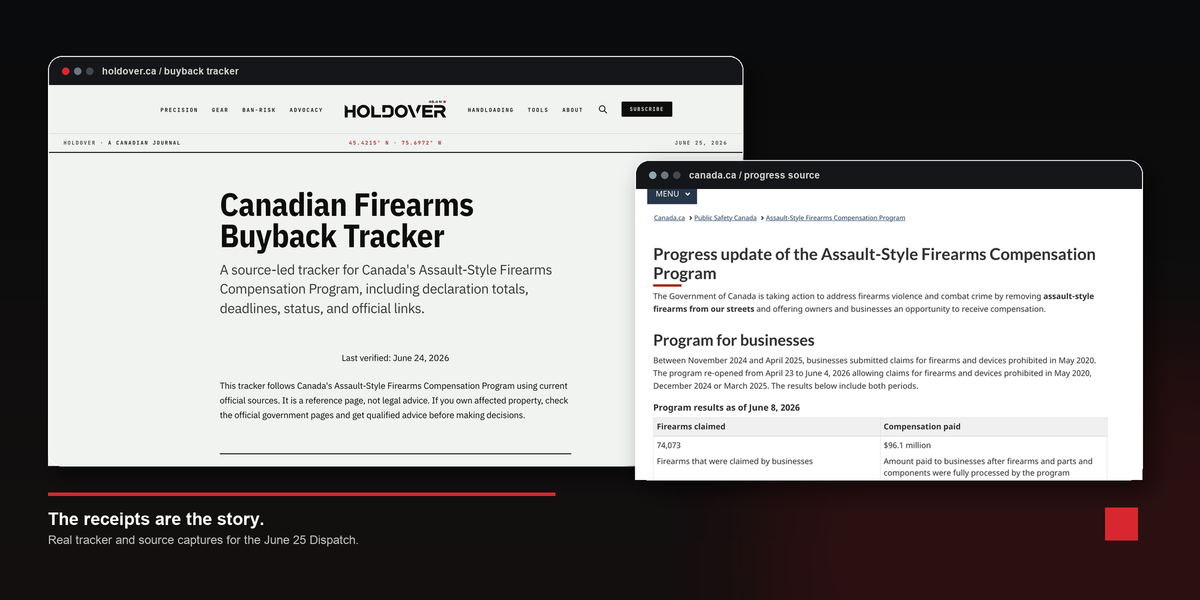
This week's lead is the Canadian Firearms Buyback Tracker.
The tracker was refreshed on June 24, and the best reason to lead with it is not drama. It is hygiene. Public Safety's main program page was modified on June 24 and now points to a program progress page that reports business-program results as of June 8: 74,073 firearms claimed by businesses and $96.1 million paid after firearms, parts, and components were fully processed.
That number belongs beside the older individual declaration number, not blurred into it. Public Safety's earlier June 9 release said more than 68,000 firearms were declared in the individual phase, and the tracker keeps those categories separated because claimed, declared, collected, destroyed, deactivated, validated, and compensated are not synonyms. Ottawa has many talents. Precision naming is not always one of them.
The practical read: save the tracker, then watch for the next source that changes the owner-facing clock, payment reality, or collection process.
This Week On Holdover
- Canadian Firearms Buyback Tracker. Refreshed June 24, with the current court-plus-90 amnesty language and declaration totals kept separate from business claims and compensation.
- Holdover Armory is now on iPhone and Android. The Android listing is live on Google Play, so the private rifle log is no longer an Apple-only thing.
- 64x needs a job. A current Canadian KAHLES K864 listing is a useful reminder that high magnification is a job description, not a personality.
- Your .22 barrel gets a vote. Rimfire precision is having a good Canadian moment, and the cheapest accuracy lesson may still be testing the box before blaming the rifle.
Armory On Both Phones
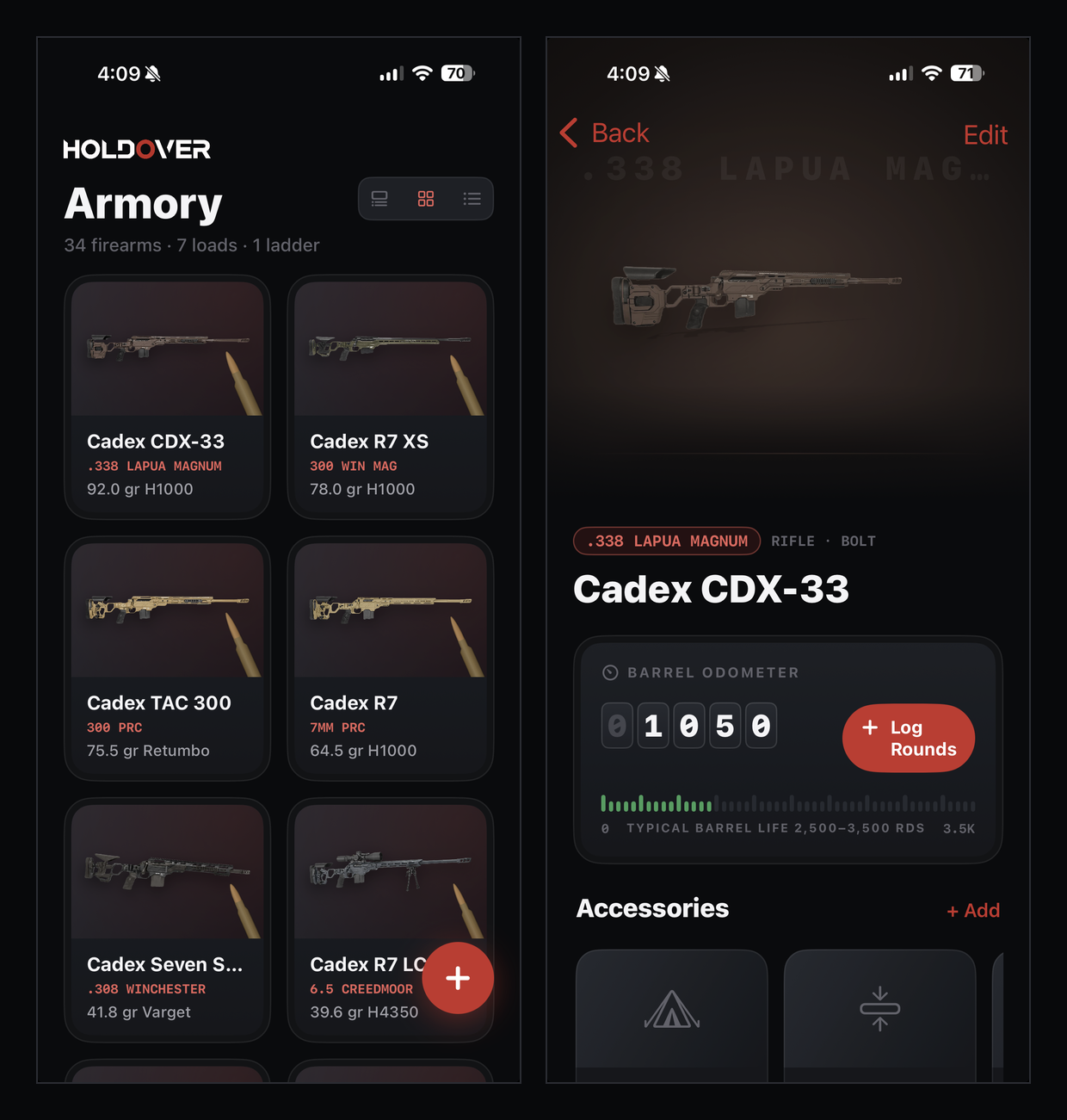
One more useful thing: Holdover Armory is now also available for Android on Google Play.
That matters because the app is not trying to be a social feed, a marketplace, or another place to perform ownership for strangers. It is a private working log for rifles, mounted accessories, round counts, loads, ladder notes, range results, and the small details that become expensive when they vanish. The pitch is intentionally boring: know what is on the rifle, what it has fired, what load looked promising, and what actually happened the last time you took it out.
It started as the kind of app I wanted because my notes were scattered between a range book, photos, and optimism. Now it is on both major phone platforms. That feels like a better use of software than making another login screen for people who already have enough of those.
The Week In The File
Public Safety's progress update is the week's useful source. It says the business program reopened from April 23 to June 4, 2026 for firearms and devices prohibited in 2020, 2024, or 2025, and that the results include both business periods. The headline figures are 74,073 business firearms claimed and $96.1 million paid after processing.
The collection timeline page says collection for compensation is underway and gives province and territory windows. Ontario is listed as June to October 2026. Quebec is June to September. British Columbia is May to September. Alberta and Saskatchewan are handled with a warning footnote telling residents to consult provincial laws or regulations that may impede or limit participation.
The amnesty source has not been replaced by a better one. The current legal text is still Canada Gazette SOR/2026-114, and the practical owner-facing shorthand remains court-plus-90. I checked the SCC appeal files again during this draft. They remain process pages, not a judgment. StatsCan did publish a June 18 Juristat on mass casualty events, but that is context for another day, not the lead for this issue.
From The Bench
The bench note this week is really a records note: write down the source you are relying on before the next source moves.
Range data works the same way. If you do not record the lot, the wind, the rifle setup, or the weird thing the target did, you end up arguing with your memory later. Policy files are worse. They use PDFs, modified dates, program pages, backgrounders, and one sentence in a release that changes the whole practical read.
Do Future You one favour. Keep the source with the claim.
One Useful Link
Save Public Safety's Progress update of the Assault-Style Firearms Compensation Program. It is the cleanest current place to check the business-claim and compensation numbers without rereading three releases and a Gazette order over coffee like a person who has made poor life choices.
Tool Or Tracker
For rifle-specific risk, keep the Ban-Risk Index close. The buyback tracker tells you where the program file sits. Ban-Risk helps with the other question Canadian buyers keep circling: is this rifle only a good deal because everyone is nervous?
Reply
What should the tracker show next: payment totals, province-by-province collection windows, SCC appeal milestones, business-claim numbers, or a plain-language owner checklist?
Reply to this email. Specific beats loud.
If someone at your club is trying to make sense of this file without losing an evening to bad takes, forward them The Dispatch.