The Dispatch: 55 counts and the harder file
This week: prohibition-order breach counts, fresh StatsCan IPV data, no new buyback/SCC movement, and a practical reason to keep the source file close.

Forwarded this by someone with better taste than average? Subscribe to The Dispatch.
A charge sheet is not a time machine.
That is the annoying little sentence I kept coming back to this week. A prohibition order can matter. A release condition can matter. A court file can matter. But when the order shows up in the police release after the shooting, after the warrant, after the loaded shotgun, after the stolen property, after the drug file, then the useful question is not whether the paper exists. It is whether the paper mattered early enough.
That is the difference between a public-safety tool and a public-safety receipt.
The Main Shot
This week on Holdover: 55 breach counts ask the harder question.
The lead this week is the source-file piece on prohibition-order breach counts. CSSA's current review says it found 24 people, arrested for other offences, who were also charged with 55 counts of breaching firearm prohibition orders over 30 days. That number is CSSA's review, not a government statistical release, so it needs to be handled carefully.
The reason it still leads is the primary-source layer underneath it. Two recent Winnipeg Police releases put the problem in plain view: serious allegations, firearms, ammunition, release-order issues, and prohibition-order charges appearing after police contact. Charges are allegations. Courts decide facts. Still, the pattern is the point. If Ottawa wants to talk about public safety, it should spend less time congratulating itself for finding licensed owners and more time explaining how high-risk breach signals are supposed to be caught before the next release.
Criminal Code section 117.01 is not vague. It makes it an offence to possess a firearm, firearm part, ammunition, prohibited weapon, or related item while prohibited from doing so by an order made under federal law.
Read it here: 55 breach counts ask the harder question.
This Week On Holdover
- New South Wales handed Canada a dealer warning. A buyback eventually needs dealers, storage, chain of custody, and competent counters. Funny how policy remembers that late.
- Prince George, 19 stages, and the missing on-ramp. The 2026 IPSC Canadian Handgun Nationals show the sport is still organized. Federal policy has made the next generation harder to explain.
- Nightforce put new pressure on the middle shelf. The NX6 appearing at Canadian mid-tier money does not end the scope argument. It makes the counter comparison more honest.
The Week In The File
There is one fresh source worth reading closely: Statistics Canada released Firearms and intimate partner violence in Canada on July 8. The Daily says there were 1,096 victims of police-reported firearm-related intimate partner violence in 2024, a rate of 3.1 victims per 100,000 population aged 12 and older. It also says those victims represented 10% of all victims of firearm-related violent crime and 0.9% of all victims of intimate partner violence in 2024.
That is serious data. It is also specific data. Do not let anyone flatten it into a slogan before they have read what StatsCan is actually counting.
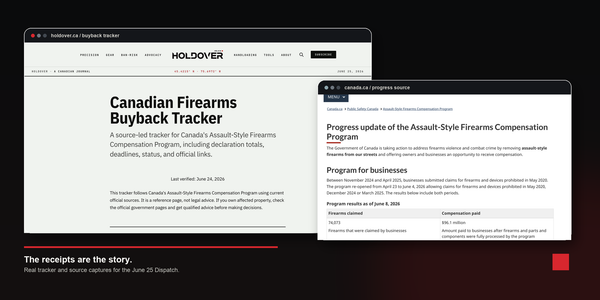
On the buyback/SCC file, I did not find meaningful new public movement this morning. Public Safety's progress page still points to the June 8 program results. The collection timeline remains approximate. The Canada Gazette amnesty order remains SOR/2026-114 from June 17. The SCC firearms appeal pages remain active process records, not final judgments.
So the correct read is not "nothing matters." It is "keep the source stack close." The Canadian Firearms Buyback Tracker exists for exactly this reason.
From The Bench
The practical bench note this week is not a load note or a gear note. It is a source habit.
When a number shows up in the firearms file, write down what kind of number it is before you argue from it. Police release. Advocacy review. StatCan victim count. Gazette order. SCC docket event. Program progress total. Those are not interchangeable.
It is the same discipline as a range note. Group size without distance is not data. Velocity without temperature is not enough. A "firearms statistic" without the counting frame is just noise with better shoes.
One Useful Link
StatsCan: Firearms and intimate partner violence in Canada. New July 8 data worth reading carefully because it separates firearm-related IPV from the broader firearms-crime file.
Tool Or Tracker
This week's practical Holdover link is the Ban-Risk Index.
It is not a prediction machine. It is a buyer's sanity check for the moment when a rifle looks attractive because the price is softer than it used to be. Sometimes the discount is a deal. Sometimes it is the market asking you to hold the bag politely.
Reply
What number in the Canadian firearms file do you think gets repeated without enough context?
Reply to this email. Specific beats loud.
If someone at your club is trying to make sense of this file without losing an evening to bad takes, forward them The Dispatch.