15 inch-pounds, or *28.*
Outdoor Canada's pre-season checklist points to one small job with four separate answers. Scope rings, bases, rail clamps and action screws each need the number their maker publishes.


Outdoor Canada published its pre-season gear checklist on August 26 with a sensible instruction in the optics section: check the base and ring screws, then use a torque driver at the setting the manufacturer publishes.
That last part needs more room than a checklist can give it. A scoped rifle has several fastening interfaces, and they do not share one number. The base meets the receiver. The rings meet the rail or base. The cap squeezes the scope tube. A chassis rifle adds action screws beneath the stock line. The same driver may touch every joint, but the source for each number changes with the part.
Write those values down before a range day or hunting trip. The work takes minutes. Finding the right reference after a scope begins to wander takes longer.
Four joints, four sources
Start with the scope tube. Vortex says its ring-cap screws take 15 to 18 inch-pounds. MDT lists 15 to 22 inch-pounds for Premier Ring caps, then gives the more useful instruction: the optic manufacturer supplies the final value.
Leupold's STD mounting instructions put its ring screws at 28 inch-pounds maximum. Those numbers do not cancel each other out. They describe different rings and different contact surfaces. A Vortex scope in Vortex rings belongs to Vortex's cap specification. A Leupold STD ring belongs to Leupold's instruction. An MDT ring still has to respect the optic maker's ceiling when that ceiling is lower.
The interface below the tube carries its own source. Leupold lists 22 inch-pounds for 6-48 base screws and 28 for 8-40 screws. Its instructions also call out lower limits for a Ruger 10/22 and a Browning X-Bolt. That is enough to end the habit of treating every receiver screw as the same job.
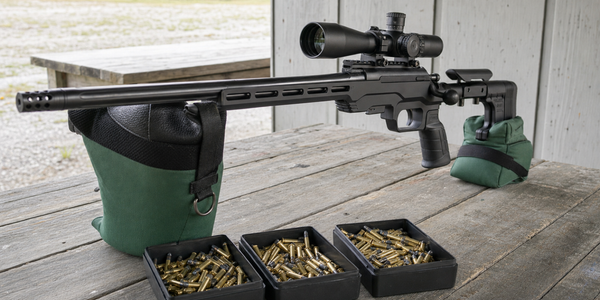
I see the distinction on my own bench. My Cadex CDX-SS Seven wears Vortex 34 mm precision rings, so the cap screws answer to the Vortex sheet. That combination makes the record-keeping point: the cap specification belongs to the rings and optic in front of you, while every other joint has its own source.
Warne makes the hierarchy plain in its installation FAQ. The company publishes a mount maximum, yet directs owners to use the firearm or scope manufacturer's lower value when one applies. The part maker sets the envelope. The component with the narrower requirement wins.
The number that belongs to the part
Choose the specification for the joint in front of you, then set the driver. A tool accurate to the wrong number can still squeeze the scope tube too hard.
That distinction matters most at the ring cap, where excess clamp force acts directly on a thin scope tube. Vortex describes permanent tube damage, restricted internal movement and reduced ability to hold zero as the cost of over-torque. The company also tells owners to keep thread-locking compound off its ring-cap screws because the compound can change how much clamp force a given reading produces.
The base, rail clamp and chassis screws live in different mechanical relationships. They also get different guidance. A rifle owner who keeps one line in a notebook labelled "scope torque" has not solved that problem. Put the manufacturer, the interface, the fastener and the value on the same line. Leave room for the date and the driver used.
The list can stay short:
- scope ring caps;
- base or rail screws;
- ring-to-rail clamp or cross-bolt;
- chassis action screws, where the rifle has them.
The source page should sit beside each item. A current manual or support article beats a remembered forum post, especially when a company updates a product line or differentiates one ring family from another.
Feel has a limit
Experienced hands can tell when a fastener has seated. That skill earns respect at a bench. It does not create a transferable record for a precision optic mount.
A published torque value does two useful things. It tells the next person working on the rifle what the part maker intended. It also lets you identify the joint worth checking when a setup starts showing an unexplained shift.
The driver itself needs care. Use the units printed in the manual. Do not turn inch-pounds into foot-pounds by memory. Keep the bit seated squarely. Work the cap screws evenly so the gap stays balanced. Those are ordinary bench habits, yet they matter more than a dramatic last pull on the handle.
None of that calls for a universal number. The honest answer begins with the exact ring, base, rail and chassis on the rifle in front of you. The manufacturer has already done the work of assigning the value. Read it before you set the driver.
Before the opener
Outdoor Canada's checklist gets the priority right. A loose optic ruins a range day quickly. Over-tightening can create the slower problem: a scope that looks secure while the tube or internals carry more force than they should.
Open the manuals. Record the four interfaces that apply to your rifle. Keep the list with the rifle, its dope or its range notes. Then put the driver away.
Keep the setup record with the rifle so the next person reaching for the driver can find the right value.
Sources
- Ken Bailey, "Now's the time to prepare for hunting season. These 7 expert tips will have you - and your gear - ready to head afield," Outdoor Canada, August 26, 2026. The optics section directs readers to check base and ring screws and follow the manufacturer's torque setting. Retrieved September 10, 2026. https://www.outdoorcanada.ca/huntingprep/7/
- Vortex Optics, "How To Torque Your Riflescope Rings," May 16, 2023. Source of the 15 to 18 inch-pound ring-cap specification, thread-locker warning and over-torque explanation. Retrieved September 10, 2026. https://vortexoptics.com/blog/how-to-torque-your-riflescope-rings.html
- MDT Help Center, "What are the torque specs on the MDT Premier Rings?" updated January 29, 2025. Source of the 15 to 22 inch-pound Premier Ring cap specification and the instruction to follow the optic manufacturer's final value. Retrieved September 10, 2026. https://support.mdttac.com/hc/en-us/articles/360024397972-What-are-the-torque-specs-on-the-MDT-Premier-Rings
- Leupold, STD Bases and Rings Mounting Instructions. Source of the 22 inch-pound 6-48 base-screw figure, 28 inch-pound 8-40 base-screw figure, and 28 inch-pound maximum for STD ring screws. Retrieved September 10, 2026. https://www.leupold.com/media/manuals/std_mounting_instructions.pdf
- Warne Scope Mounts, FAQ. Source of the instruction to follow a lower firearm or scope manufacturer's torque value where applicable. Retrieved September 10, 2026. https://warnescopemounts.com/faqs/
Keep the range notes worth reading later.
If this piece has you thinking about range time, keep the notes useful enough to read later.
Use the Holdover Range Bench Log Card to record rifle, optic, ammunition, distance, weather, zero, group notes, correction, and next test without turning a range trip into a memory test.
Safety note: the card is a note-taking worksheet, not shooting instruction, load data, legal advice, or a substitute for range rules, official guidance, manufacturer manuals, or qualified instruction.