From 12,143 to 74,073 firearms claimed
The 187-business ATIP figure belongs to the first compensation phase. Public Safety's current business total is 74,073 firearms claimed across both periods.

Buyback reference Open the tracker
Advocacy / Firearms Policy. The table on screen has three useful labels: initial phase, businesses, and 12,143 firearms.
It appears in a new Rebel News video shared on Reddit this week. The narration says 187 businesses participated in the initial phase of the federal Assault-Style Firearms Compensation Program and claimed compensation for 12,143 prohibited firearms.
Those figures describe a real part of the program. They have since been overtaken by a much larger federal total. Public Safety Canada now reports 74,073 firearms claimed by businesses across two compensation periods.
The distance between those numbers is 61,930 firearms. Keeping the phase label attached changes the story.
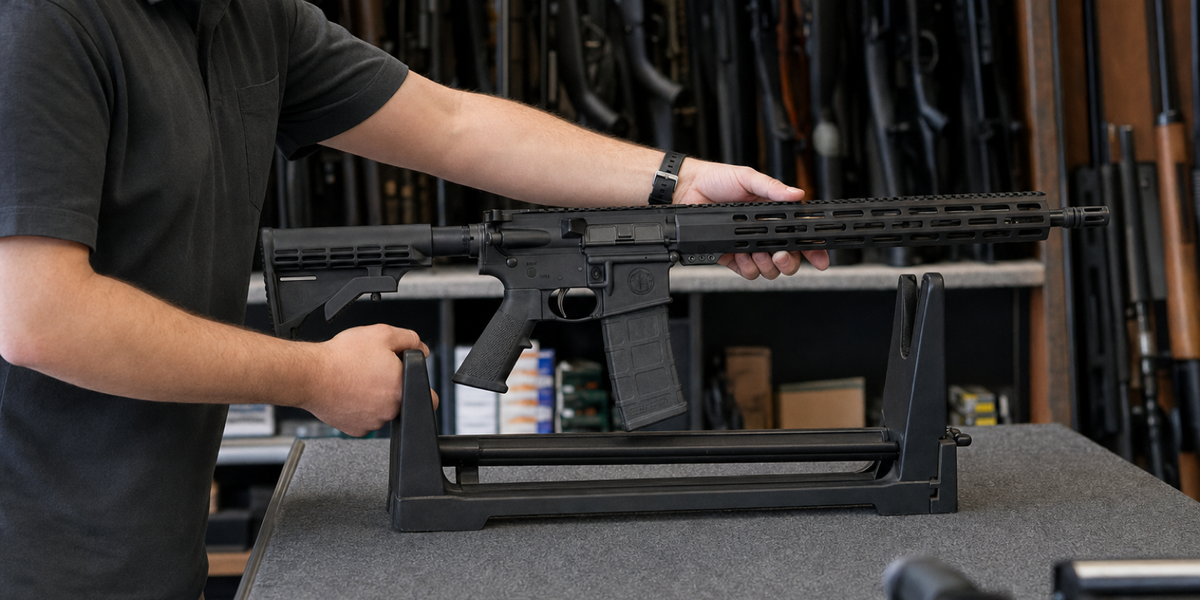
Holdover produced the feature as a fictional retailer inventory scene using current manufacturer geometry references. The person, store, rifle, and transaction do not depict a named business, exact product, compensation-program participant, documented claim, or actual event.
The 187-business figure has a date
The first business period ran from November 2024 to April 2025. It covered firearms prohibited in May 2020.
The ATIP-derived table shown by Rebel labels itself Initial Phase - Program for Businesses. It gives 187 participating businesses and 12,143 firearms claimed. I could not locate the matching request in the federal government's current public ATI-summary file, so the exact headcount belongs with that source and that limitation.
Public Safety's own April 2026 account of the first phase uses rounded language. It says more than 12,000 firearms were processed and destroyed and businesses received more than $22 million.
That is a substantial first-phase result. It also fixes the boundary around the 187-business figure. The headcount tells us how many businesses participated during the first period. It says nothing about how many joined the reopened period in 2026.
The second period added 61,930 firearms
Public Safety reopened the business program from April 23 to June 4, 2026. The second period included firearms prohibited in May 2020, December 2024, and March 2025.
Its current public-data page combines both periods and reports 74,073 firearms claimed by businesses as of June 8. That is about 6.1 times the initial 12,143. The subtraction is cleaner than the ratio: 61,930 more business firearms appear in the combined total after the first phase.
The payment column also moved. Public Safety reports $96.1 million paid to businesses after firearms, parts, and components were fully processed. Its business next-steps page says the claim window has ended and payment follows validation and full processing.
That gives the business side a published intake total and a published payment total. The current number of participating businesses remains absent from the cited federal pages.
The individual column measures an earlier stage
The same federal reporting page gives 68,717 firearms declared by individual owners. The business firearm count is 5,356 higher.
That comparison needs a label of its own. Businesses are counted under firearms claimed. Individuals are counted under firearms declared. Ottawa's individual next-steps page, updated August 7, says declarations are being assessed and collection, deactivation, and compensation are underway. Owners are told to wait for a notification and funding agreement before completing disposal steps.
The public pages do not give a national total for individual firearms already collected, deactivated, destroyed, or paid. A declaration records entry into the process. It leaves the final outcome open.
Here is the current public ledger in its safest form:
| Program stage | Published count | What the count covers |
|---|---|---|
| Initial business phase | 12,143 firearms claimed | 187 businesses in the ATIP-derived table shown by Rebel |
| Both business periods | 74,073 firearms claimed | May 2020, December 2024, and March 2025 prohibition waves |
| Individual program | 68,717 firearms declared | Owner declarations awaiting or moving through later steps |
Three rows, three stages. They can sit beside each other. They cannot become one completion rate.
A stage label does real work
At my reloading bench, a prepared case, a charged case, a seated round, and a fired group belong to different parts of the record. Counting one stage answers one question. The label keeps that answer from wandering into the next column.
The federal program deserves the same discipline. Claimed describes what a business submitted. Fully processed is the condition attached to the $96.1 million payment figure. Declared describes where individual owners entered. Collection, deactivation, destruction, and compensation each need their own totals.
The government's case is straightforward. It says the program removes prohibited assault-style firearms from circulation, compensates owners and businesses, and brings inventory into lawful compliance. The first business phase produced destroyed firearms and completed payments. The reopened phase produced a much larger claim total.
Those claims are strong enough to publish with their proper dates and stages. Public confidence would gain from two additional fields: the total number of businesses across both periods and the number of individual firearms that have completed each disposal and payment step.
The current number belongs on the current story
The 187-business figure answers a useful historical question. It shows how concentrated the initial business phase was and how many firearms those early participants held.
It has become a weak headline for the whole business program. Ottawa's own published firearm count has moved from 12,143 to 74,073, and the current participant total has not moved into public view with it.
The clean correction is small: add initial phase whenever 187 or 12,143 appears. Use 74,073 for the combined business firearm total. Keep 68,717 under individual declarations until Public Safety publishes later-stage outcomes.
Ottawa has counted the inventory. Its next useful number is what the program has finished.
The amnesty file is still moving.
If this piece sent you back to government pages, do not wait for the next portal, Gazette, or court move to find you by accident.
The Dispatch follows Public Safety, RCMP, Canada Gazette, court, compensation, collection, and amnesty updates so the next change comes with the source that moved.
Safety note: the tracker is a worksheet for source hygiene, not legal advice or a substitute for current official guidance.