PAL test week, with less panic
A fast PAL/RPAL study companion for the week before CFSC or CRFSC: practice questions, weak-area drills, ACTS/PROVE, storage, transport, and quick reference.

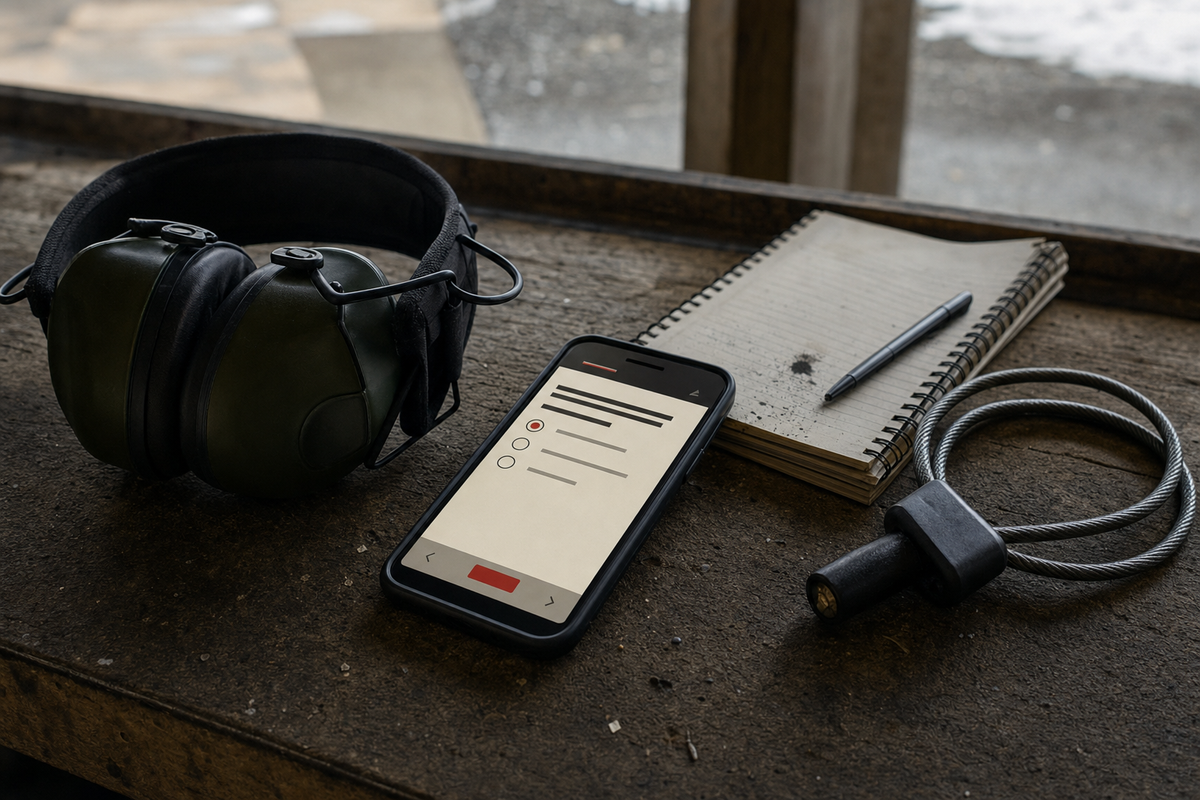
I would have wanted this before my CFSC and CRFSC.
Not another giant guide. Not another forum thread where three people are half-right in different directions. Just a fast way to drill the parts that make your brain tighten up before class: ACTS, PROVE, storage, transport, classifications, and the questions that feel obvious until you are staring at four answer choices.
That is what this is for.
Build your practice test
Pick the level and length. We'll randomize from a bank of 87 questions and grade you against the 80% written-test threshold.
First time? Start with a 10-question warm-up.
Your results
You'd pass the written test. Keep drilling weak areas before test day.
Performance by topic
| Category | Score | % |
|---|
Review your answers
Every question, your answer, the correct answer, and the explanation with citation.
Drill by topic
Browse questions by category. Flashcard-style, with instant feedback after each card.
Storage & transport walkthrough
Three clicks - firearm class, scenario, exact legal requirements with citations.
What kind of firearm?
Storage and transport rules in Canada are tied to the firearm's legal class - not its size or appearance.
What are you doing with it?
For a non-restricted firearm, pick the situation that fits.
Quick reference
One page. Take it to test day or print it for the range bag.
ACTS · The four vital rules
PROVE · How to check
Firearm classification at a glance
| Class | Examples | Licence required |
|---|---|---|
| Non-Restricted Non-restricted |
Most hunting rifles and shotguns: bolt-action, lever, pump, break-action, many semi-autos with barrel ≥ 470 mm. | PAL |
| Restricted Restricted |
Most handguns with barrel > 105 mm; semi-auto centerfire rifles with barrel < 470 mm; some specific models prescribed as restricted. | RPAL |
| Prohibited Prohibited |
Handguns with barrel ≤ 105 mm or in .25/.32 calibre; fully automatic; sawed-off; AR-15 and ~1,500 models prohibited May 2020; converted autos. | RPAL (with prohibited privileges) - frozen for new acquisitions. |
Storage at home · the short version
| Class | Required | Citation |
|---|---|---|
| Non-Restricted | Unloaded AND one of: trigger / cable lock, OR bolt removed, OR locked container / receptacle / room. Ammunition must not be readily accessible unless it is locked up, together with or separately from the firearm. | SOR/98-209 s. 5 |
| Restricted | Unloaded AND trigger lock AND locked container / receptacle / room (or vault / safe / room built for it). Not readily accessible to ammunition unless ammo is locked up too. | SOR/98-209 s. 6 |
| Prohibited | Same as restricted, plus: if bolt or bolt-carrier is removable, store it separately in a locked container. Fully-auto and converted-auto firearms have stricter requirements. | SOR/98-209 s. 7 |
Transport · the short version
| Class | While transporting | If left in unattended vehicle |
|---|---|---|
| Non-Restricted | Unloaded. No ATT needed. PAL must be on your person. | Locked in trunk; or if no trunk, out of sight + vehicle locked. |
| Restricted | Unloaded, secure locking device fitted, in a locked opaque container. Use a reasonably direct route. Approved ranges in your province are normally covered by licence conditions; gunsmiths, gun shows, ports of entry/exit, and other destinations generally require a specific ATT. | Locked in trunk; or if no trunk, container out of sight + vehicle locked. Container must not be readily breakable. |
| Prohibited | Generally not transportable except for specific authorized purposes - call your provincial CFO before moving one. | Same as restricted, plus any specific ATT conditions. |
Quick-fire facts that trip people up
| Shotgun gauge math | Smaller gauge number = larger bore. A 12-gauge bore is bigger than a 20-gauge. |
| Rimfire vs centerfire | Rimfire (.22 LR, .17 HMR): primer is in the rim. Centerfire: primer is a separate cup in the centre of the case head. |
| Hangfire | Trigger pulled, delayed ignition. Keep the muzzle pointed downrange for at least 60 seconds before opening the action. |
| Misfire | Trigger pulled, no ignition. Same procedure: muzzle downrange, wait 60 seconds, then open the action and remove the cartridge. |
| Zone of fire (group hunting) | Each hunter has an assigned arc. Never swing your muzzle outside your zone or shoot at anything outside it. |
| Crossing an obstacle alone | Unload the firearm, place it across the obstacle with the action open and muzzle pointed away, then cross. |
| Crossing with a partner | Both unload. One passes both firearms to the other (action open, muzzle controlled), then crosses, then receives them back. |
| Pass threshold | 80% on the written test (40 / 50) and 80% on the practical handling test. |
What it does
The companion has four useful modes.
Practice Test gives you CFSC, CRFSC, or combined quizzes, scored against the 80 percent written-test threshold. Topic Drill lets you work one weak area at a time. Storage Walkthrough turns class and situation into a plain list of requirements with citations. Quick Reference puts ACTS, PROVE, classification, storage, transport, and common tripwires on one printable page.
The point is not to replace the course. The point is to arrive less scrambled.
What it is not
Keep its boundary clear: this is a study aid. The official manual, your instructor, the RCMP Canadian Firearms Program, the Firearms Act, SOR/98-209, and your provincial Chief Firearms Officer are the authorities.
Start with a 10-question warm-up. If you miss storage, drill storage. If ACTS and PROVE are automatic, move on. If transport rules are the part you keep second-guessing, stay there until they stop feeling slippery.
That is the whole job: fewer vague worries, more specific repetitions.
Quick FAQ
Is this the official PAL or RPAL test?
No. It is an independent Holdover study companion built around CFSC/CRFSC topics and current public legal references.
What score do I need?
The written and practical tests use an 80 percent pass threshold.
Does this replace the course manual?
No. Always defer to the official manual, your instructor, the RCMP Canadian Firearms Program, the current law, and your provincial CFO.
Can I use this for storage and transport decisions?
Use it as a reference starting point, not as a ruling. The tool links back to official sources because those are the sources that matter.
Related Holdover Tools
If you are still choosing a first rifle or trying to understand the gear path after the course, these are the next practical Holdover references.
Cite This Tool
Suggested citation: Holdover, "Free Canadian PAL/RPAL Practice Test", last updated May 19, 2026, https://www.holdover.ca/pal-rpal-practice-test/.
Sources
- RCMP, Storing, transporting and displaying firearms, accessed May 17, 2026: https://rcmp.ca/en/firearms/firearms-safety-training-transport-and-storage/storing-transporting-and-displaying-firearms
- Justice Laws, Storage, Display, Transportation and Handling of Firearms by Individuals Regulations, SOR/98-209, current to March 17, 2026, accessed May 17, 2026: https://laws-lois.justice.gc.ca/eng/regulations/SOR-98-209/FullText.html
- Justice Laws, Firearms Act, current to March 17, 2026 and last amended April 4, 2025, accessed May 17, 2026: https://laws-lois.justice.gc.ca/eng/acts/F-11.6/
- RCMP, Former Bill C-71 - What you need to know, accessed May 17, 2026: https://rcmp.ca/en/firearms/former-bill-c-71-what-you-need-know?wbdisable=false
- Public Safety Canada, Firearms Buyback Program, accessed May 17, 2026: https://www.canada.ca/en/public-safety-canada/campaigns/firearms-buyback.html
Keep the first PAL steps in order.
If this piece has you mapping the licence process, keep the official steps and follow-up notes together.
Use the Holdover PAL/RPAL First-Steps Checklist to keep the official forms, course booking, references, photo, fees, and follow-up notes in one place while you work through the process.
Safety note: the checklist is an orientation aid, not legal advice or a substitute for current RCMP/CFP/CFO guidance or instructor direction.