100.18 is not a *typo*
The current Canadian F-Class Nationals score table has clean cards like 100.18 and 100.17. For newer shooters, the useful lesson is the number after the dot.

Opinion. A F-Class score string can look like a spreadsheet mistake until the shooter understands what the dot is doing.
The current TargetScore page for the 2026 Canadian F-Class Nationals at Heffley Creek Gun Club lists the match for July 1-3, with FTR and F-Open divisions under ICFRA rules. The result record I checked on July 3 was timestamped July 2 at 13:28 UTC and showed public scoring rows for Matches 1-3.
The useful part for the rest of us is not a winner claim. The useful part is the score string.
In the first match, the board includes 100.18. In another match, it includes 100.17. There are 100.15, 100.12, 100.9, and 100.8 strings too. To a newer shooter, that can read like someone accidentally put decimals into a rifle match.
They did not.
The first number is the points. The number after the dot is the V-count, the centre-count that starts separating clean cards from one another. In plain language, a clean score is not always the same kind of clean.
That is the whole article, really. The dot is small because the target already did the shouting.
The dot is doing work
F-Class looks specialized because it is specialized. The rifles, rests, loads, wind calls, target systems, divisions, and match routines can make an ordinary range shooter feel like he wandered into a room where everyone else read the manual twice and then laminated it.
I get that feeling. I have had range days where the rifle seemed fine, the notes looked confident, and the target quietly explained that my memory was a public-relations department. The paper does not care how persuasive the shooter sounded at the bench.
That is why score notation matters.
If a shooter fires a clean 20-shot string, the points alone say something important. The V-count says something more precise. It tells you how often those full-value shots were in the smaller centre. That extra number is where the day stops being a pass/fail mood and starts becoming a useful record.
For a newer shooter, the translation is simple: do not only ask whether the shot counted. Ask how much middle was actually there.
That question changes the notebook.
Clean is not one thing
The TargetScore rows are a good public lesson because they show several flavours of excellent shooting in one place. A 100.18 and a 100.8 both have the clean 100-point front end. They do not tell the same story.
That does not make the lower V-count embarrassing. Most of us would accept a clean card with the solemn dignity of a person trying not to dance in the parking lot. The point is narrower than bragging rights. The score string keeps the centre honest.
At the top of a discipline, perfect has texture. It has density. It has a second number.
This is useful even if you never shoot F-Class and never intend to. Canadian shooters spend a lot of money trying to buy precision, then sometimes record results as if the only categories are "good" and "bad." The F-Class string is a better habit. It separates the result from the feeling around the result.
That matters because the feeling is unreliable. A stable position can feel awkward. A lucky group can feel like progress. A sloppy string can feel acceptable until the score forces you to stop complimenting it.
The dot is rude in the best possible way.
What newer shooters can steal
Start by stealing the notation habit, not the equipment list.
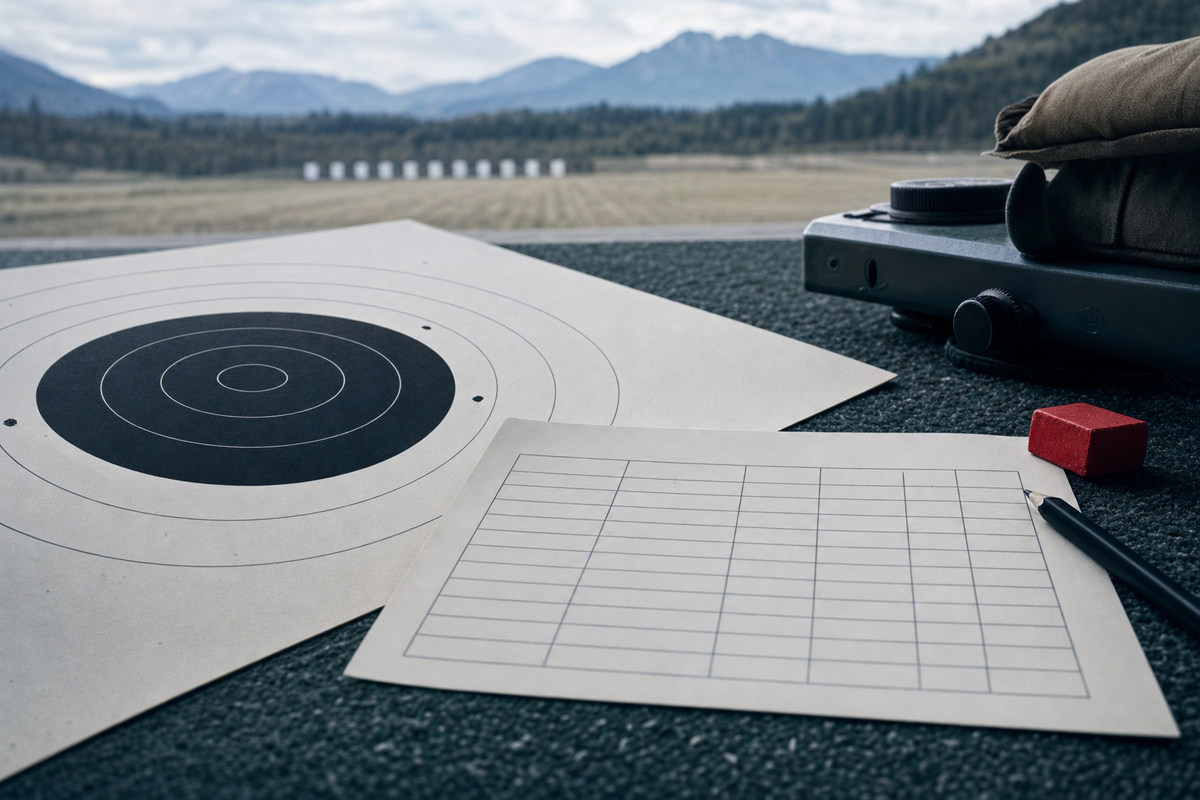
If your range day uses paper, record more than the group size or the score. Record how many shots were truly in the centre you were trying to own. If you are shooting for groups, write down whether the group was centred or merely small in the wrong place. If you are testing a zero, separate the question of impact location from the question of consistency. If you are checking a load, do not let one tidy cluster erase the call you knew you pulled.
The useful notebook has enough friction to correct the shooter later.
I like simple notes because I am fully capable of making complicated ones and then hating the person who wrote them. Distance. Rifle. Ammunition. Wind. Position. Score or group. Centre count or best honest equivalent. What changed. What to test next.
The centre-count idea also helps newer shooters resist the worst gear lesson. A rifle, optic, rest, bag, or load can improve the work, but it should be made to answer a measured problem. "I want more V-hits" is a better sentence than "I want the setup to feel more serious."
The former can be tested.
Why this is a Canadian story
The Nationals are not happening in a vacuum. DCRA registration opened earlier this year for the 2026 Canadian Fullbore and F-Class National Championships. Heffley Creek's match material points to a serious long-range club environment, electronic target workflow, safety expectations, and a full championship rhythm. ATPQ/PQRA's schedule thread also places the Nationals from July 1-3, followed by Team Canada practice on July 4.
That is healthy shooting infrastructure: lawful, organized, public, scored, and more accurate than most politics-first coverage of the subject.
The current F-Class board is a reminder that Canadian shooters are still doing the measured work: running relays, tracking scores, keeping categories straight, using public scoring systems, and producing numbers that are far more demanding than most casual arguments about "accuracy."
100.18 is a small artifact from that world. It is not dramatic. It is better than dramatic. It is specific.
Write the second number
The practical takeaway is not that every shooter needs to chase a national-level V-count.
Start smaller. The next time the target comes back, write down the second number in whatever form makes sense for the day. Centres. Called centres. Clean hits. Shots that were in the exact place the plan asked for, not merely somewhere acceptable. Keep the note plain enough that next-month you can understand it without becoming an archaeologist.
A score that says "100" is useful. A score that says 100.18 is more useful because it refuses to flatten the work.
That is the lesson newer shooters should borrow from the current Canadian F-Class Nationals. Precision is not only whether the shot scored. Precision is whether the shooter can tell what kind of score it was and make the next string answer to it.
The first number tells you whether the shots counted.
The second number tells you how honestly they lived in the middle.
Sources
- TargetScore,
2026 Canadian F-Class Nationals: https://targetscore.com/2026-canadian-f-class-nationals_huJudU - TargetScore API event record,
2026 Canadian F-Class Nationals: https://api.targetscore.com/api/event/2026-canadian-f-class-nationals_huJudU - TargetScore API results record,
2026 Canadian F-Class Nationals: https://api.targetscore.com/api/results/2026-canadian-f-class-nationals_huJudU - TargetScore API recent results: https://api.targetscore.com/api/results/recent
- DCRA,
Registration Now Open for the 2026 Canadian Fullbore and F-Class National Championships: https://dcra.ca/2026/03/09/registration-now-open-for-the-2026-canadian-fullbore-and-f-class-national-championships/ - Heffley Creek Gun Club,
Revised HCGC 2026 F-Class Match Info: https://www.heffleycreekgunclub.com/files/2026_files/F-Class/Revised_HCGC_2026_F-Class_Match_Info.pdf - ATPQ/PQRA,
2026 Match Schedule: https://atpq-pqra.org/viewtopic.php?t=29 - ICFRA,
Rules and Match Conditions: https://icfra.com/rules-match-conditions/
Keep the range notes worth reading later.
If this piece has you thinking about range time, keep the notes useful enough to read later.
Use the Holdover Range Bench Log Card to record rifle, optic, ammunition, distance, weather, zero, group notes, correction, and next test without turning a range trip into a memory test.
Safety note: the card is a note-taking worksheet, not shooting instruction, load data, legal advice, or a substitute for range rules, official guidance, manufacturer manuals, or qualified instruction.