On a Canadian firing line, 300 needs a unit
Canadian shooting disciplines use metres and yards side by side. Label the range, solver entry, and dope card before one number becomes two distances.

A range sign that says 300 has left out the part your ballistic solver needs most.
Three hundred metres is 328.1 yards. Three hundred yards is 274.3 metres. The same number can move the target line by 53.8 metres, and every other input can still look perfectly sensible.
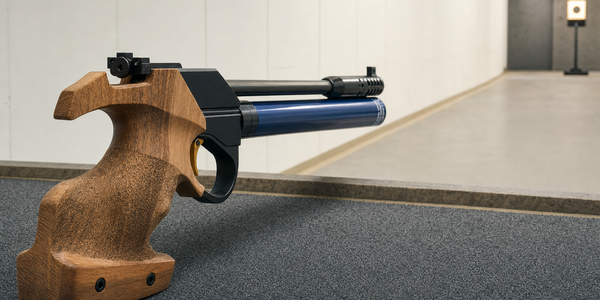
Canadian shooting uses both conventions. DCRA's current disciplines page lists Target Rifle and F-Class from 300 to 900 metres and Precision Rifle from 200 to 900 metres. On the same page, Service Pistol runs from 10 to 25 yards. DCRA also has registration open for its 2026 Fullbore and F-Class national championships.
The Canadian Rimfire Precision Series makes the split even plainer. ORPS runs from 25 to 100 yards. CRPS runs from 50 to 350 metres. King of .22 Miles uses 100 to 700 metres, while Rimfire Precision Paper returns to 50 and 100 yards. One Canadian organization publishes all four formats.
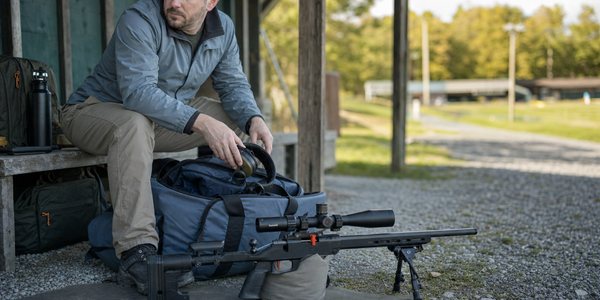
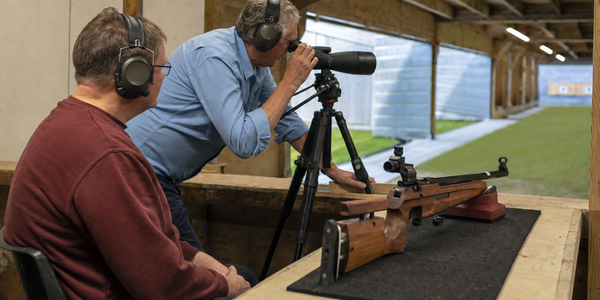
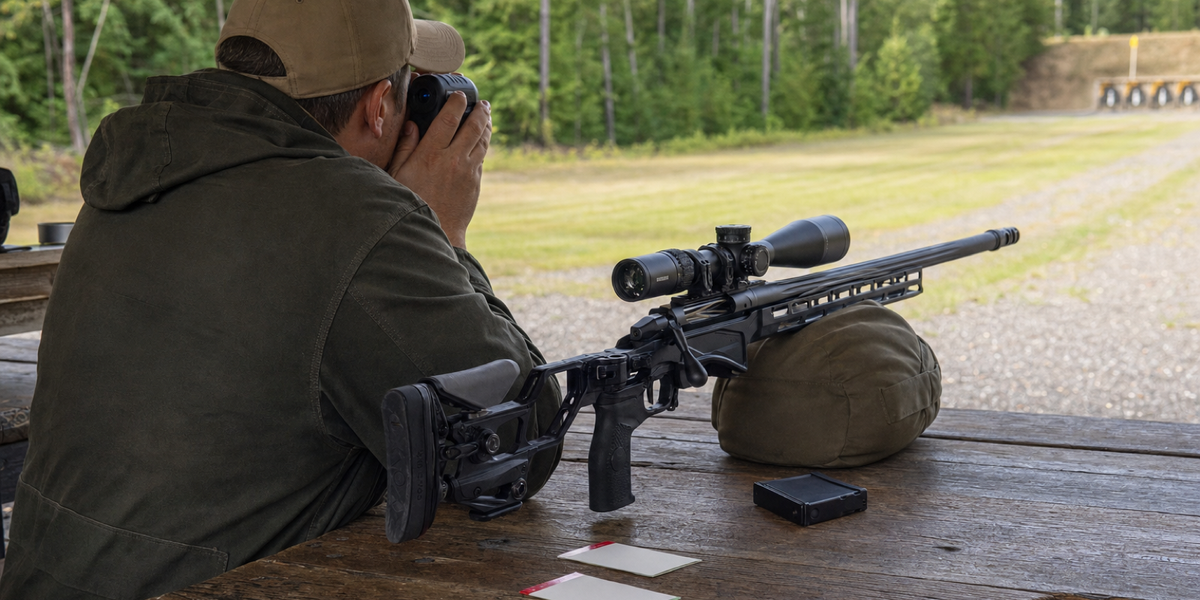
Holdover produced the feature as a fictional Canadian firing-line scene from official Cadex Defence family references. The person, rifle, range, and moment are representative. They do not depict a real club, match, product, or owner.
The unit belongs to the discipline
The mix has a practical history. Canadian and British fullbore traditions lean metric on current DCRA pages. American-derived formats often arrive in yards, along with the course documents, rangefinder defaults, factory trajectory tables, and much of the online discussion that supports them.
NRL22 publishes a standard five-stage course each month. Its FAQ describes ordinary distances to 100 yards, with an option to reach 200. Match directors may adjust some prop spacing for range restrictions, but the target distances and sizes stay as written. NRL22 Canada points its clubs and shooters to that official monthly course.
Each convention works inside its discipline. Trouble starts when the number travels without its unit.
My own useful rule is small enough to fit in the margin of a range book: every distance gets an m or a yd. A naked 300 asks future me to remember which club, course, app setting, and card produced it. Future me has already shown limited enthusiasm for that job.
A solver obeys the wrong input
A ballistic solver needs the true target distance. Enter 300 yards for a target at 300 metres and the solver builds a solution for a point 28.1 yards closer than the steel. The precise vertical error depends on the cartridge, muzzle velocity, ballistic coefficient, atmosphere, zero, and sight height. The distance error exists before any of those details enter the calculation.
The quiet part makes this mistake expensive. The app still returns a tidy number. The turret still tracks. The rifle still sends the bullet where the inputs told it to go. Nothing flashes red to identify a unit mismatch.
Rimfire makes the lesson easy to see because its trajectory changes fast and its targets stay small. At 100, metres places the target 9.36 yards beyond yards. At 200, the gap grows to 18.72 yards. A new shooter can spend a stage changing wind holds, position, or ammunition while the wrong distance sits at the top of the card.
Put the unit on three surfaces
The fix costs no ammunition and requires no new gear.
- Confirm the range. Ask whether the markers, stage brief, or target list uses metres or yards. Ask again at a mixed club or unfamiliar match.
- Match the solver. Set the target-distance unit to the range convention. Elevation output can remain in the angular unit marked on the turret.
- Label the card. Write
morydbeside every distance. Give separate cards to separate conventions when the season uses both.
That third step matters after the match. A card that made sense in July can become an anonymous column of numbers by October. The suffix preserves the range convention when the weather note, rifle name, or stage context has fallen out of memory.
One confirmation shot at a known distance can also catch the problem before a stage. Treat it as a check on the complete system: rifle, ammunition, zero, solver, card, and unit.
Angular units stay separate
Mils fit metric arithmetic neatly. One tenth of a mil spans one centimetre at 100 metres. MOA fits familiar inch-and-yard arithmetic. Those conveniences can help a shooter think through a correction, but they do not choose the target distance inside the solver.
A mil scope works at a yard-marked range. An MOA scope works at a metric range. The solver converts the geometry. Your job is to tell it where the target stands and read the correction in the unit engraved on the turret.
This is why changing scopes will not repair an unlabeled dope card. The useful upgrade is one letter.
The cheap fix survives every range
Canadian precision shooting has enough real variables: wind, light, position, ammunition, target size, and a calendar that can put DCRA, CRPS, and NRL22 formats in the same season. Units should be the settled part.
Ask the range. Match the solver. Mark the card. Then spend the rest of the stage on the variables that deserve the blame.
A clean dope card begins with the smallest useful mark on it: m or yd.
Sources
- Dominion of Canada Rifle Association, Registration Now Open for the 2026 Canadian Fullbore and F-Class National Championships, March 9, 2026.
- Dominion of Canada Rifle Association, Disciplines, accessed July 30, 2026.
- NRL22, NRL22 & NRL22X FAQs, accessed July 30, 2026.
- NRL22 Canada, Canada's Precision Rimfire League, accessed July 30, 2026.
- Canadian Rimfire Precision Series, Competitive formats and distances, accessed July 30, 2026.
Shortlist the rifle before the checkout page.
If this piece helped you narrow the rifle question, keep the tradeoffs visible before the next tab becomes a shopping cart.
Use the Holdover Rifle Cartridge Shortlist Card to compare use case, distance, recoil, ammunition availability, rifle fit, optics plan, budget, and what you will actually practice.
Safety note: the card is a planning worksheet, not buying advice, legal advice, hunting guidance, load data, or a substitute for current manufacturer, range, provincial, federal, or qualified-instructor guidance.