900 metres makes *scorekeeping* honest
The KS Arms Canadian F-Class Westerns are live at Heffley Creek, with Nationals following this week. For newer shooters, the lesson is not the rifle. It is what a 900 m score sheet refuses to hide.

Opinion. The useful part of a serious match is that it does not have to believe you.
The 2026 KS Arms Canadian F-Class Westerns are live at Heffley Creek Gun Club this week, with the Canadian F-Class Nationals following on the same British Columbia range from July 1 to July 3. TargetScore's current event records put FTR and F-Open on the board, with individual matches, team matches, and a field close to the stated cap when checked on June 29.
That is news enough for Canadian precision shooters. It is also a useful correction for the rest of us.
F-Class can look distant from ordinary range life. The distances are long. The gear can get specialized. The people who know the wind often make the rest of us feel like we are trying to read a moving receipt at the far end of a parking lot.
But the real lesson is not exotic. A 900 m score sheet is brutally plain. It asks what happened, not what the rifle was supposed to do.
The number is not decorative
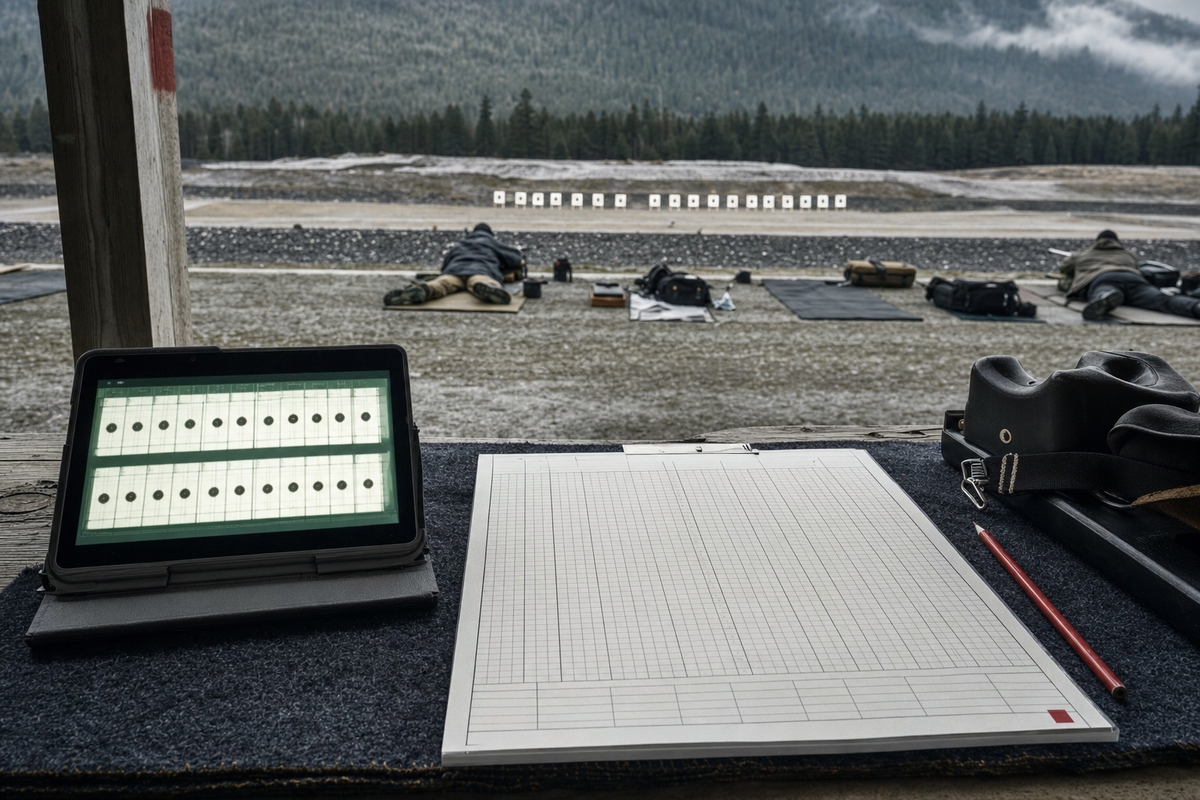
Heffley Creek's 2026 F-Class match information describes electronic targets at 900 m, convertible sighters, strings for score, prep time, pair shooting, and the ordinary safety expectations that make a line function. Bring the right rifle category. Use a bolt flag or remove the bolt before racking. Wear eye and ear protection. Have a phone or tablet for electronic targets. Be ready for the safety meeting.
None of that is lifestyle language. It is operating language.
That matters because newer precision shooters are often sold the dream in the wrong order. First the rifle, then the optic, then the bipod, then the bag, then the app, then another bag because the first bag did not seem serious enough once the second invoice arrived.
I understand the pull. On my own range mornings, the gear pile can start to feel like competence before the first round is fired. A heavier bag, a cleaner dope card, a better scope level, a more impressive case. The range parking lot has a way of making equipment feel like evidence.
The firing line is less polite.
At 900 m, vague notes collapse quickly. Guessed wind calls become visible. A rifle that was "basically on" at 100 arrives without a plan. The score sheet judges the result, not the feeling that the purchase made sense when the cart was open.
That is why match structure is useful even for shooters who never intend to become F-Class competitors. It gives precision a measuring tool.
Electronic targets are not a shortcut
There is a tempting misunderstanding around electronic targets. Because the system can make scoring faster and more visible, it can sound like the discipline is being automated.
It is not.
Electronic targets change the workflow. They do not remove accountability. The shot still lands where it lands. The call still has to survive contact with the condition. The shooter still needs to know whether the result came from wind, hold, position, recoil management, load behaviour, or the small personal comedy of doing everything right except the one thing that mattered.
That is the part worth stealing.
A newer Canadian shooter does not need a national-level match calendar to borrow the habit. After a normal range trip, the question can be just as plain: what did the rifle do, what did I do, what changed, and what is the next correction?
If the notebook only says "good day" or "needs work," it is not a notebook. It is a souvenir.
The better note is boring in the right way. Distance. Ammunition. Zero. Wind. Position. First impact. Best string. Worst string. The correction that helped. The correction that did not. The thing to test next time. The thing to stop buying until the last result is understood.
That is not paperwork replacing shooting. That is shooting refusing to disappear into memory.
What the match tells the buyer
This is where the current Heffley Creek week becomes more than a calendar listing.
F-Class makes a hard distinction between gear that supports a result and gear that merely makes a shooter feel prepared. The support gear matters. Of course it does. At this level, nobody is pretending equipment is irrelevant. F-Open and FTR exist because categories matter, rests matter, cartridges matter, rifles matter, and rules matter.
But the match does not start with a product page. It starts with conditions, categories, a line, a schedule, safety rules, relays, sighters, and scoring.
That order is healthier than most buying advice.
If a match requires prone work, the first problem might be position instead of magnification. If the format gives you convertible sighters, the first problem might be learning what a useful sighter actually tells you. If the day uses team matches, the first problem might be listening well enough to be useful beside another shooter. If the line is 900 m, the first problem might be building notes that survive wind, not buying a part that photographs well.
That is not anti-gear. It is pro-proof.
Good gear should make the scored work easier to repeat. It should not become a costume for a range habit that never arrives.
Start with the score sheet
There is a good Canadian humility in a match like this. It happens at a real club, under real rules, with a finite number of places, in weather that will not care how much the rifle cost. People will do the unromantic work. They will set up, listen, record, score, adjust, and shoot again.
That is the culture worth noticing.
New shooters can take a slower path. Local clubs, rimfire matches, service conditions, informal practice, and normal range days all have a place. The point is to let the most demanding version of the sport clarify the ordinary one.
Before the next precision purchase, ask what score sheet it serves. Before the next load ladder, ask what decision the last target actually created. Before the next optic argument, ask whether the previous note was clear enough to be useful a month later.
Canada does not make shooting cheap, easy, or administratively light. That is all the more reason to make the range time count.
The 900 m line is not magic.
It is just far enough away that the story has to become a number.
Sources
- TargetScore,
2026 KS Arms Canadian F-Class Westerns: https://targetscore.com/ks-arms-2026-canadian-westerns_fqVPTD - TargetScore API event record,
2026 KS Arms Canadian F-Class Westerns: https://api.targetscore.com/api/event/ks-arms-2026-canadian-westerns_fqVPTD - TargetScore,
2026 Canadian F-Class Nationals: https://targetscore.com/2026-canadian-f-class-nationals_huJudU - TargetScore API event record,
2026 Canadian F-Class Nationals: https://api.targetscore.com/api/event/2026-canadian-f-class-nationals_huJudU - Heffley Creek Gun Club,
Revised HCGC 2026 F-Class Match Info.pdf: http://www.heffleycreekgunclub.com/files/2026_files/F-Class/Revised_HCGC_2026_F-Class_Match_Info.pdf - DCRA,
Registration Now Open for the 2026 Canadian Fullbore and F-Class National Championships: https://dcra.ca/2026/03/09/registration-now-open-for-the-2026-canadian-fullbore-and-f-class-national-championships/ - ICFRA,
Rules and Match Conditions: https://icfra.com/rules-match-conditions/
Keep the range notes worth reading later.
If this piece has you thinking about range time, keep the notes useful enough to read later.
Use the Holdover Range Bench Log Card to record rifle, optic, ammunition, distance, weather, zero, group notes, correction, and next test without turning a range trip into a memory test.
Safety note: the card is a note-taking worksheet, not shooting instruction, load data, legal advice, or a substitute for range rules, official guidance, manufacturer manuals, or qualified instruction.