A *$1.04-million grant* with something to measure
New Westminster's second federal prevention round arrives with a narrow 2024 baseline. Give the local work time, then publish what changed.

Opinion / Canadian Context. Public Safety Canada put up to $1.04 million into gun and gang violence prevention in New Westminster on July 27. This time, Ottawa chose a lane Holdover has asked it to fund.
The federal release says the money will support locally designed prevention and intervention for children, youth, and young adults who face a higher risk of gang involvement and violence. The Building Safer Communities Fund can pay for mentorship, outreach, education, employment readiness, trauma-informed services, mental-health support, local partnerships, data collection, and evaluation.
That is a credible public-safety theory. Reach young people while schools, families, community workers, and local agencies still have room to change the path.
Holdover spends plenty of ink on federal measures that land on licensed owners and lawfully held property while offering a weak account of the crime they will reduce. Fairness requires equal clarity when federal money moves toward an identifiable risk and local services built to address it.
Ottawa deserves credit for the direction. New Westminster now owes the public a useful scorecard.
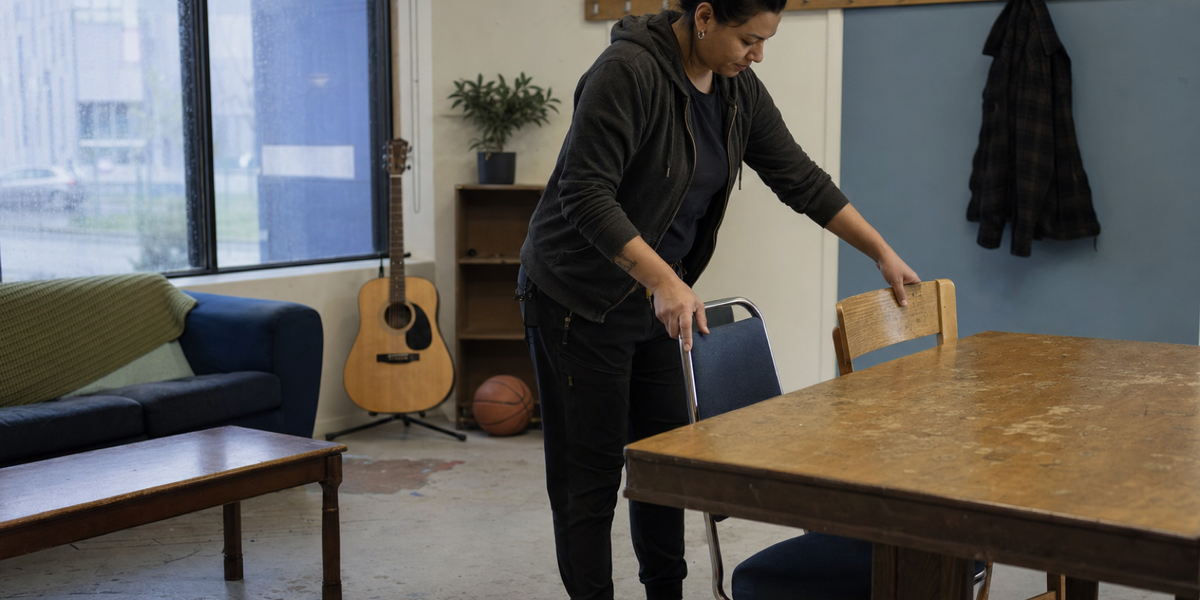
Holdover produced the feature as a fictional Metro Vancouver community-room setup before opening. The adult worker and place are representative. They do not depict a real participant, employee, youth program, or New Westminster site.
A second round arrives
The $1.04 million follows a first local BSCF allocation. New Westminster says it received $1.7 million over four years for programming through March 31, 2026.
The city's program page describes more than a funding envelope. Its initiatives include a weekly Situation Table, a city-wide youth strategy, a downtown youth hub, a youth-led diner, middle-school workshops, and the Her Time program for girls. The Situation Table brings schools, police, provincial ministries, health and social agencies, and community organizations together for collaborative, rapid triage.
Public Safety's national renewal adds $157.5 million over three years to a fund launched with $250 million in 2022. New Westminster therefore enters this round with an operating history, named partners, and one linked set of local intervention data.
That history changes the question. A first announcement can describe a plan. A second round can report movement.
Thirty-seven discussions are a start
New Westminster's BSCF page links British Columbia's Situation Tables in BC: 2024 RTD Analysis. The local profile records 37 discussions during 2024. It says 68.8% of interventions led to overall lowered risk.
The same page reports an average of 7.8 risk factors and 5.2 agencies per discussion. Negative peer association appeared in 50% of discussions, missing school or truancy in 43.8%, and suspected mental-health concerns in 34.4%. The School District originated 93.8% of the discussions and served as the lead agency in 74.2%.
Those numbers describe a small, complex caseload. They also show the local mechanism more clearly than a slogan about root causes. A discussion can bring several agencies around a young person facing several overlapping risks.
The profile supplies a narrow baseline. The Situation Table is one linked initiative, and the city says it also receives provincial support. The report's overall risk lowered measure records the intervention result defined by the table model. Long-term changes in violence, school participation, health, housing, or police contact require their own evidence.
The profile also leaves 2022 and 2023 blank for New Westminster. Readers have one year to work from, with 37 discussions. That is enough to begin a comparison and far too small for swagger.
Count activity and result separately
I recently counted what one range week creates at my bench: about 150-200 rounds fired, followed by three to five days of case work around the rest of life. Depriming, cleaning, drying, sorting, annealing, sizing, trimming, priming, charging, and seating all produce visible activity.
Improvement appears later on the target, after I track what changed.
Public programs deserve the same separation. Dollars committed, partner meetings, workshop seats, referrals, and hours of service are outputs. They show that work occurred. Risk reduction, sustained school participation, stable housing, completed training, employment, fewer violent contacts, and healthier relationships are outcomes. They show whether the work helped.
Both kinds of numbers matter. Program staff need operational counts to manage capacity. The public needs outcome measures to judge the renewal.
Prevention also resists a single clean number. A young person can need school support, housing, mental-health care, a safer peer group, and one dependable adult at the same time. Small local samples make percentages volatile. Privacy matters more than a tidy dashboard, especially when the people involved are minors.
Those limits call for careful reporting. They still leave room for evidence.
A useful second-round scorecard
New Westminster and Public Safety can make the next report useful with a short, consistent set of aggregate measures:
- referrals received, accepted, and completed, with the time from referral to
first support;
- the number of young people reached by each funded initiative, separated from
repeat visits;
- risk at intake, closure, and a later follow-up using the same defined
measure where consent and privacy rules allow;
- school re-engagement, training, employment, housing, health, or other
program-specific outcomes tied to the service delivered;
- the share of participants still connected to appropriate support after
three, six, or twelve months;
- dollars spent by initiative and year, with a plain explanation of major
changes in delivery; and
- the limits of each measure, including small samples, missing follow-up, and
the difference between association and attribution.
The city should also keep the Situation Table series comparable. If the meaning of overall risk lowered changes, say so. If another agency funds part of the result, identify the contribution. If a program ends or changes shape, preserve the old denominator.
That kind of reporting protects the people in the program and the credibility of the program. Aggregate data can show whether the work is moving while individual stories stay private.
The national file remains larger
Statistics Canada's latest national report recorded 14,488 firearm-related violent crimes in 2024, representing 2.6% of police-reported violent crime. Gang or organized-crime links appeared in 4% of all firearm-related violent crime and 39% of firearm-related homicides. Seventy per cent of people accused of firearm-related violent crime had recent police contact for another Criminal Code incident, excluding traffic.
One local youth program carries a small part of that file. Its value lies in the part it can reach: specific people, identifiable risks, local services, and intervention before another violent contact.
Licensed owners should recognize the distinction. This grant still needs evidence and public accountability. Its causal theory starts with people and risk factors connected to violence. That is a more serious starting point than administrative access to a list of compliant owners.
The July 27 announcement supplied the amount and the intention. New Westminster's own linked report supplied a baseline.
Ottawa chose a credible lane. The next obligation is to show how far $1.04 million moved it.
Sources
- Public Safety Canada, Government of Canada invests in gun violence prevention in New Westminster, British Columbia, July 27, 2026.
- Public Safety Canada, Building Safer Communities Fund, accessed July 28, 2026.
- City of New Westminster, Building Safer Communities Fund Program, accessed July 28, 2026.
- British Columbia Ministry of Public Safety and Solicitor General, Situation Tables in BC: 2024 RTD Analysis, New Westminster profile, page 34.
- Statistics Canada, Firearms and violent crime in Canada, 2024, April 21, 2026.
The amnesty file is still moving.
If this piece sent you back to government pages, do not wait for the next portal, Gazette, or court move to find you by accident.
The Dispatch follows Public Safety, RCMP, Canada Gazette, court, compensation, collection, and amnesty updates so the next change comes with the source that moved.
Safety note: the tracker is a worksheet for source hygiene, not legal advice or a substitute for current official guidance.