An Olympic handgun exemption measured in *57 transfers*
Three current owner reports signal that Canada's Olympic handgun exemption remains active. Public Safety's last specific snapshot counted 57 transfers since 2022.

Opinion. Three Canadian owners posted newly arrived handguns across July 17 and 18. Public Safety Canada's last specific published count explains why each arrival looks like news.
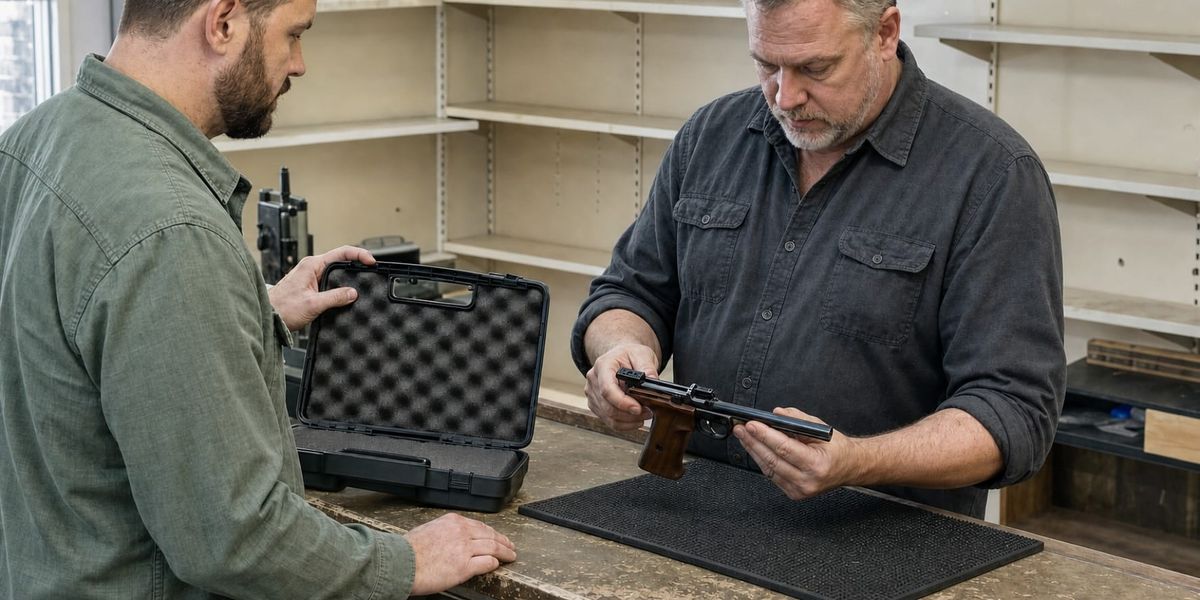
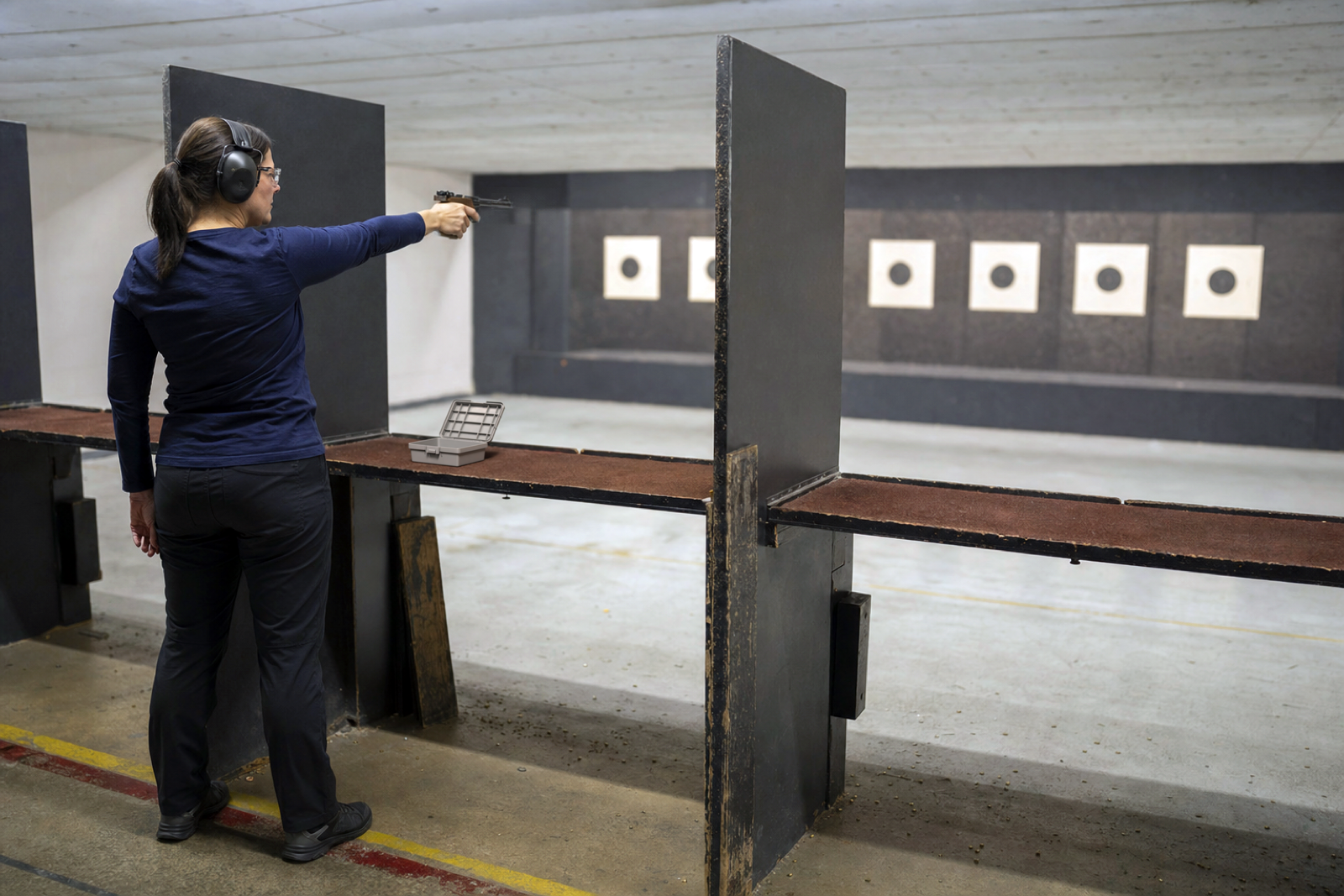
The buyer, retailer, and handgun pictured are fictional. The scene represents a lawful sport-exemption transfer. Original generated editorial photograph.
One r/canadaguns post described a first handgun after a new RPAL. Another reported a British Columbia arrival. A third said several handguns had arrived through a Shooting Federation of Canada letter.
They remain owner accounts. Federal sources provide the legal rules and the 57-transfer count.
In a ministerial briefing package prepared for an October 20, 2025 Senate committee appearance, Public Safety Canada said 57 handgun transfers had been made under the Olympic and Paralympic sport exemption since 2022. Eligibility had been confirmed by four governing bodies.
The 57-transfer count confirms that people authorized for qualifying sport acquired handguns through the national route.
Fifty-seven makes the pathway real
The handgun freeze closed ordinary individual acquisitions in October 2022 and was later written into the Firearms Act. Parliament preserved a narrow route for people who train, compete, or coach in handgun disciplines on the Olympic or Paralympic programme.
Public Safety's briefing named the Shooting Federation of Canada, Alberta Federation of Shooting Sports, British Columbia Target Shooting Association, and Saskatchewan Target Shooting Association as the four bodies that had confirmed eligibility.
The same briefing said the department had no plans to expand the exemption. Its stated purpose is to support Olympic and Paralympic athletes while limiting handgun proliferation.
That is the government's strongest number for its own design. The 57-transfer count shows a controlled route operating at a scale that could fit inside one modest club.
The current owner posts report that pistols are still reaching people through the exemption in 2026. The public record has yet to show how many.
The letter is a three-part test
The word exemption can sound casual from outside the system. The actual route is annual, specific, and reviewable.
Section 97.1 of the Firearms Act requires a letter from a provincial or national sport shooting governing body. The letter must confirm that the person trains, competes, or coaches in a qualifying discipline, name that discipline, and state that the handgun is necessary for it.
The transfer regulations give the Chief Firearms Officer the authorization decision. The RCMP repeats the same three-part test in its current handgun-transfer guidance.
The SFC's exemption page, updated July 10, adds the working requirements for its members: an RPAL, membership in good standing, club membership, and documents supporting active training, competition, or coaching. The SFC retains discretion over the letter. A CFO may require a current letter each year.
An import adds Global Affairs Canada. Notice to Importers No. 1106 requires an import permit for a new restricted handgun entering Canada for the qualifying sport purpose.
A member, licence, club, discipline, governing-body letter, particular handgun, CFO decision, and sometimes an import permit sit behind the word.
The sport is narrower than the word sport
The SFC's current introduction to target shooting describes 25 m rapid fire pistol and 25 m pistol as .22 calibre, one-handed disciplines. Those are recognizable sporting activities with equipment, coaching, practice, scores, and international rules.
The legal route follows the Olympic and Paralympic programme. Other supervised Canadian handgun sports fall outside that line. Public Safety's briefing addressed IPSC and IDPA and said no expansion was planned.
I received my RPAL after the freeze and now shoot a privately leased CZ SP-01 Shadow. I have written about the cost and administrative oddness of that arrangement before. The 57-transfer count adds a national scale to the personal experience. Canada kept one equipment route open, then drew the qualifying sport boundary tightly around it.
The route matters because a shooting discipline needs firearms in the hands of participants. Club pistols, private leases, and pre-freeze owners can keep some people active. A functioning sport also needs a lawful way for a new participant to acquire the equipment the discipline requires.
Every current arrival is therefore both ordinary and unusual. It is ordinary because a vetted club member acquired sporting equipment through a defined legal process. It is unusual because the same event has nearly disappeared from the rest of Canadian handgun sport.
The strongest case for keeping it narrow
The government argues that broad individual handgun availability increases the domestic supply and that a small exemption preserves Olympic participation without reopening the market. CFO oversight, annual documentation, and governing-body verification are meant to prevent abuse.
The published count supports the claim of narrowness. A total of 57 transfers over roughly three years describes a tightly limited programme.
It also leaves a policy consequence. The ordinary target shooter who practises under club rules, transports a restricted firearm under federal rules, and submits to the same licensing system receives different treatment based on the discipline's place on an international programme.
Parliament drew that line deliberately. Public Safety should report how it operates.
The July posts have limits
The current posts show owners reporting successful acquisitions. Their public text does not provide Holdover with the transfer documents, governing-body letters, CFO records, import permits, or a national total.
The paths may differ. A domestic transfer and an import can both end with a handgun arriving, while the import carries the additional Global Affairs step.
Readers should take the posts for what they are: a current signal that the route is producing acquisitions. The law and official guidance remain the source for eligibility and process.
That distinction protects the owners in the posts as much as the article. A photograph and a caption should never become an invitation for strangers to audit somebody else's lawful file from a screen.
Publish the count
Public Safety has already shown that it can count these transfers and identify the governing bodies involved. The same number should appear in a current annual table.
Publish transfers by year. Name the governing body. Separate domestic transfers from imports. Report applications, approvals, refusals, and typical processing time where privacy permits.
Transparency would help both sides of the policy argument. Supporters of the freeze could show that the exception remains controlled. Shooting organizations could see whether the athlete-equipment route is functioning. Owners could judge the process from something stronger than scattered forum posts.
A sport survives one approved transfer at a time. The government should at least keep the count in public.
Sources
- r/canadaguns,
My first gun! FN 502 Tactical, New RPAL: https://www.reddit.com/r/canadaguns/comments/1uyvo6c/my_first_gun_fn_502_tactical_new_rpal/ - r/canadaguns,
New exempted pistol has arrived! (BC): https://www.reddit.com/r/canadaguns/comments/1uzg0c0/new_exempted_pistol_has_arrived_bc/ - r/canadaguns,
Got my handguns today through the SFC!!! Looking for optic recommendations: https://www.reddit.com/r/canadaguns/comments/1uzkorm/got_my_handguns_today_through_the_sfc_looking_for/ - Shooting Federation of Canada,
Exemption Letters: https://www.sfc-ftc.ca/member-services/exemption-letters/ - Shooting Federation of Canada,
Introduction to Target Shooting: https://www.sfc-ftc.ca/discover-target-shooting/introduction-to-target-shooting/ - Department of Justice Canada,
Firearms Act, section 97.1: https://laws-lois.justice.gc.ca/eng/acts/F-11.6/section-97.1.html - Department of Justice Canada,
Conditions of Transferring Firearms and Other Weapons Regulations, section 4.1: https://laws-lois.justice.gc.ca/eng/regulations/SOR-98-202/section-4.1.html - RCMP,
What you need to know: changes to handgun transfers: https://rcmp.ca/en/firearms/what-you-need-know-changes-handgun-transfers - Public Safety Canada,
Parliamentary Committee Notes: Minister Anandasangaree's appearance before the Standing Senate Committee on National Security, Defence and Veterans Affairs: https://www.publicsafety.gc.ca/cnt/trnsprnc/brfng-mtrls/prlmntry-bndrs/20260217/index-en.aspx?wbdisable=true - Global Affairs Canada,
Notice to Importers No. 1106 - Importation of restricted handguns into Canada: https://www.international.gc.ca/controls-controles/systems-systemes/excol-ceed/notices-avis/1106.aspx?lang=eng
The amnesty file is still moving.
If this piece sent you back to government pages, do not wait for the next portal, Gazette, or court move to find you by accident.
The Dispatch follows Public Safety, RCMP, Canada Gazette, court, compensation, collection, and amnesty updates so the next change comes with the source that moved.
Safety note: the tracker is a worksheet for source hygiene, not legal advice or a substitute for current official guidance.