At Edmonton, the trap line got *wet*
The 2026 Canadian Trapshooting Championships hit real weather at Edmonton Gun Club. For newer shooters, the lesson is not that trap is easy. It is that the simple game reveals the club culture behind it.

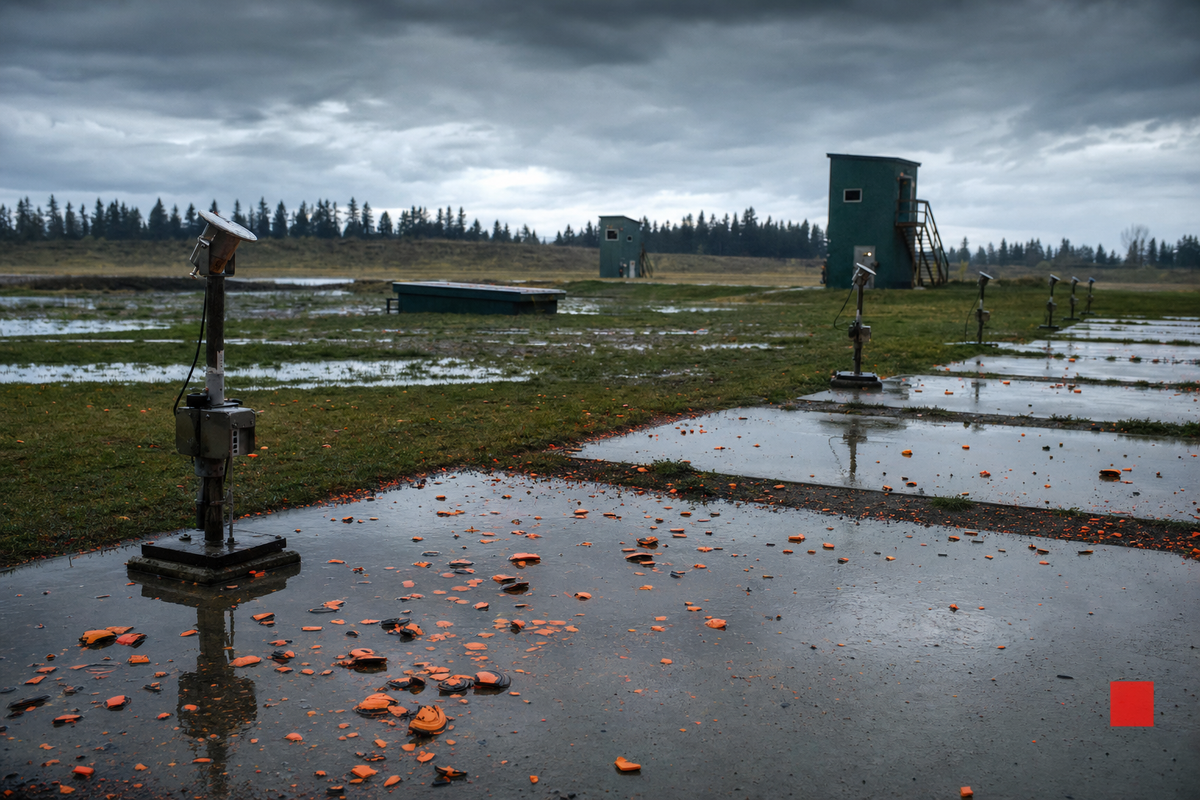
Opinion. Trapshooting looks like the simple shotgun sport until the weather starts doing committee work.
The Canadian Trapshooting Association's June 29 update from the 2026 Canadian Trapshooting Championships says the Handicap Championship event at Edmonton Gun Club was cancelled after poor weather caused flooding and trap-machine problems. The organization pointed readers to the CTA Scoreboard for results and said details would follow on how and when the event would be completed.
That is the current news hook. It is also a useful little correction for anyone who thinks clay target sports are only about calling "pull" and turning orange disks into dust.
The championships were hosted by Edmonton Gun Club, a club south of the city that traces its roots to 1908 and describes itself as one of Canada's oldest and largest trapshooting clubs. The CTA schedule put singles, handicap, doubles, high-all-around, and high-over-all work into the championship program. It is a serious week on a serious Canadian trap line.
Then the low spots filled with water.
Simple is not easy
The appeal of trap is that a new shooter can understand it in about thirty seconds. Stand at the station. Call for the target. The clay leaves the house. Break it or miss it. Move through the squad. Let the score follow you around like a small, orange-coloured conscience.
That is why trap is such a useful sport to watch. There is no grand mystery in the basic format. There is not much room for a gear sermon either. Better shotguns matter. Fit matters. Choke, shell selection, mount, stance, eyes, rhythm, and follow-through all matter. But the first truth is immediate: the target broke or it did not.
I like disciplines that do that to a person. Rifle targets have the same useful cruelty when the group opens up and the bench suddenly knows more than the buyer. Trap just does it faster and more publicly, which is rude but efficient.
For newer Canadian shooters, that is the point. A sport does not need to be complicated to be demanding. Trap is a clean introduction to repeatable gun handling, visual focus, timing, and the discipline of letting a score exist without turning every missed bird into an equipment investigation.
That last part is harder than it sounds. The clay left at a bad angle. The wind was funny. The sun hit the bead. The shell felt slow. The machine hated me personally. Every shooter knows the first draft of the excuse. The score sheet is less literary.
Weather shows the club
The June 29 update is also a reminder that a Canadian club is not just a firing line. It is a piece of local infrastructure run by people who deal with whatever the day brings.
Bad weather does not merely inconvenience a clay event. It tests the ground, the machines, the fields, the volunteers, the schedule, the scorekeeping, the communication, and the decision-making. Anyone can write a program for a sunny day. The useful culture shows up when the program meets a puddle deep enough to have an opinion.
That is why the cancellation note should not be read as a failure. The safer, more competent answer is often to stop the event, preserve the results that can be preserved, explain what happened, and finish the job properly when the field allows it. That is not glamorous. It is exactly what adults running a national championship are supposed to do.
The sport's public image rarely gets credit for that kind of ordinary competence. Canadian firearms coverage tends to find its way to court filings, bans, crime scenes, political clips, and the occasional badly lit stock photo. The less dramatic truth is that much of the country’s shooting culture is made of club volunteers checking machines, scoring cards, fixing fields, calling meetings, and deciding that a flooded low spot is more important than pretending the schedule is sacred.
It is not a cinematic version of lawful ownership. Good. The cinematic version is usually worse.
Why newer shooters should care
Trap is one of the better on-ramps into shooting because it is social without being vague. You stand beside other people, follow a routine, accept a score, and learn quickly whether you are seeing the target or just admiring the shotgun.
A new shooter does not need to start with a national championship. A local club night is enough. A practice round is enough. The useful thing is the rhythm: one target, one result, one correction, then another target before the ego has time to hold a press conference.
That rhythm matters across the rest of the sport. Precision rifle shooters need it. Handloaders need it. Hunters need it. Anyone who buys gear on hope needs it most of all.
Trap also makes visible something policy arguments often flatten. Licensed firearms owners are not an abstract category. They are the people running fields in the rain, lending time to a sport, keeping records, teaching the new person where to stand, and making the dull safety decisions that keep the day boring in the best possible way.
There is a political argument inside that, but it does not need to shout. Canada already asks licensed owners to do a great deal of paperwork, training, storage, transport, and compliance. It is worth noticing that the same people also build the clubs where competence gets passed along.
Let the result count
The Edmonton weather note is a small firearms story with a useful lesson. Holdover does not need every article to arrive wearing a federal docket number.
Sometimes the useful story is a trap field that got too wet, a championship that had to adjust, and a sport simple enough to show newer shooters why scorekeeping matters.
Before the next equipment explanation, shoot a round where the result is public and immediate. Let the station, the target, the score, and the weather do their jobs. Notice how quickly a simple game becomes honest.
The clay either breaks or it does not.
Everything after that is the part where the shooter improves.
Sources
- Canadian Trapshooting Association,
2026 Canadian Trapshooting Championships: https://www.shootcanada.ca/shootinfo.php - Canadian Trapshooting Association,
CTA Scoreboard: https://www.shootcanada.ca/scoreboard/index.php - Canadian Trapshooting Association,
Results: https://www.shootcanada.ca/results.php - Edmonton Gun Club, home page: https://www.edmontongunclub.com/
- Alberta Provincial Trapshooting Association,
Calendar of Shoots and Results: https://www.shootalberta.com/calendarandresults.php - Canadian Gun Nutz,
2026 Canadian Trapshooting Championships At EGC: https://www.canadiangunnutz.com/forum/threads/2026-canadian-trapshooting-championships-at-egc.2584443/
Keep the range notes worth reading later.
If this piece has you thinking about range time, keep the notes useful enough to read later.
Use the Holdover Range Bench Log Card to record rifle, optic, ammunition, distance, weather, zero, group notes, correction, and next test without turning a range trip into a memory test.
Safety note: the card is a note-taking worksheet, not shooting instruction, load data, legal advice, or a substitute for range rules, official guidance, manufacturer manuals, or qualified instruction.