Cookstown's ten medal rows close the scorecard
SFC's final Cookstown shotgun result records ten medal categories, from trap and skeet to junior, master, and para competition.

Shooting Sports / Precision. Ten rows on the Shooting Federation of Canada's final results page carry the finish of Canada's 2026 shotgun nationals.
They cover trap and skeet. They also carry junior, master, and para competition. That is the useful part of the Cookstown record. A single open winner can make for a tidy headline. The complete result shows the structure of the sport that ran across two weekends at the Toronto International Trap & Skeet Club in Cookstown, Ontario.
SFC says more than 80 people took part. Its August 17 result post puts the names in public view after the cases were packed and the range had gone quiet.
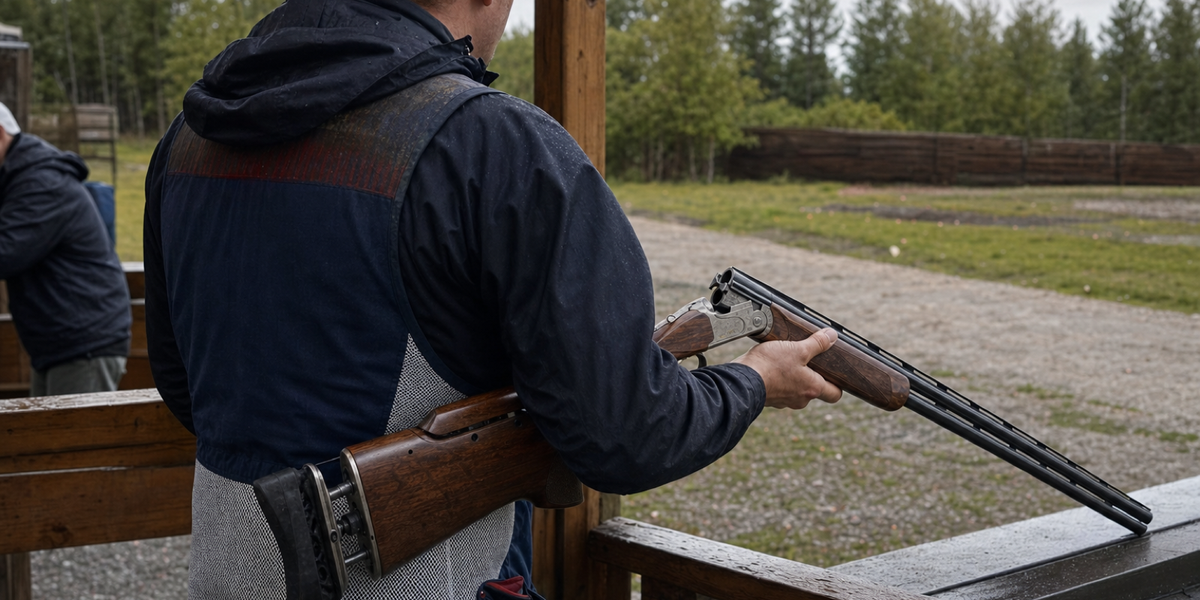
Holdover produced the feature as a fictional post-relay clay-range scene using official manufacturer references for generic over-under shotgun geometry. The person, range, firearm, and session do not depict Cookstown, the 2026 championships, a medallist, or an exact product.
Ten rows, one national record
The official list has five trap categories and five skeet categories. The gold rows read as follows:
| Discipline and category | Gold medallist | Province |
|---|---|---|
| Trap female | Lindsay Boodez | Alberta |
| Trap male | Colin Grover | British Columbia |
| Trap junior combined | Kevin Shao | British Columbia |
| Trap para | Zeren (Ryan) Yu | Ontario |
| Trap master | Vadim Zevlever | Ontario |
| Skeet female | Yu-Chuan (Nicky) Chang | British Columbia |
| Skeet male | Luke Gong Cheng | British Columbia |
| Skeet junior female | Xincheng Guo | British Columbia |
| Skeet junior male | Andrew Dong | British Columbia |
| Skeet master | Robert Pankiewicz | Manitoba |
The table is a direct reading of SFC's published result. British Columbia takes six of the ten listed gold rows. Ontario takes two. Alberta and Manitoba take one each. The distribution gives the final record a provincial and category spread across more than one club, age group, and discipline.
The names also answer a simpler question that public coverage often skips: who received recognition once the event was over? The final result gives an answer that a pre-event program cannot.
The category is part of the result
The trap side includes a separate para gold for Zeren Yu, a junior combined row led by Kevin Shao, and a master category led by Vadim Zevlever. On the skeet side, Xincheng Guo leads the junior female result, Andrew Dong leads the junior male result, and Robert Pankiewicz leads masters.
Those labels are more than filing cabinets. They tell readers what the event chose to recognize at the end of a national weekend. A scorecard that records only one overall line makes the rest of the competitive work harder to see. SFC's published rows keep the categories where competitors, families, clubs, and the next group of athletes can find them.
I have watched a range day turn into a story about one excellent group, one missed call, or the person who happened to be standing near the targets when the camera came out. A proper results page has a better memory. It keeps the names attached to the category and the category attached to the event.
Twenty-six medal positions require some attention
SFC lists 26 medal positions across the ten categories. The trap para entry has one published gold. Each of the other listed groups carries gold, silver, and bronze. That structure gives the final record room for people who competed beside the gold medallist without disappearing from the public version of the weekend.
The podiums themselves have a useful provincial mix. Trap female results place Alberta's Boodez ahead of Ontario's Mackenzie Dedman and British Columbia's Cynthia Meyers. Skeet male results put Gong Cheng ahead of Ontario's Zeeshan Zeeshan and Angad Bajwa. Skeet masters put Manitoba's Pankiewicz ahead of British Columbia's Nelson Chan and Quebec's Yan Zhou.
Those are specific, source-backed outcomes. The result page supplies the medal record; this article reports the recognition that the governing body placed on the record.
A public record does its own work
SFC's result post describes rough weather, a host club, volunteers, match directors, international shooters, and a field of more than 80 participants. The page uses celebratory language because it is a governing body's result announcement. Its durable value is more practical: the organization has made a finished national record easy to inspect.
That matters for a sport that many Canadians still encounter through a single photograph or a political slogan. A clear record shows people arriving in separate disciplines, competing in named categories, and leaving with results that can be checked without guesswork.
The medal list will not tell you what a competitor saw from a station or how a particular target read in the weather. It does leave a public accounting of who stood on the final result across trap and skeet. That is a sound place for Canadian shooting sport to end a national weekend.
Cookstown's final row has been entered. The full record is the part worth keeping in public view.
Sources
- Shooting Federation of Canada, 2026 Shotgun National Championships Results, August 17, 2026, checked August 22, 2026.
- Shooting Federation of Canada, National Championships, current page checked August 22, 2026.
- Shooting Federation of Canada, 2026 Canadian International Skeet Championships match program, checked August 22, 2026.
Keep the range notes worth reading later.
If this piece has you thinking about range time, keep the notes useful enough to read later.
Use the Holdover Range Bench Log Card to record rifle, optic, ammunition, distance, weather, zero, group notes, correction, and next test without turning a range trip into a memory test.
Safety note: the card is a note-taking worksheet, not shooting instruction, load data, legal advice, or a substitute for range rules, official guidance, manufacturer manuals, or qualified instruction.