Fifty metres at race pace
Whistler's summer biathlon weekend puts five targets 50 metres away after the course has already made a calm trigger press expensive.

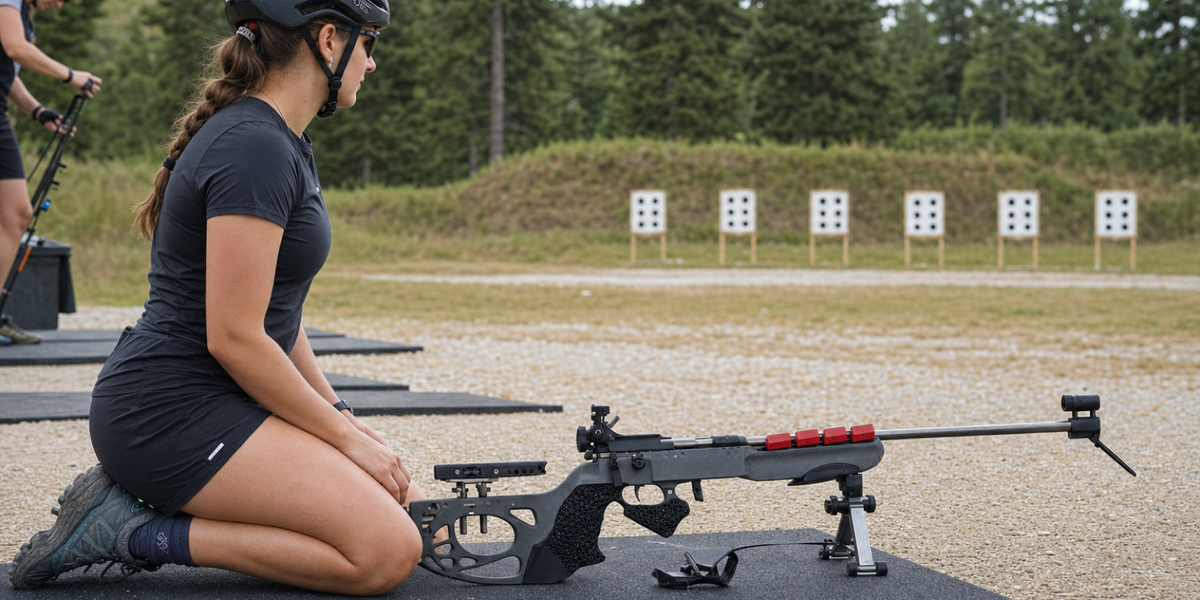
At Whistler this weekend, five targets wait 50 metres downrange while athletes arrive from the course. Whistler Olympic Park lists Friday, August 21, as a training day, then schedules Individual and Sprint competition for the weekend. Biathlon Canada lists the same August 21 to 23 window as Western Summer Series 2.
The useful part is the distance. It does not shrink because the athlete has been moving. It does not grow more generous because a heartbeat has started to argue with the sight picture. Five targets remain five targets, and the course gets a vote in how calmly a shooter arrives to meet them.
The International Biathlon Union puts each shooting stage at five targets, 50 metres away. Its general rules give prone targets a 4.5-centimetre diameter and standing targets an 11.5-centimetre diameter. In sprint competition, a miss carries a 150-metre penalty loop. The precise local format at Whistler is for its organizers to run. The measurements explain the durable point.
The feature is a fictional summer-biathlon training scene supplied by Steve Coppola. The athlete, range, rifle, targets, and session do not depict Whistler, a named competitor, an exact product, or the 2026 Western Summer Series.
The target keeps its terms
On a quiet precision-rifle day, a shooter can walk to the targets, come back a little warmer, settle in behind the bench, and discover that the next shot has not agreed to participate in the previous group's confidence. The target is still where it was. The body, the wind call, and the attention available to the trigger press may have changed their mind.
Biathlon makes that exchange public. There is no need to imagine a penalty for a casual lapse. The loop is already part of the event's language. The score board gets the arithmetic, and the athlete carries the extra distance.
That is why the five targets are more interesting than the spectacle around them. A very small target can make a shooter feel clever on a clean, unhurried bench. Add race pace, a time clock, and the practical cost of a miss, and the same target begins asking better questions.
Was the position settled? Did the eyes arrive before the shot? Was the trigger press treated as one more item to rush through? The target itself does not answer. It leaves the receipt.
Five targets make a process visible
The published target sizes give the event its sharp edges. Prone presents the smaller 4.5-centimetre target. Standing is larger at 11.5 centimetres, though the shooter is also working from a less supported position. Each stage asks for five results, so one decent press cannot talk over four impatient ones.
This is familiar territory to anyone who has worked a group honestly. A good shot belongs to a sequence. It came after a position, a sight picture, a breath cycle, and the decision to leave a questionable press alone. Biathlon puts the sequence under a deadline without changing the target's standards.
The sport is also careful about what a miss means. In the IBU's general Sprint description, every missed target adds a 150-metre loop. Individual competition uses time penalties instead. Those are format-level rules, not a claim about the exact sequence at this week's local races. They show how the sport keeps a miss attached to the rest of the day rather than filing it away as an interesting anecdote.
There is a useful humility in that. The clean bench can persuade a person that precision is mostly a matter of waiting long enough for conditions to become pleasant. A summer biathlon lane points to another truth: process is what remains available after pleasant conditions have stopped doing favours.
A Canadian weekend worth watching
Whistler Olympic Park calls this weekend's listing a Summer Biathlon Race, with an August 21 training day before the listed Individual and Sprint dates. The Biathlon Canada calendar places Western Summer Series 2 in Whistler across the same three days. That makes the event a live Canadian reason to look at a sport whose central question is easy to recognize far from a race course.
Can a shooter build a repeatable process when the easy reset has gone missing?
I know the moment after a walk to check the targets: back at the bench, a slightly warmer body is offering a familiar story about how quickly the next group should begin. The useful move is ordinary. Take the time to settle again, read the sight picture, and make the next decision real.
A deliberate walk to check targets, an uncomfortable wind call, a warm afternoon, or a mediocre group can all change the conditions around a careful shot. The target remains a fixed measurement. The process around it is what earns the right to trust the result.
Fifty metres at race pace is a compact version of the lesson. The course creates urgency. Five targets make it visible. The penalty loop ensures that a miss continues to take up space after the moment has passed.
Sources
- Whistler Olympic Park, "Summer Biathlon Race", event listing accessed August 21, 2026.
- Biathlon Canada, "Results", current calendar listing accessed August 21, 2026.
- International Biathlon Union, "Rules overview", accessed August 21, 2026.
- International Biathlon Union, "Event and Competition Rules", current governing rules accessed August 21, 2026.
Keep the range notes worth reading later.
If this piece has you thinking about range time, keep the notes useful enough to read later.
Use the Holdover Range Bench Log Card to record rifle, optic, ammunition, distance, weather, zero, group notes, correction, and next test without turning a range trip into a memory test.
Safety note: the card is a note-taking worksheet, not shooting instruction, load data, legal advice, or a substitute for range rules, official guidance, manufacturer manuals, or qualified instruction.