Four barrel makers, four *cleaning clocks*
PROOF, Bartlein, Krieger, and Criterion publish different barrel-cleaning intervals. Their shared method is the useful part.

Precision. Ask four respected barrel makers when to clean a precision rifle and you get four different clocks.
PROOF Research says "less is more" and points to an accuracy decline, harsh conditions, or a few hundred rounds. Criterion recommends cleaning after every shooting session. Bartlein says, "I shoot them, I clean them," then spends much of its guidance warning about the damage caused by rods, brushes, mixed solvents, and abrasive paste. Krieger gives a staged break-in schedule, tells the owner to watch the fouling pattern, and warns that over-cleaning can damage the barrel.
The disagreement is useful. It turns a range ritual into an owner decision with sources, conditions, and evidence.
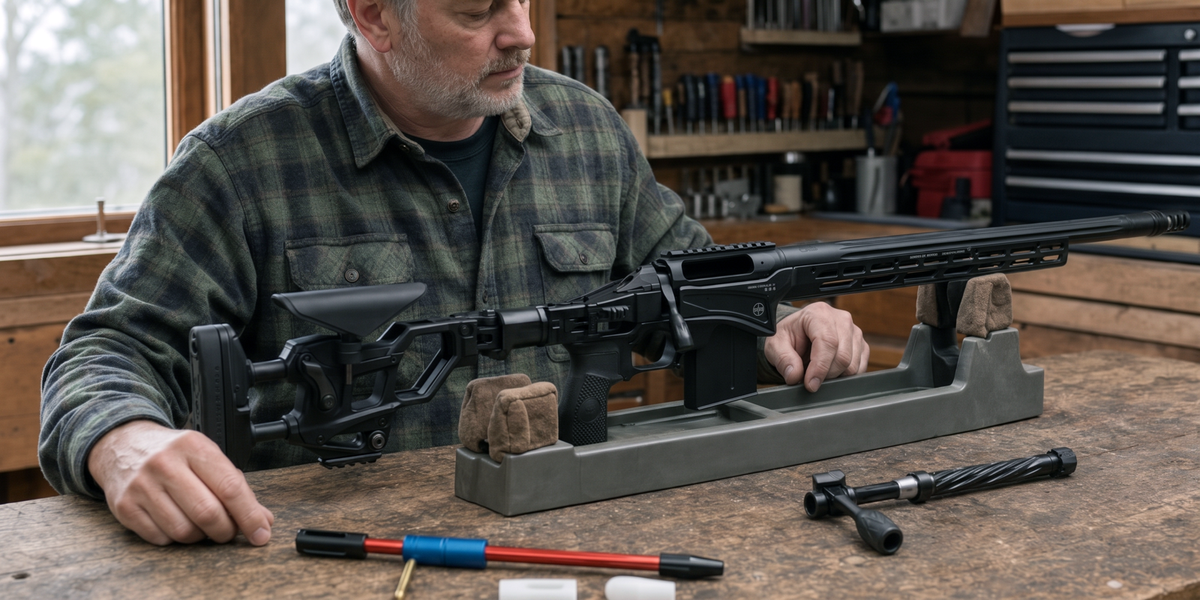
Holdover produced the feature as a fictional maintenance scene reference-grounded to a Cadex CDX-SS Seven S.T.A.R.S. Pro and a separate bore-guide reference. Cadex supplies the visual rifle geometry only. The image does not depict Steve's equipment or routine, a Cadex cleaning recommendation, or a manufacturer result.
Four makers, four intervals
PROOF publishes the simplest clock. A barrel that still performs can stay in the safe after a normal session. PROOF names an accuracy decline, harsh exposure, or a few hundred rounds as reasons to clean. Wet and dry patches usually carry the work, with a nylon brush reserved for a deeper job.
Criterion uses a shorter interval. Its current procedure recommends cleaning after each shooting session to remove condensation, copper, and carbon. The condensation point deserves attention in Canada. A cold rifle moving through a warm vehicle, case, or house has a different moisture history from a rifle used on a dry summer bench.
Bartlein cleans after shooting, though its method is deliberately gentle. It prefers a one-piece rotating rod, bore guide, patches, and solvent. Its FAQ says cleaning causes more damage than firing when tools and compounds are used badly. Bartlein gives paste cleaners the sort of review normally reserved for a scope that lost zero inside the box.
Krieger starts with the barrel's fouling behaviour. Its break-in guidance moves from one-shot cycles to longer strings as copper fouling drops. Once the barrel settles, Krieger asks the owner to observe what the barrel says through the patches and performance. It also names over-cleaning and abrasive misuse as damage paths.
Four reputable makers can hold those positions because barrels, finishes, cartridges, firing schedules, storage conditions, and owner goals vary. A single universal round count erases the variables that decide the answer.
Interval and method are separate decisions
The schedule changes. The shared method stays much steadier.
Bartlein, Krieger, and Criterion all specify a quality one-piece rod. Bartlein and Krieger want a handle that rotates with the rifling. All three give the bore guide a central job: keep the rod aligned, protect the throat at the chamber end, and reduce contact with the bore. They favour cleaning from the breech where the rifle allows it and treat the crown at the muzzle as accuracy-critical geometry.
The chemical advice also converges. Follow the maker's dwell time. Keep incompatible solvents separate. Dry one product out before another enters the bore. Treat abrasive compounds as specialized tools with a real wear cost. Krieger bans stainless brushes. Bartlein largely avoids brushes. Criterion starts with patches and reserves brushes for heavier work.
That consensus has more value than a borrowed interval. A careful clean done at the maker's chosen time protects the barrel. A rigid calendar paired with a segmented rod, poor alignment, or aggressive paste can spend barrel life while claiming to preserve it.
The data book gets the next vote
At my bench, group shape, velocity, conditions, and the last maintenance entry belong in the same conversation. A clean date by itself says very little.
Start with the barrel maker's current page or manual. Record the round count and conditions. Note the rifle's normal group behaviour, any velocity change, and how the fouling pattern develops. The next cleaning decision then has a baseline behind it.
Moisture can shorten the interval. A long, dry practice block may extend it when the maker permits. A group that opens or velocity that changes deserves investigation. A barrel that continues to behave gives the owner evidence too.
This approach also keeps break-in separate from ordinary maintenance. Krieger's early shoot-and-clean progression has a specific job: watch copper fouling decline as the throat settles. Carrying that same clock through the rest of the barrel's life turns a temporary process into a permanent ritual.
The internet will still supply one confident number. It always does. The barrel maker has better access to the steel, rifling process, finish, and warranty. The rifle supplies the actual result. Your notes connect the two.
The barrel maker starts the schedule. The data book gets the next vote.
Sources
- PROOF Research, Support - cleaning recommendation, accessed July 24, 2026.
- Bartlein Barrels, How to Clean a Barrel, accessed July 24, 2026.
- Bartlein Barrels, Barrel FAQ, accessed July 24, 2026.
- Krieger Barrels, Frequently Asked Questions, accessed July 24, 2026.
- Criterion Barrels, Recommended Rifle Barrel Cleaning Procedures, accessed July 24, 2026.
Keep the first PAL steps in order.
If this piece has you mapping the licence process, keep the official steps and follow-up notes together.
Use the Holdover PAL/RPAL First-Steps Checklist to keep the official forms, course booking, references, photo, fees, and follow-up notes in one place while you work through the process.
Safety note: the checklist is an orientation aid, not legal advice or a substitute for current RCMP/CFP/CFO guidance or instructor direction.