Fourteen hits, then the shoot-off
Anshul Malik and Seth Norman both reached 14 hits in Saskatoon's rapid-fire final. The series differed, the total tied, and SO decided the order.

Anshul Malik and Seth Norman each reached 14 hits. The PDF still had to put one name first.
The current Shooting Federation of Canada outdoor-results file records the August 11 25 m Rapid Fire Pistol final in Saskatoon. It ranks Malik first, Norman second, and Jesse Olsen third. All three rows carry SK in the province field.
Malik and Norman share the same total. Norman's remark column carries SO: shoot-off.
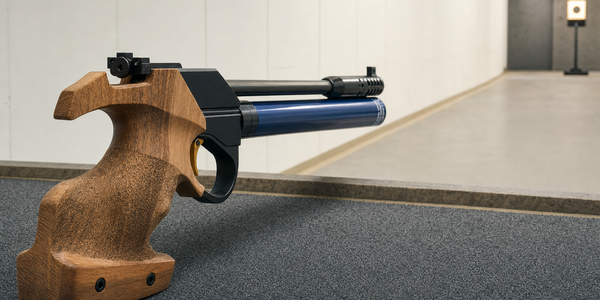
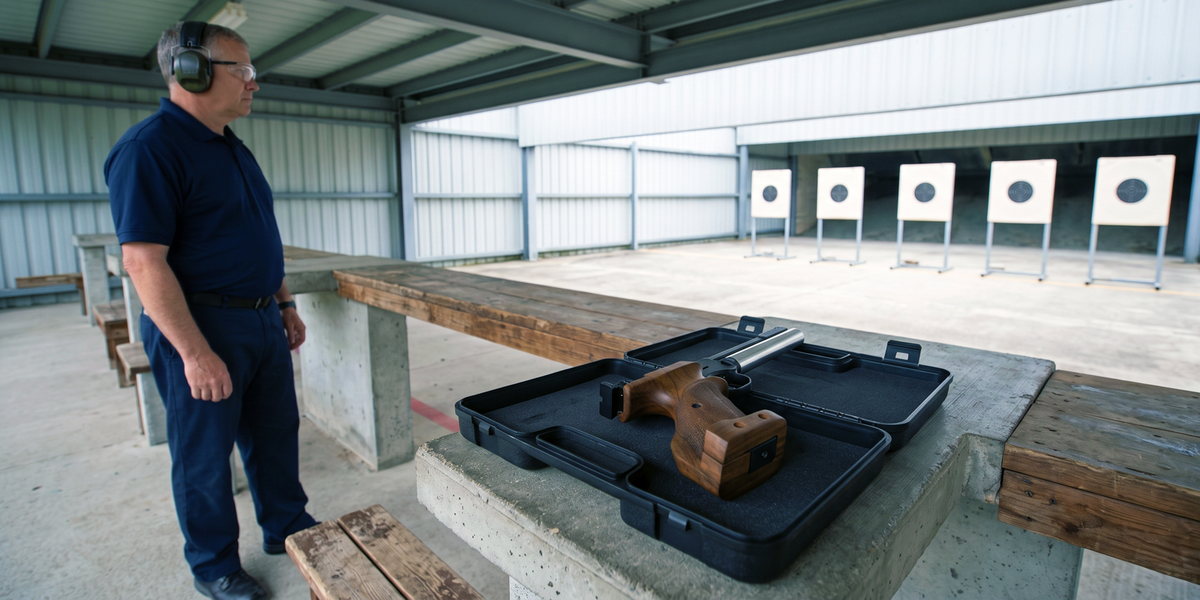
The feature is a fictional post-relay rapid-fire range scene supplied by Steve Coppola. The person, range, pistol, targets, and session do not depict a named athlete, exact product, Saskatoon, or the 2026 Nationals.
Two routes reached 14
The result gives each finalist a row of series, then a total. Malik's line reads 1, 2, 1, 3, 2, 2, 2, and 1. Add those eight entries and the total is 14.
Norman's line reads 1, 0, 2, 3, 2, 4, 1, and 1. The total is also 14.
The paths feel different before the arithmetic settles them. Malik recorded at least one hit in every listed series. His strongest entry was three. Norman had a zero in the second series, then put four into the sixth. After seven series, both athletes stood at 13. Each added one in the eighth.
That is the tie inside the total. Malik's cumulative path runs 1, 3, 4, 7, 9, 11, 13, 14. Norman's runs 1, 1, 3, 6, 8, 12, 13, 14. One route stayed steadier. The other had the deepest low and highest single series. The final line made them equal.
The table narrows as the final moves
Olsen's third-place row ends at 12 after seven listed series: 1, 2, 2, 3, 1, 3, and 0. Jim Sandall ranks fourth at 10 after six. Rex Norman ranks fifth at seven after five, followed by Stuart Burns at four after four. Yeremia Djaja and Zhuang Zhang each finish with two after three listed series.
Those blank later cells show the field narrowing. The SFC match program places the championship under the 2026 ISSF rules, with named Canadian technical updates. The ISSF's current reporting uses hits for rapid-fire final totals and records shoot-offs when a tie reaches a deciding place.
The vocabulary matters. These final rows count hits. The qualification course uses a different scoring presentation. Mixing the two would turn an accessible result into the wrong explanation.
SO is the last published fact
The SFC file ranks Malik first and Norman second. It prints SO on Norman's row. That establishes a shoot-off and the final order.
The file does not print the deciding series. It does not state the shoot-off hit count, the number of extra series, or the margin. Those details may exist in the live system or the range record, but they are absent from this public five-page file.
A two-letter remark can be enough. It tells the reader why equal totals occupy different ranks while protecting the line between a published fact and an editor's guess.
This is useful beyond one match. Result sheets often tempt readers to fill an empty field with the most likely story. A tie was close, so the shoot-off must have been close. A stronger middle series must have carried momentum. A final rank must summarize every part of the performance. Each sentence could sound reasonable. The source supplies none of them.
Repeatable performance leaves a trace
I shoot for recreational skill and repeatable performance. I would try an occasional bench match as an experiment. I have not shot this rapid-fire pistol course.
The part I recognize is the value of keeping the route beside the outcome. A group size or final zero can hide the sequence that produced it. The useful notes preserve the string, condition, correction, and next decision. This SFC table does the sporting equivalent in eight small columns.
Malik's 14 includes no empty series. Norman's 14 includes a zero and a four. The score treats both totals equally before the shoot-off. The series keep each performance legible.
That is also what organized Canadian handgun sport looks like in a primary source: named athletes, timed relays, series records, range staff, a final, and a tie-break. The SFC's current championship page links the result while the August 8-15 program continues. Lawful sport appears here as measured work, with enough structure to resolve 14-14.
Keep the missing margin missing
Start with the series. Malik reached 14 through 1, 2, 1, 3, 2, 2, 2, and 1. Norman reached 14 through 1, 0, 2, 3, 2, 4, 1, and 1. Olsen followed at 12.
Then read the remark column. SO explains why the two leaders have different ranks. The unpublished shoot-off margin stays unpublished.
The result gives us two distinct routes, one equal total, and one final order. Fourteen hits got the leaders to the same line. The shoot-off moved one name above the other.
Sources
- Shooting Federation of Canada: National Championships
- Shooting Federation of Canada: August 11 outdoor pistol results
- Shooting Federation of Canada: 2026 Rifle and Pistol Nationals match program
- Shooting Federation of Canada: Introduction to target shooting
- ISSF: May 29, 2026 Rapid Fire Pistol final report
Keep the range notes worth reading later.
If this piece has you thinking about range time, keep the notes useful enough to read later.
Use the Holdover Range Bench Log Card to record rifle, optic, ammunition, distance, weather, zero, group notes, correction, and next test without turning a range trip into a memory test.
Safety note: the card is a note-taking worksheet, not shooting instruction, load data, legal advice, or a substitute for range rules, official guidance, manufacturer manuals, or qualified instruction.