How you split 15 rounds changes the *answer*
A 2026 ammunition study found that three five-shot groups gave a less biased precision estimate than five three-shot groups using the same 15 rounds.

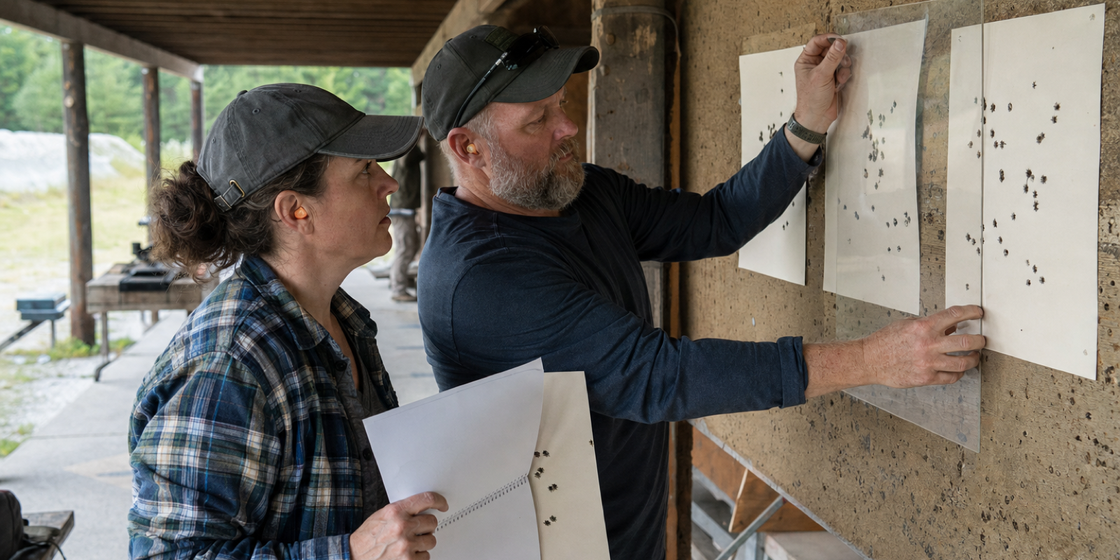
Precision. The smallest group on a range bench has a habit of becoming the whole story. Three close holes earn a circle. A wider cluster gets blamed on wind, fouling, a cold bore, or the person behind the rifle. Soon the little group is carrying more confidence than three shots can support.
A 2026 peer-reviewed study gives that familiar range argument a useful number. With the same 15 rounds, three five-shot groups produced a less biased estimate of rifle-ammunition precision than five three-shot groups. The ammunition budget stayed fixed. The way the shooter divided it changed the answer.
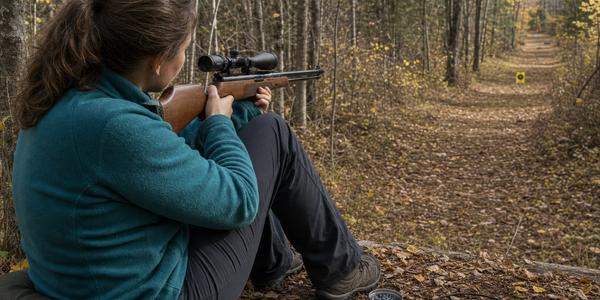
Holdover produced the feature as a fictional range scene. The people, range, targets, and marks are generic and do not depict the study or its participants.
The same 15 rounds gave different answers
Michael McTee, Jordan Hampton, and Philip W. Ramsey tested 37 rifle-ammunition combinations under standardized shooter-operated field conditions. Their paper, published online May 7 in Wildlife Biology, used complete or near-complete groups of up to 15 shots, then repeatedly sampled smaller groups from the recorded impacts.
The researchers ran 1,000 random simulations for every group size from three through 15 shots. They also compared two familiar ways to spend a 15-round box at the bench: five groups of three and three groups of five.
The five three-shot arrangement understated the 15-shot extreme spread by an average of 42.5 percent. Three five-shot groups understated it by 26.4 percent. The same pattern appeared with mean radius: five threes came in 15.3 percent low, while three fives came in 7.1 percent low.
Both arrangements flattered the reference group. The three five-shot version flattered it less.
That result gives the shooter a practical choice. If the range card has space for 15 rounds, put five on each of three targets. Keep the three individual groups, then combine all 15 impacts into a composite. The paper recommends that arrangement over five three-shot groups because it struck a better balance between bias and variance.
Two measurements tell different parts of the story
Extreme spread is the greatest distance between any two impacts. It is easy to understand, easy to measure, and highly sensitive to the two shots that land farthest apart. The other 13 shots in a 15-shot group do not enter the calculation directly.
Mean radius uses every shot. Find the centre of the group, measure each impact's distance from that centre, and average those distances. A single wide shot still matters, though it has less power to define the whole result.
The study found that mean radius began showing diminishing returns around nine shots. Its extreme-spread estimate did not reach that point until 14 shots, and it stabilized less readily. That difference supports a range record with both numbers. Extreme spread tells the shooter about the worst separation in the sample. Mean radius describes how the entire group gathered around its centre.
Neither number turns 15 rounds into final truth. The authors used the 15-shot group as their reference because that was the available maximum. They note that mean-radius estimates can continue to stabilize in groups of 20 to 50 shots. Their work also leaves an important range question open: consecutive shots may cluster because of barrel heating or fouling, and this study did not isolate that effect.
Build a range card that can be repeated
The paper's recommendation is at least 10 shots for each rifle-ammunition combination. A 15-round plan gives enough room to keep three separate five-shot groups and one composite result.
My current range world is built around 100- and 300-yard bookings at Stittsville. On either lane, a 15-round plan is easy to understand before the first shot and easy to repeat on the next visit. The extra discipline belongs in the notebook, not in another box of ammunition.
The useful record can stay simple:
- Fire three five-shot groups under as consistent a process as the range allows.
- Preserve every impact in a 15-shot composite.
- Record extreme spread and mean radius for the composite.
- Note the rifle, ammunition, distance, muzzle velocity, barrel length and twist, and meaningful conditions.
- Repeat the test when a load or equipment decision deserves more confidence.
The paper studied lead-free ammunition, and the authors say the sampling method applies to all bullets. It examined rifle-ammunition combinations rather than one rifle in isolation. A different barrel, lot, projectile, or shooter can move the result. That is another reason to keep the range card specific.
Three-shot groups still have ordinary uses. A hunter checking zero before a season may care about point of impact, limited ammunition, and a cold barrel more than a formal precision estimate. A shooter watching a hot barrel can pause between strings. The method should match the question written at the top of the page.
Canada had 946 approved shooting ranges and 767 shooting clubs at the end of 2025, according to the RCMP. Across all those benches, a small procedural change costs no additional ammunition: give the 15-round result a structure before the first shot.
The little group can stay in the notebook. Give all 15 rounds a vote.
Sources
- Michael McTee, Jordan Hampton, and Philip W. Ramsey, How many shots are enough? Optimizing precision measurements when testing lead-free ammunition, Wildlife Biology, published online May 7, 2026.
- Murdoch University, official research record and open-access paper, accessed July 22, 2026.
- Royal Canadian Mounted Police, 2025 Commissioner of Firearms Report, accessed July 22, 2026.
Keep the range notes worth reading later.
If this piece has you thinking about range time, keep the notes useful enough to read later.
Use the Holdover Range Bench Log Card to record rifle, optic, ammunition, distance, weather, zero, group notes, correction, and next test without turning a range trip into a memory test.
Safety note: the card is a note-taking worksheet, not shooting instruction, load data, legal advice, or a substitute for range rules, official guidance, manufacturer manuals, or qualified instruction.