At Borden, 900 metres still runs on *iron sights*
Entries are open for Canada's August Target Rifle championship at Mons Range. The discipline pairs aperture sights with prone sling support from 300 to 900 metres.

Precision. Entries are open for the Canadian Fullbore Rifle Championships at Mons Range, CFB Borden, from August 17 to 23.
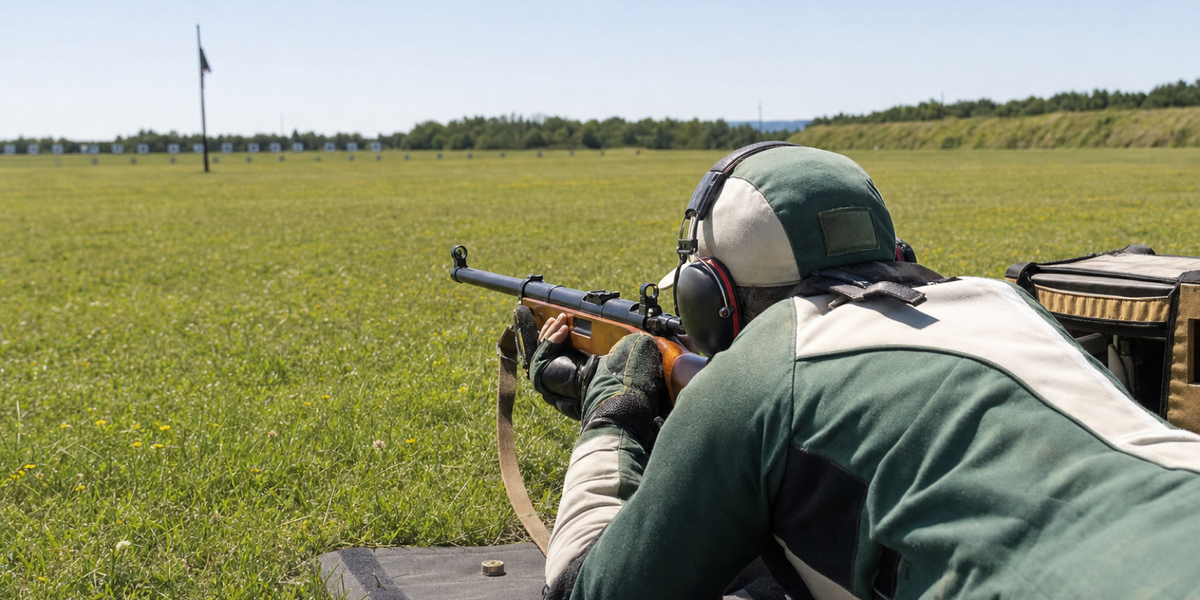
The Target Rifle line is the part worth explaining before the first relay. The shooter lies prone. The rifle points through aperture iron sights. A sling and shooting jacket hold the position together. The targets begin at 300 metres and finish at 900.
The equipment is specialized, though the bargain is plain: keep the aiming system small and make the shooter read the conditions.
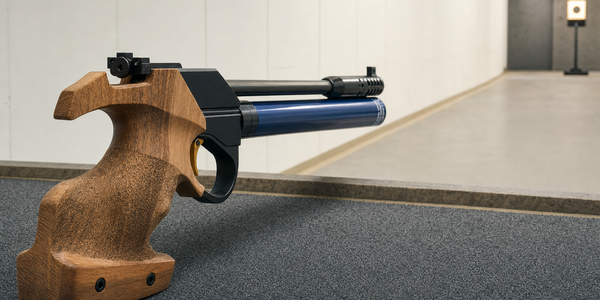
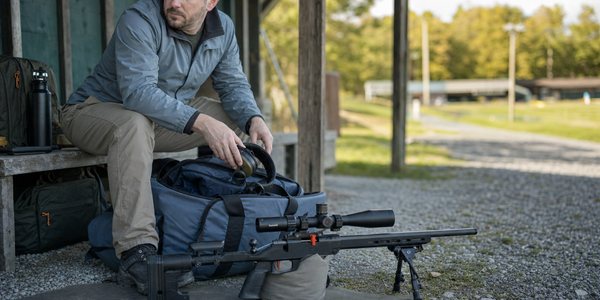
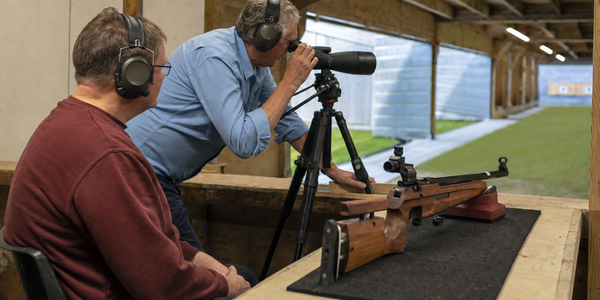
Holdover produced the feature as a fictional Canadian Target Rifle scene from official discipline references. The person, rifle, range, and relay are representative. They do not depict Mons Range, CFB Borden, a DCRA competitor, or an actual championship.
The national date is current
DCRA's current calendar lists the Target Rifle championship for August 17 to 23 at Mons Range. Its March registration notice says entries are open through Target Score. DCRA membership is mandatory, and confirmation follows payment and approval.
Those details matter because Target Rifle can look closed from outside the sport. The rifles are long. The jackets are stiff. The rear sight sits close to the eye. A spotting scope may sit beside the shooter, while the rifle itself has no telescopic sight.
The public route is less mysterious than the equipment. Start with the current DCRA discipline page, rulebook, and registration notice. Then ask the DCRA, a provincial association, or a local fullbore club which current match conditions and equipment checks apply.
Most of my precision shooting begins behind a telescopic sight. Magnification, parallax, and a reticle are available before I settle into the shot. Target Rifle removes those familiar adjustments from the rifle and makes the small rear aperture part of the position.
That order can save an expensive assumption. A rifle that looks suitable from a retailer photograph may belong in another class once its sights, chamber, support, or dimensions meet the rulebook.
The rifle has a narrow job
Rule 8.05 gives the ordinary TR rifle a tight outline. It is bolt action and may be single-shot or magazine-fed. The mechanism must permit manual chambering and extraction. The chamber is 5.56 NATO/.223 Remington or 7.62 NATO/.308 Winchester, with SAAMI or CIP dimensions. Improved chambers are prohibited.
The current ammunition rule leaves .223 bullet weight unrestricted and caps .308 at 156 grains. That replaces the rough Claude seed's obsolete 81-grain .223 statement.
The rest of the rifle is less uniform than the silhouette suggests. DCRA sets no overall TR rifle weight limit. Stocks can include adjustable cheekpieces and butt plates within the published limits. A handstop is allowed. The barrel must be at least 500 millimetres long, and the sight radius cannot exceed 1.2 metres.
Muzzle brakes and suppressors are out. A bipod may be attached, though it cannot support the rifle while firing.
That last line separates storage convenience from match technique. During the shot, the shooter supplies the structure through position, jacket, sling, shoulder, and hands.
One aperture makes the wind larger
The DCRA describes Target Rifle as bullseye shooting from 300 to 900 metres. The UK National Rifle Association uses a similar public definition: prone, single-shot precision through aperture sights, from 300 to 1,000 yards. Its description names wind judgement as the central long-range challenge.
An aperture sight does not make the target large. It gives the eye a repeatable alignment between rear opening, front element, and round aiming mark. The shooter still has to build a position that returns to the same place, break the shot without disturbing it, and decide what the wind changed since the last score appeared.
At 300 metres, a poor position can enter the record quickly. At 900, a correct position can still send a shot away from the centre when the condition changes. The discipline rewards mechanical consistency and weather judgement together.
That is also why the rifle's apparent simplicity should not be confused with a cheap or casual setup. A well-fitted stock, dependable aperture adjustments, the right jacket and sling, ammunition that stays inside the match rules, and enough practice to use them all are a complete system.
Target Rifle and F-Class share a calendar
DCRA lists Target Rifle and F-Class as separate disciplines. Both put fullbore rifles on long outdoor ranges. Their supports and sights create different games.
Target Rifle uses iron sights and the shooter's sling-supported prone position. F-Class uses optical sights and permits a bipod or mechanical front rest, with a rear bag. Its centre is smaller as well; DCRA's public discipline page describes a 10-inch bullseye at nearly one kilometre.
One format does not graduate into the other. A scoped precision-rifle owner may find F-Class visually familiar. A Target Rifle shooter accepts a different equipment boundary and develops a different set of repeatable actions.
The national calendar has room for both. That is useful context when Canadian precision shooting gets flattened into one picture of a chassis, a large optic, and a barricade.
Start with the rulebook, then the rifle
A prospective entrant should confirm four things before spending money or submitting an entry:
- current DCRA membership and registration status;
- the current program and any venue-specific match conditions;
- rifle, sight, sling, clothing, and ammunition compliance; and
- a local place to learn the firing-point routine safely.
The rulebook is not a substitute for instruction. It does show which questions to bring to a club. Ask how equipment inspection works, which distances the local program can provide, how scoring and target service operate, and what a new shooter should practise before a national week.
DCRA was founded in 1868. The current championship is not valuable because old things deserve automatic protection. It is valuable because the organization still publishes a calendar, a rulebook, an entry route, and a national line where a demanding Canadian shooting discipline can be tested in public.
August 17 is close enough to make the question practical.
At Mons Range, 900 metres will still fit through a small aperture. The hard part remains everything the shooter has to do before and after the sight picture looks right.
Sources
- Dominion of Canada Rifle Association, 2026 calendar and championship dates, checked July 28, 2026.
- DCRA, Registration now open for the 2026 Canadian Fullbore and F-Class National Championships, March 9, 2026.
- DCRA, Target Rifle, checked July 28, 2026.
- DCRA, Disciplines, checked July 28, 2026.
- DCRA, 2024 Rules for the Conduct of Fullbore Rifle Competitions, Rules 8.05 and 8.14.
- DCRA, About, checked July 28, 2026.
- DCRA, Ranges, checked July 28, 2026.
- National Rifle Association, Target Rifle, checked July 28, 2026.
Keep the range notes worth reading later.
If this piece has you thinking about range time, keep the notes useful enough to read later.
Use the Holdover Range Bench Log Card to record rifle, optic, ammunition, distance, weather, zero, group notes, correction, and next test without turning a range trip into a memory test.
Safety note: the card is a note-taking worksheet, not shooting instruction, load data, legal advice, or a substitute for range rules, official guidance, manufacturer manuals, or qualified instruction.