One receiver, three rows, and a *30-day clock*
Federal records track calibre and can hold multiple configurations. Section 4 gives permanent and continuing temporary changes different clocks.

Ownership. A fresh Canadian owner question asks whether a restricted firearm is registered with its calibre, especially when the same platform can accept more than one.
The short answer is yes. Calibre forms part of the information used to describe and verify a registered firearm.
The longer answer matters more. Federal forms can hold multiple calibre, shot, and barrel-length combinations. The modification regulation uses different reporting instructions for a change intended to be permanent and a temporary change that still exists after 30 days.
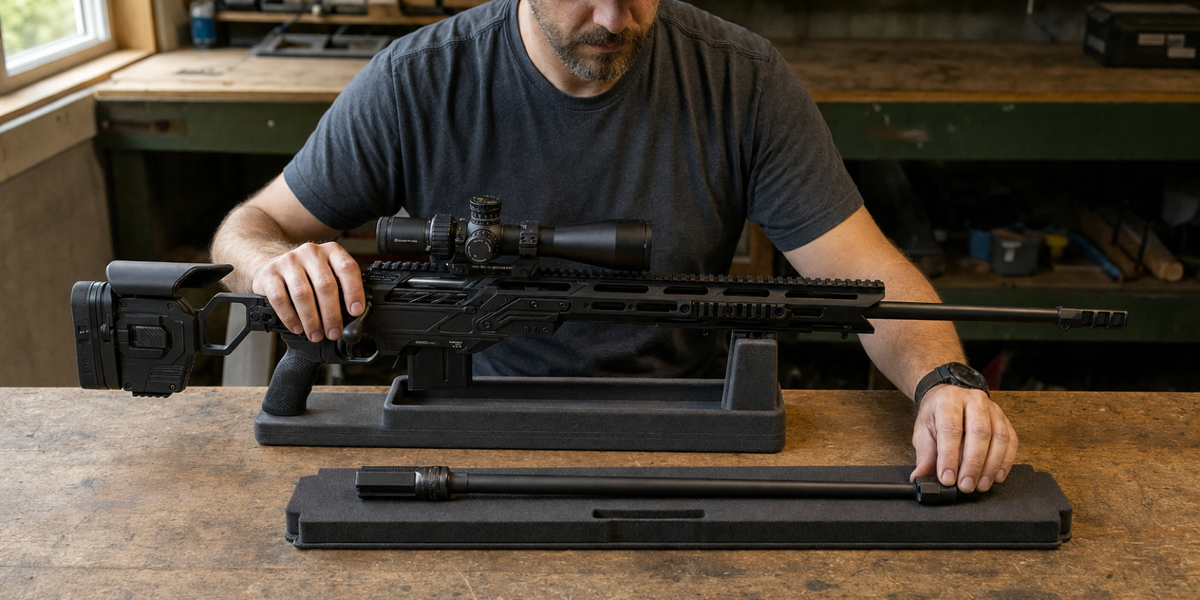
Holdover produced the feature as a representative workshop photograph. The rifle is an illustrative bolt-action family archetype, not an exact-product claim. The official legal and RCMP sources are linked below.
This is a paperwork question with a mechanical answer.
The certificate is one piece of the record
As an RPAL holder, I am familiar with how sparse a registration certificate can look. It does not resemble a technical dossier. That small piece of paper is easy to mistake for the complete record.
The Registry file behind it contains more.
Section 83 of the Firearms Act requires the Registrar to maintain the Canadian Firearms Registry, including records of registration certificates issued for restricted and prohibited firearms. The Firearms Records Regulations add the application and all information that accompanied it.
The federal description standard is explicit too. Section 1.1 of the Firearms Registration Certificates Regulations describes a firearm by its make, class, type, action, and calibre or gauge for the stated purpose.
The RCMP's individual registration application, form 5624, includes a Gauge/Calibre field. Its verifier instructions also require the Firearms Reference Table number with the Barrel, Calibre and Shot identifier exactly as it appears in the FRT.
The official material therefore supports a precise answer: calibre forms part of the registered description and supporting record.
Those sources do not establish that every calibre a platform could accept must be printed on the short certificate in the owner's file. They also do not show that an unreported conversion part sitting in a cabinet is automatically known to the Registry.
The paper is one output. The Registry record behind it is the larger file.
One firearm can have three combination rows
The most useful document in this question may be the RCMP's Firearm Verification form 5547.
Its main firearm-description row includes Gauge/Calibre, Shots, Barrel Length, and an FRT number. Directly below it are first, second, and third Calibre / Shot / Barrel Length Combination rows.
If more than three combinations apply, the form gives the verifier an attachment path.
That structure shows that the federal verification system can describe one firearm with more than one calibre, shot, and barrel-length combination. It does not prove that every multi-calibre firearm is recorded the same way. It does not establish that buying a second barrel changes the registered description.
The form preserves distinctions that a forum answer can easily flatten: receiver, firearm, certificate, calibre, verified combination, and conversion part.
The 2025-04 transfer form adds another useful detail. A verifier recording an FRT number must include the exact BCS identifier, including parent and child records. If the firearm's description differs from the registration certificate, the verifier supplies a corrected description on form 5547.
The 30-day clock splits in two
Section 4(2) of the Firearms Registration Certificates Regulations covers a modification to the type, action, calibre, or gauge of a registered firearm.
The wording creates two timing branches.
When the modification is intended to be permanent, the certificate holder must advise the Registrar within 30 days after the modification.
When the modification is not intended to be permanent but still exists 30 days after it was made, the holder must advise the Registrar without delay after that period.
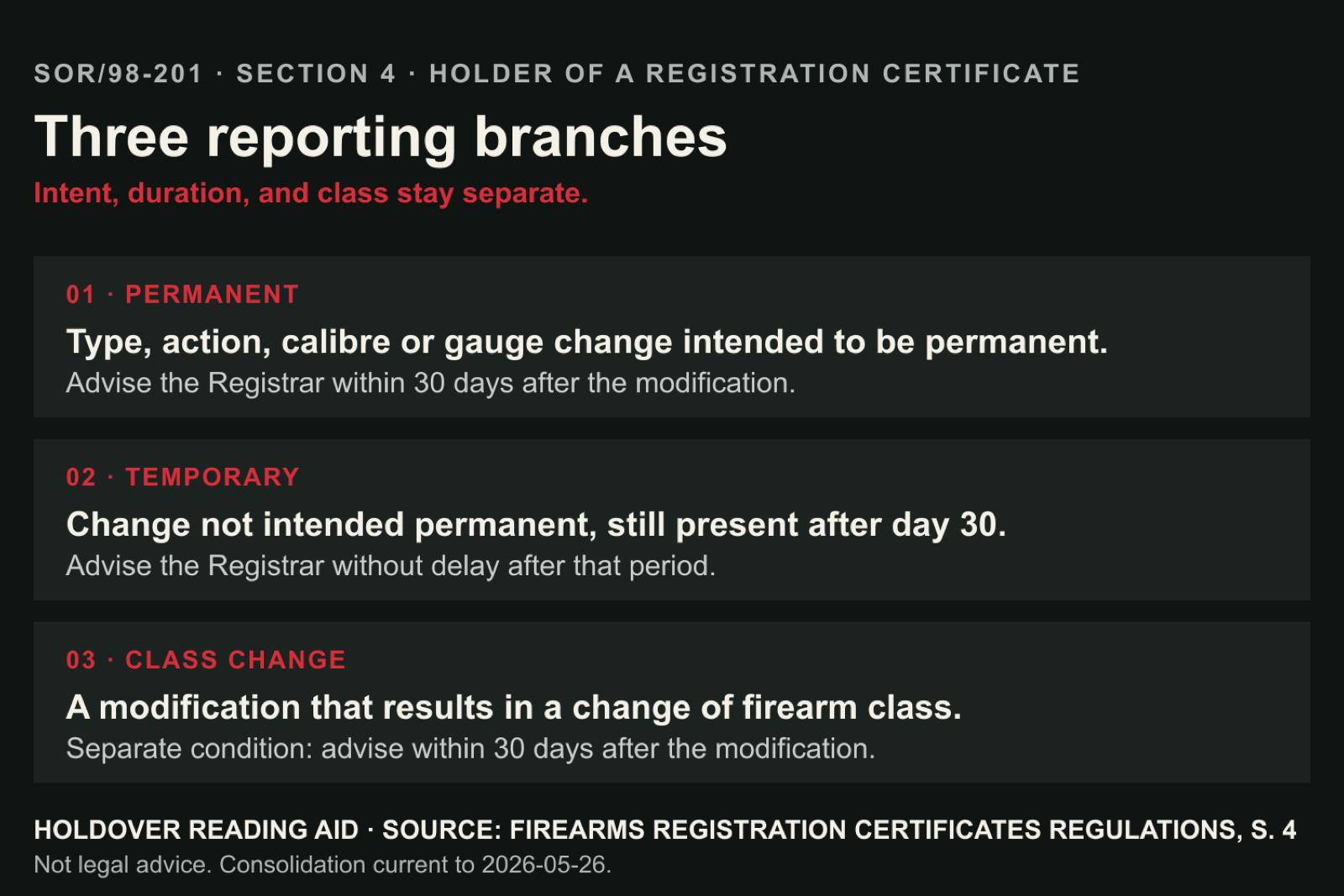
The permanent branch begins with intent. The temporary branch asks whether the change still exists at the 30-day mark.
Section 4(2) does not say every temporary calibre change must be reported on day one. It also cannot serve as a 29-day safe harbour for any configuration. The regulation attaches a reporting condition to a registration certificate. It does not grant permission to build an otherwise unlawful configuration.
A modification that changes the firearm's class sits in a separate branch under section 4(1)(a), with notice required within 30 days. Reporting cannot make an unlawful class-changing configuration lawful. Anyone considering a change that could affect classification needs a current answer before the work begins.
The RCMP's current registration guidance adds a practical point. A previously registered restricted firearm normally does not need another verification unless the Registrar needs to confirm its description or classification, or the firearm has been modified.
Ask about the record before changing the hardware
For an owner considering a multi-calibre setup, useful questions are specific.
What calibre and Barrel, Calibre and Shot combinations are currently associated with the firearm? Is the planned combination already part of its verified description? Does the Registrar require a new verification? Could the change affect the firearm's class? If it is reportable, which section applies and when does the clock begin?
Those are Canadian Firearms Program questions. A retailer cannot answer for the Registry, and a forum vote cannot settle the record. The CFP's published number is 1-800-731-4000.
Have the registration certificate number, make, model, serial number, current configuration, and intended configuration ready. Describe the actual change. A second barrel, a complete upper assembly, and a permanent alteration are different facts.
This article explains the current federal sources. A firearm-specific legal answer must come from the authorities responsible for the record and, where needed, qualified legal counsel.
Ottawa should make the record easier to see
There is a sound administrative reason to record calibre and verified combinations. A national registry needs enough detail to distinguish one firearm description from another.
The owner-facing explanation is the weak part.
An owner currently has to assemble the answer from a statute, two regulations, an RCMP web page, and forms designed for applicants and verifiers. The backend can accommodate a primary calibre plus multiple combinations. The certificate holder should be able to see the current registered description and the applicable change process just as clearly.
Until that improves, keep the distinctions straight.
The paper certificate is one part of the Registry record. The verification form can describe multiple configurations. A permanent calibre change and a temporary one that remains after 30 days follow different reporting language. A class change is a separate problem.
One receiver can produce three combination rows.
It can also start a 30-day clock.
Sources
- Firearms Act, sections 83 and 88.1
- Firearms Records Regulations, section 2
- Firearms Registration Certificates Regulations, sections 1.1 and 4
- RCMP, Registration and verification of firearms
- RCMP 5624, Application to Register Firearms
- RCMP 5547, Firearm Verification
- RCMP 5492, Application to Register Restricted and Prohibited Firearms Acquired by Transfer
- RCMP, Canadian Firearms Program contact
- r/canadaguns recurring FAQ thread
The amnesty file is still moving.
If this piece sent you back to government pages, do not wait for the next portal, Gazette, or court move to find you by accident.
The Dispatch follows Public Safety, RCMP, Canada Gazette, court, compensation, collection, and amnesty updates so the next change comes with the source that moved.
Safety note: the tracker is a worksheet for source hygiene, not legal advice or a substitute for current official guidance.