Ontario says a *variant* needs a boundary
Ontario's Supreme Court factum asks for a readable boundary around an undefined firearm 'variant.' Canada's response says the regulations already give licensed owners enough notice.

Opinion
Ontario's latest filing in the Supreme Court challenge to the May 2020 firearms regulations turns on a word the regulations use without defining: "variant."
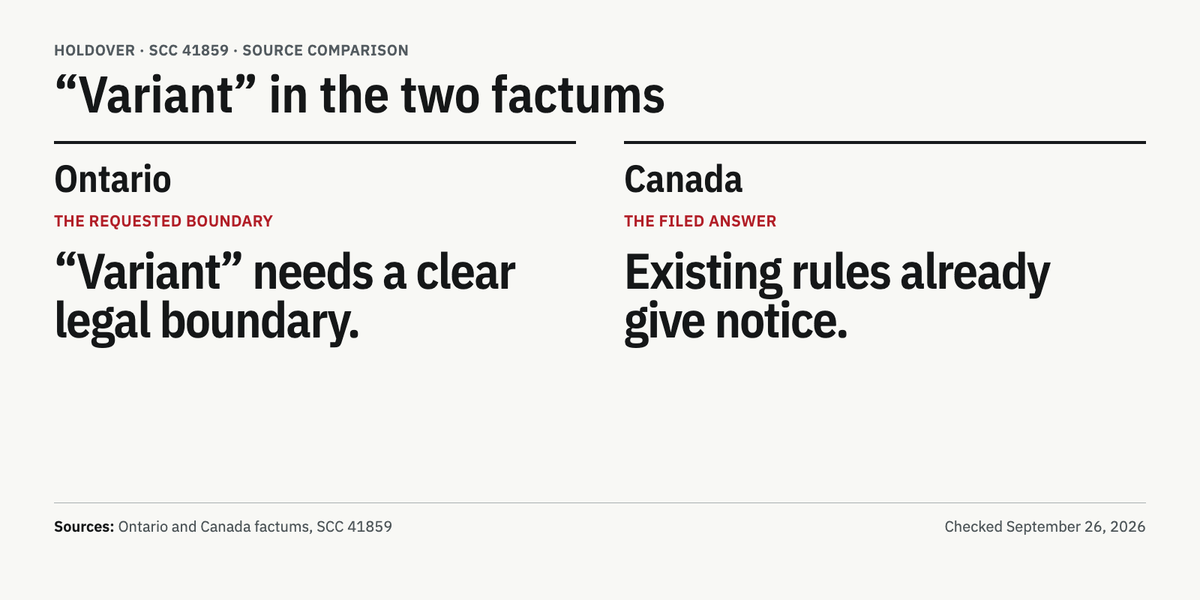
The province has intervened in Supreme Court file 41859 for a limited purpose. Its factum asks the Court to decide whether a regulation can make "variants or modified versions" of named firearms prohibited when the law gives licensed owners no clear boundary for that category. The Attorney General of Canada has filed the other side of the question. Canada says the regulations, ordinary industry meaning and available reference material give enough notice.
That disagreement deserves to be read carefully. It is narrower than the whole challenge to the regulations, and it is more useful than another round of hearing-date speculation. The Court has the filings. Owners now have a clearer view of the question being put to it.
I hold a firearms licence, so I read this kind of argument from the side of the person expected to comply with it. A reference table can help answer a question. The rule itself should still tell an owner where the question begins.
The phrase Ontario wants the Court to examine
Ontario's 19-page intervenor factum accepts that Parliament can prohibit firearms and delegate regulation-making authority to Cabinet. Its argument starts at the outer edge of that delegated power.
The 2020 regulations list specific makes and models. They also extend to "any variants or modified versions" of those listed firearms. Ontario says neither the Criminal Code, the regulations nor another federal statute defines those terms. In its view, that matters because the prohibition can carry criminal consequences for a person who possesses a firearm captured by the regulation.
Ontario frames the issue as legal precision. Criminal rules need enough clarity for a person to know what conduct the law captures. Parliament can give Cabinet a defined task. Ontario says Cabinet needs clear statutory authority before it uses an undefined category to draw the boundary of a crime.
This is a practical concern for licensed owners. A named model gives a reader a starting point. A category that reaches beyond named models needs a way to identify its edge before the reader has to act on it. Ontario does not ask the Court to decide every classification dispute in its intervention. It asks whether the language chosen here can do the work the regulation assigns to it.
Canada's answer is already in the record
Canada's respondent factum describes the same regulations differently. It says the 2020 order identifies named makes and models, then captures their variants or modified versions. Canada argues that "variant" has an established use in the firearms industry, tied to a common lineage with a listed firearm.
The federal filing also addresses a tool many owners know by name: the RCMP's Firearms Reference Table. Canada calls it a reference resource rather than the legal source of a prohibition. Its position is that an owner can read the regulations, use publicly available resources and seek information where necessary. The factum says this gives adequate notice of the rule's reach.
That is the government's strongest point. Regulations often rely on ordinary technical language, and a rule can use a term that professionals understand without defining every application in a separate section. The Crown's argument is that this system supplies a workable answer for a regulated field.
Ontario's point remains important because the stakes shape the level of clarity required. When a category can turn lawful possession into a criminal matter, a reader should be able to find its boundary in the law itself or in an authority the law clearly adopts. A non-binding reference resource may be useful. Its usefulness does not settle the question Ontario has put before the Court.
A narrow intervention with a useful consequence
Ontario has deliberately kept its intervention limited. The province says it takes no position on the broader constitutional and Charter questions raised by the parties. That restraint helps readers separate this filing from the entire appeal.

It also makes the filing more valuable. The province has isolated one question that reaches beyond a dispute between governments: what does a regulated person need in order to know that a category applies to their property?
The answer matters before anyone decides whether to sell, store, transport or surrender a firearm. A licensed owner should be able to find the line before crossing it. The Canadian firearms system already asks owners to follow detailed rules on licensing, storage, transport and classification. A prohibition category deserves the same discipline.
No one should treat this factum as a Court decision. The appeal remains pending, and the Court will hear arguments from the parties and interveners before issuing reasons. Canada may persuade the Court that the existing language and resources meet the required standard. Ontario may persuade it that Cabinet needed a clearer legislative instruction.
For now, the useful development is simpler. The filed record has moved the debate from broad claims about a ban to a defined question about notice. That lets owners, lawyers and policy-makers test the actual arguments instead of projecting their own onto the case.
The rule has to be readable before it is enforceable
Ontario's filing will not settle the 2020 regulations by itself. It gives the Court a clear place to look: the moment an undefined term reaches beyond a named firearm and into a category with legal consequences.
Canada is entitled to defend the regulations and the usefulness of industry terms. Owners are equally entitled to expect a boundary they can locate before the penalty is real. That is a modest expectation in a system that demands careful compliance from the people it regulates.
The least a licensed owner can expect is a rule whose outer edge can be found before crossing it.
Sources
- Supreme Court of Canada: file 41859 docket, checked September 26, 2026.
- Attorney General of Ontario: intervenor factum, file 41859, filed September 8, 2026; docket completed September 23, 2026.
- Attorney General of Canada: respondent factum, file 41859, accessed September 26, 2026.
The amnesty file is still moving.
If this piece sent you back to government pages, do not wait for the next portal, Gazette, or court move to find you by accident.
The Dispatch follows Public Safety, RCMP, Canada Gazette, court, compensation, collection, and amnesty updates so the next change comes with the source that moved.
Safety note: the tracker is a worksheet for source hygiene, not legal advice or a substitute for current official guidance.