In Quebec, the licensed-owner count crossed *500,000*
The RCMP's 2025 report puts Quebec at 502,111 adult PAL holders, 20.4% of Canada's total. The historical tables make the milestone more precise.

Opinion. The RCMP's 2025 report lists 502,111 adult Possession and Acquisition Licence holders in Quebec.
Add 584 Minor's Licences and the provincial total reaches 502,695. The adult number alone now clears half a million.
Quebec accounts for 20.4 per cent of Canada's adult PAL holders. Just over one in five is in the province.
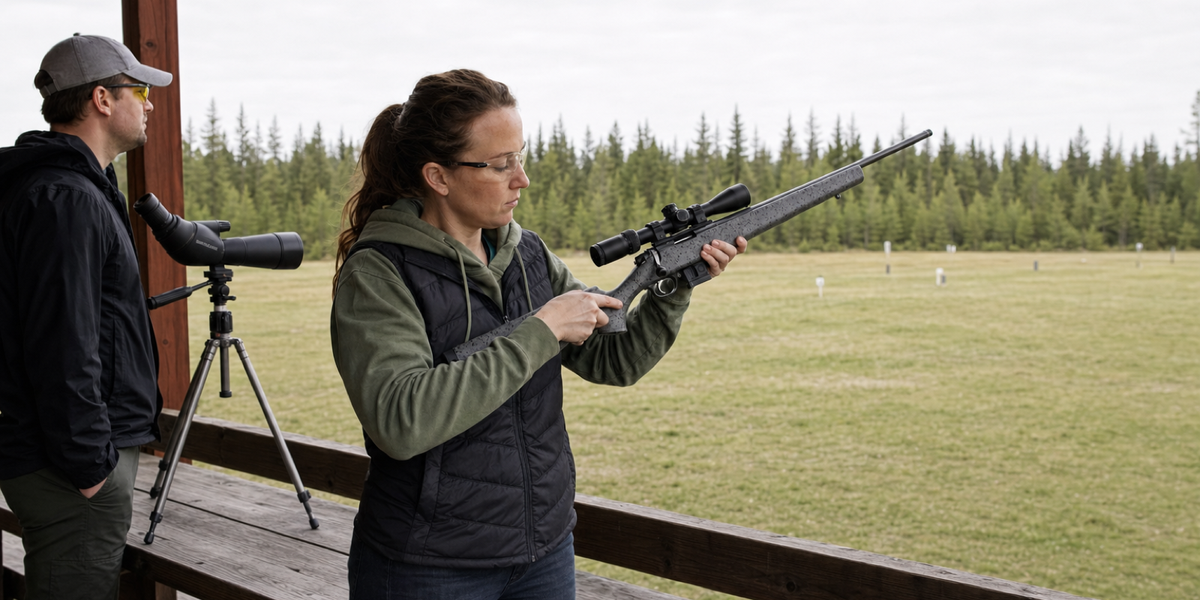
The people, club, and rifle pictured are fictional. Official manufacturer references define conventional rimfire family geometry only. Original generated editorial photograph.
I remember when my own PAL was still new and the range felt like a small, procedural corner of Canadian life. The card and rules came first. The scale became visible on ordinary weekends, when benches filled, spotting scopes moved between shooters, and hours disappeared.
The Quebec row puts a number beside that experience.
The line is 502,111
The 2024 report counted 499,272 adult PAL holders in Quebec. The 2025 report adds 2,839, an annual increase of about 0.6 per cent.
That is a modest change. The threshold matters because of the base underneath it. Half a million adults have completed the federal licensing process and kept a valid licence current in one province.
The same table lists 2,458,677 adult PAL holders across Canada. Quebec's share is larger than the provincial firearms conversation often sounds from outside the province.
The number describes people, not firearms. A PAL holder with one rifle and a PAL holder with a full collection each count once. A licensed person who hunts, competes, collects, visits a range twice a year, or has stopped shooting for a season also counts once.
It is still a useful head count. Policy and advocacy both begin with knowing who is already in the room.
The history needs two columns
The clean historical slogan would be that Quebec crossed half a million for the first time since 2006. The official reports do not support that sentence cleanly.
In 2006, Quebec had 510,671 valid individual licences. That old total combined 275,925 Possession Only Licences, 234,691 PALs, and 55 Minor's Licences. The next year's combined total fell to 499,543.
The modern series uses a different category structure. In 2018, Quebec had 499,995 adult PAL holders, five short of the line. Add 63 minors and the total was 500,058.
By 2024, the adult PAL count was 499,272. In 2025, it reached 502,111.
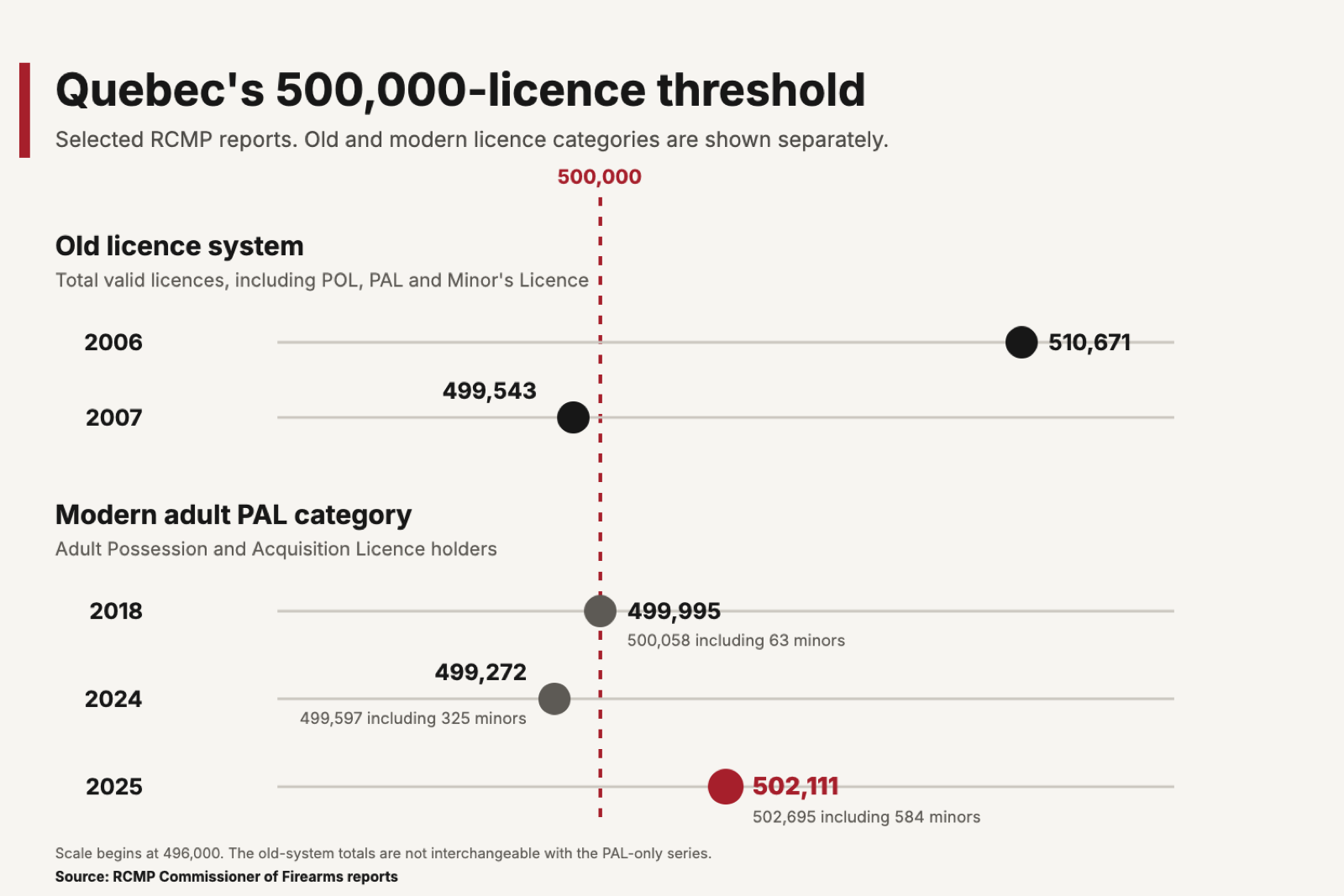
The category break matters. A precise article can say adult PAL holders crossed 500,000 in the current report. It cannot turn the old POL-plus-PAL total into a seamless modern trend line.
That correction makes the story better. Quebec hovered around this threshold under different licence systems for years. The 2025 table shows the adult PAL category itself clearly above it.
Quebec adds another registry
Federal licensing is only one layer of the Quebec ownership file.
Quebec's Firearms Registration Act came into force on January 29, 2018. The province's current guidance requires owners to register non-restricted firearms present in Quebec. Its official page says those rifles and shotguns represent about 95 per cent of firearms in the province.
The federal PAL count and the provincial registry answer different questions. The RCMP counts licensed people. Quebec's service records covered non-restricted firearms and their owners under provincial law.
That distinction is easy to lose in a national argument. Quebec has a separate registration system, a long legal history around registry records, and more than half a million adult federal licence holders at the same time.
Those facts coexist. They do not reduce the province to one position.
A licence count has limits
The RCMP table stops at licensing status. Voting preference and support for any specific ban, registry, compensation programme, party, or advocacy organization sit outside it.
Current range attendance, hunting participation, course demand, retailer health, and provincial-registry compliance sit outside it too.
The annual increase was 0.6 per cent, so the threshold should not be sold as a sudden rush. Population change, renewals, new applications, expiries, and movement between provinces can all affect the row.
The table still establishes scale. Any explanation of Canadian firearms ownership that treats Quebec as marginal has to account for 20.4 per cent of the country's adult PAL holders.
That is the useful conclusion. It is narrower than a political claim and stronger than a stereotype.
Half a million changes the advocacy job
National firearms advocacy needs a Quebec plan that begins with current numbers and works in both official languages.
Federal and provincial rules should be explained separately. Court cases, bans, registration duties, transport rules, and compensation programmes land differently when the owner can see which government created the obligation and which record controls it.
Clubs, ranges, instructors, retailers, and provincial organizations also have a planning number. The report does not prove a capacity shortage. It makes capacity a serious question: where do half a million licensed adults learn, practise, compete, sight in, and bring a new shooter?
Government consultations should carry the same discipline. A handful of familiar organizations cannot stand in for every owner. Province-level licensing data belongs in the briefing before claims are made about what Quebec thinks.
The practical tone matters. Talk to owners about the licence they hold, the firearm class they use, the provincial registration duty they face, and the place where they shoot. Start from the file in front of them.
Start with the people already here
The milestone is 502,111 adult PAL holders, measured at December 31, 2025.
Its scope is narrow: the current federal head count of licensed adults in Quebec. It represents just over one in five adult PAL holders in Canada.
That is enough to change the scale of the conversation.
Quebec's firearms debate already has half a million licensed adults in the room. Advocacy and government should begin there.
Sources
- RCMP,
2025 Commissioner of Firearms Report: https://rcmp.ca/en/corporate-information/publications-and-manuals/2025-commissioner-firearms-report - RCMP,
2024 Commissioner of Firearms Report: https://rcmp.ca/en/corporate-information/publications-and-manuals/2024-commissioner-firearms-report - RCMP,
2018 Commissioner of Firearms Report: https://publications.gc.ca/collections/collection_2020/grc-rcmp/PS96-2018-eng.pdf - Canada Firearms Centre,
Commissioner of Firearms 2006 Report: https://publications.gc.ca/collections/collection_2008/ps-sp/PS96-2006E.pdf - RCMP,
Commissioner of Firearms 2007 Report: https://publications.gc.ca/collections/collection_2008/rcmp-grc/PS96-2007E.pdf - Gouvernement du Quebec,
Owners covered by the Firearms Registration Act: https://www.quebec.ca/en/public-safety-emergencies/firearms/firearms-registration/about-firearms-registration/owners-covered-by-firearms-registration-act - Gouvernement du Quebec,
La Loi sur l'immatriculation des armes a feu entrera en vigueur le 29 janvier 2018: https://www.quebec.ca/nouvelles/actualites/details/la-loi-sur-limmatriculation-des-armes-a-feu-entrera-en-vigueur-le-29-janvier-2018 - RCMP,
History of firearms in Canada: https://www.rcmp.ca/en/firearms/history-firearms-canada
The amnesty file is still moving.
If this piece sent you back to government pages, do not wait for the next portal, Gazette, or court move to find you by accident.
The Dispatch follows Public Safety, RCMP, Canada Gazette, court, compensation, collection, and amnesty updates so the next change comes with the source that moved.
Safety note: the tracker is a worksheet for source hygiene, not legal advice or a substitute for current official guidance.