October 30, twice on the *RCMP page*
The RCMP still gives October 30 as the firearms amnesty expiry. Current law and Public Safety guidance use a court-dependent endpoint. The police page needs a correction.

Opinion
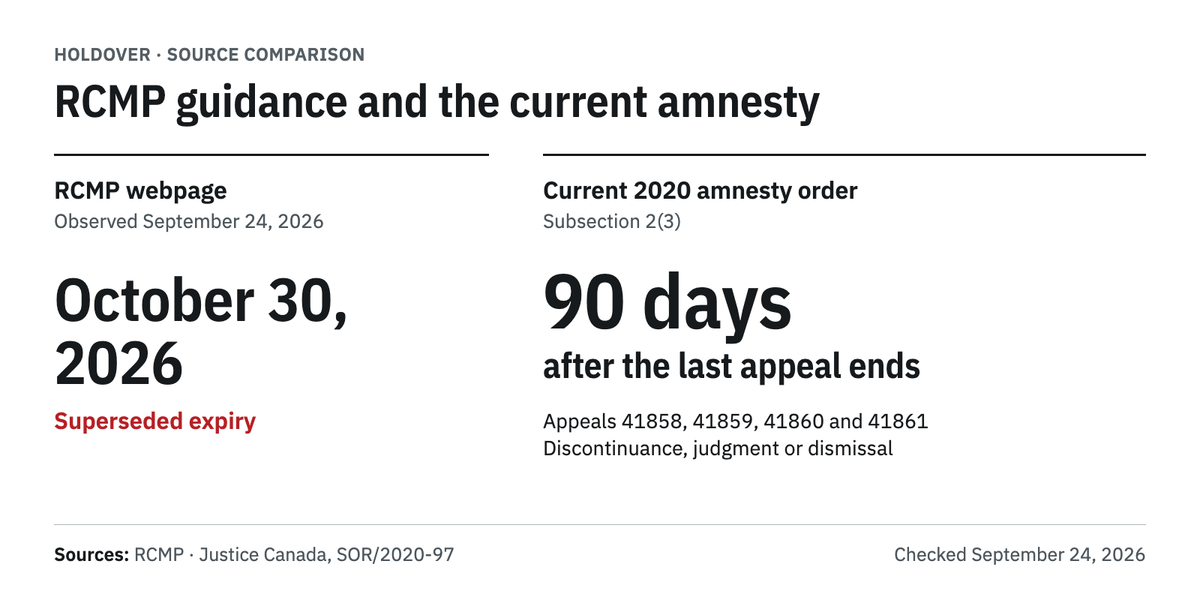
The RCMP's public explainer for the May 2020 firearms prohibition still gives October 30, 2026 as the amnesty expiry. It gives that date twice. Holdover checked the live page on September 24, more than three months after Cabinet replaced that deadline with one tied to the Supreme Court appeals.
Public Safety's current programme page sends readers to the amended order and describes the court-dependent expiry. An owner checking two federal websites can therefore receive two different answers to the same question. The answer in the law is available. The police explainer needs an edit.
I design websites for a living, and I read firearms rules as a licensed owner. Those two parts of my life meet in a detail like this: someone can choose an official source, find the relevant heading, read the sentence beneath it, and still leave with an obsolete date. That is a poor result for a public service whose readers are trying to comply.
The two sentences an owner can find
Near the top of the RCMP page, an important notice names October 30, 2026. Farther down, the section on the amnesty extension repeats that it “will expire on October 30, 2026.” The page's modification date is October 17, 2025.
That footer helps explain the age of the text. The page nevertheless presents the expiry as current guidance, with affirmative instructions addressed to owners. A reader has to know about the later amendment to recognize the problem. Someone checking the date for the first time has less reason to suspect it.
This finding has a defined scope. It concerns the wording on this particular page when checked today. The page alone cannot tell us who maintains it, whether an update is underway, or how many people have relied on it. Holdover has no evidence of an owner suffering a loss because of these sentences, and the RCMP has not been contacted for an explanation.
What the order now says
Cabinet registered SOR/2026-114 on June 5. The amendment replaced the expiry provision in each of the 2020, 2024, and 2025 amnesty orders. The relevant appeals are Supreme Court files 41858, 41859, 41860, and 41861.

The current consolidated 2020 order, subsection 2(3), sets the endpoint at the 90th day after those appeals end by discontinuance, judgment, or dismissal. If they end on different days, the latest of those days determines the endpoint. That last detail matters: a short summary about a court decision leaves out other ways an appeal can end.
The Gazette also includes background discussion of the old October 30 expiry. Read the operative amendment at the top when checking what changed; its historical explanation describes the problem the government was addressing. This is one reason a direct link to the relevant provision helps readers more than a loose reference to a long legal document.
The amnesty remains conditional. Its extension leaves the underlying prohibitions in place. Public Safety's June backgrounder says the extension protects owners and businesses while the Supreme Court hears the appeal and renders its decision. Nobody should read an extended expiry as permission to resume ordinary sporting use of a prohibited firearm.
Ottawa has already published the correction
Public Safety's programme landing page describes the revised expiry and links to the Gazette. The government therefore has a current public explanation to which the RCMP can direct readers. Its June announcement also separates the amnesty extension from the compensation programme's expected completion. Those schedules serve different purposes.
There is a fair point in the government's favour. It made the legal change, announced it, and provided a route to the authoritative wording. An owner who follows that route can establish the rule. Keeping a large collection of public pages synchronized takes ongoing work, especially when several departments publish overlapping explanations.
I still expect the page carrying instructions from the national police service to match the amended order. The cost of a missed edit falls on the person trying to reconcile the answers. At minimum, that means more reading and another check. We should be careful about claiming larger consequences without evidence, while being equally clear that this extra work is avoidable.
A small repair with a clear purpose
The RCMP can replace both expiry statements, link directly to the current provision, and mark the correction with a visible date. A brief explanation of the change would also help anyone returning with an older printout or bookmark. The rest of the page should receive the same currency check before an editor marks it updated.
From a publishing perspective, I would want one maintained explanation of the expiry, with other pages linking to it. Each time the legal position changes, an editor should check the places where the earlier answer appeared. The RCMP's internal publishing process remains outside this review.
Licensed owners deserve clear, current instructions from the institutions enforcing the rules. As of this check, the amendment and the police page give different answers. The next useful change would be an RCMP page where both October 30 sentences have been corrected and the reader can see when that happened.
Sources
- RCMP May 2020 prohibition explainer, live wording checked September 24, 2026.
- Canada Gazette, SOR/2026-114, registered June 5, 2026.
- Justice Canada, consolidated 2020 amnesty order, subsection 2(3), consolidation current to September 3, 2026; checked September 24.
- Public Safety Canada, compensation programme, current landing-page guidance checked September 24, 2026.
- Public Safety Canada, amnesty extension backgrounder, June 2026.
- Public Safety Canada, programme closure and amnesty announcement, June 2026.
The amnesty file is still moving.
If this piece sent you back to government pages, do not wait for the next portal, Gazette, or court move to find you by accident.
The Dispatch follows Public Safety, RCMP, Canada Gazette, court, compensation, collection, and amnesty updates so the next change comes with the source that moved.
Safety note: the tracker is a worksheet for source hygiene, not legal advice or a substitute for current official guidance.