Saskatchewan put a receipt on the *ban*
Saskatchewan's new appraisal service turns the federal buyback fight back into property, storage, receipts, and the lawful owners Ottawa keeps finding first.

Update, June 9, 2026. Public Safety Canada has extended the relevant amnesty period. The old the former fixed deadline date referenced below is no longer the operative expiry; the amended expiry is 90 days after the Supreme Court of Canada renders its decision.
Opinion. Saskatchewan did something Ottawa has avoided for six years: it treated banned firearms as property with receipts attached.
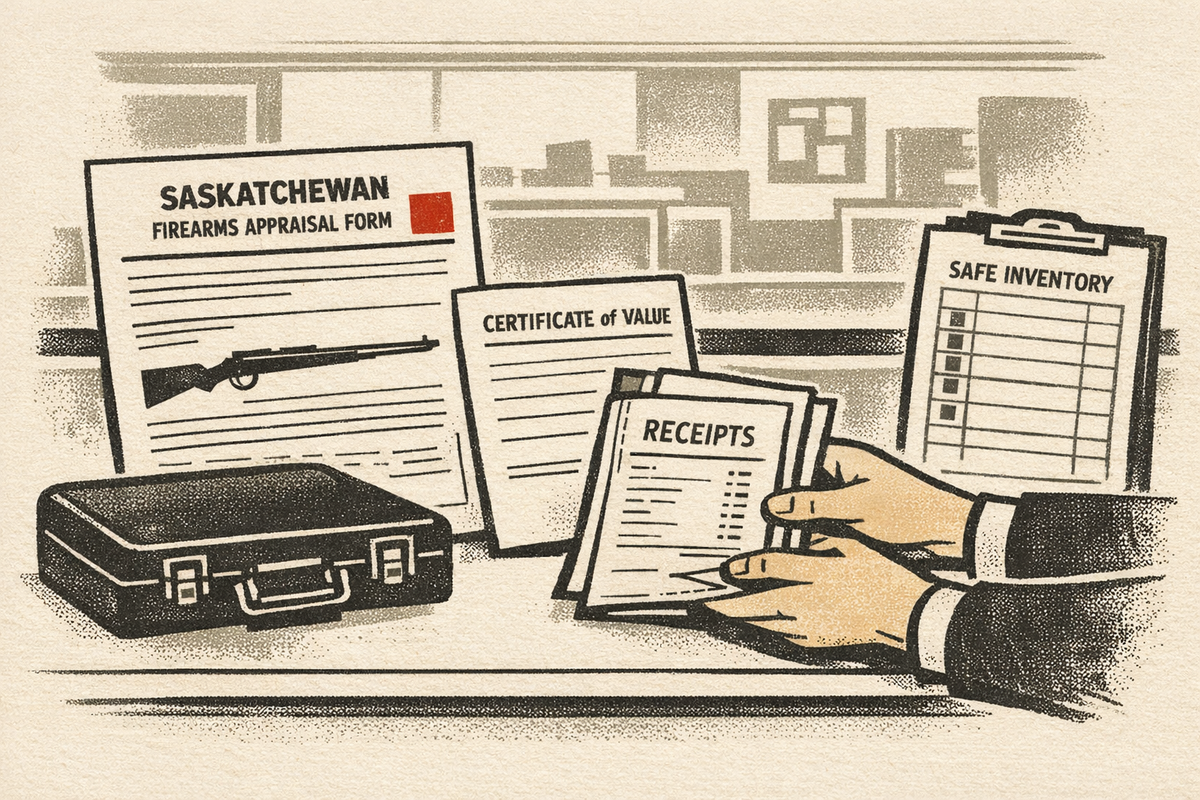
On May 4, the province announced that the Saskatchewan Firearms Amendment Act, 2026, is now in force and that its Firearms Verification and Appraisal Service is open to the public. The plain version is this: eligible Saskatchewan owners and businesses can ask the Saskatchewan Firearms Office to verify affected firearms, issue a certificate of value, and provide a certificate of exemption that the province says will let them continue storing lawfully bought, now-prohibited firearms on behalf of Saskatchewan while they pursue compensation.
That is not a small administrative footnote.
It is a direct answer to the federal buyback problem. Ottawa prohibited firearms first, built the compensation machinery years later, capped or constrained parts of the payout, and then told owners that compliance remains mandatory whether the compensation feels remotely adequate or not. Saskatchewan's move says the quiet part in institutional language: a rifle in a safe is not only a policy symbol. It is property. It has a purchase price, accessories, ammunition, storage costs, records, and an owner who was legal when the money left the bank account.
That matters, especially for newer shooters, because this is where Canadian firearms politics stops being abstract. It reaches the range bag.
The useful part is the receipt
The Saskatchewan service is not simply saying "keep your guns." That would be easier to chant and much less useful.
The interesting part is the appraisal.
Saskatchewan says residents can request a certificate of value for property affected by federal firearms legislation. Its service page says the appraisal can include prohibited firearms, non-transferable accessories, and ammunition that have been rendered valueless by federal law. That last part is the bit newer owners should read twice.
When Ottawa prohibits a firearm, the cost is not always the firearm alone.
It can be the magazines that no longer have a lawful market. It can be parts bought for a platform that can no longer be transferred. It can be ammunition attached to a use case that no longer exists. It can be the case, mounts, tools, optic pairing, range plan, and maintenance parts that made sense the day they were bought and became stranded when a cabinet table changed a classification.
Federal policy tends to talk in categories. Owners live in receipts.
That distinction is not sentimental. It is the difference between a press conference and a real accounting of loss.
Ottawa found the easiest owner
The federal Assault-Style Firearms Compensation Program page says Canada has banned more than 2,500 makes and models of "assault-style" firearms since May 2020. It also says the individual declaration period has ended, collection and compensation are expected to run from spring to early fall 2026, and owners must safely dispose of or permanently deactivate affected firearms before the SCC appeals + 90-day amnesty endpoint or risk criminal liability.
The federal declared-firearms table says more than 67,000 firearms were declared nationally during the individual declaration period. Saskatchewan's line in that table is 1,255.
Those are the people Ottawa can find.
They are not hidden. They have PALs or RPALs. They have safes. They have purchase histories, reference numbers, registration certificates where applicable, course reports, addresses, and enough paperwork to make a normal person question their hobbies. They are visible because the lawful system made them visible.
That visibility is being treated as administrative convenience.
The strongest argument for the federal side deserves a fair hearing. Governments are expected to respond to shootings. They argue that some firearms have no reasonable place in civilian circulation and that a buyback gives owners a lawful path to compensation while removing those firearms from the community. If you do not understand firearms, that sounds tidy enough.
The problem is that tidy is not the same as targeted.
The owner waiting on an appraisal is not the person driving criminal gun violence in Saskatoon, Regina, Toronto, or Vancouver. The owner storing a now-prohibited rifle under the rules is not the person smuggling handguns, defacing serial numbers, or cycling through violent offences. The policy pressure keeps landing hardest on the person already inside the system because that person is easier to administer against.
Saskatchewan's service does not solve that mismatch. It prices it.
The legal hook is narrow, but revealing
Saskatchewan says its certificates of exemption will be issued in accordance with section 117.08 of the Criminal Code. The federal text says an individual is not guilty of an offence under the Criminal Code or Firearms Act by reason only of possessing certain firearms, prohibited devices, ammunition, or related items if the individual does so on behalf of, and under the authority of, a police force, the Canadian Forces, a visiting force, or a department of the Government of Canada or of a province.
That is the legal hinge Saskatchewan is using.
It may be contested. It may be tested. The country is now deep enough into firearms-by-regulation that a province issuing exemption certificates under a Criminal Code provision reads as both clever and absurd, which is not usually a sign of healthy policy design.
Saskatchewan's own FVA page is careful about conditions. Certificates are for Saskatchewan residents 18 or older who own at least one affected firearm, hold a valid PAL or RPAL, are pursuing federal compensation, and follow the storage laws that apply to their reclassified firearms. Fail to maintain the licence or storage requirements, and the certificate can become inoperative. Stop pursuing compensation, and it can become inoperative. If it becomes inoperative, the owner needs another compliance path.
So no, this is not a magic wand.
It is still important.
The province is treating lawful storage as something other than moral failure. It is saying, in effect, that a compliant owner can continue to be compliant while compensation is fought over properly. It is also putting a public document between the owner and the lazy assumption that possession after a political ban tells you something useful about risk.
That assumption has done enough damage already.
Police resources are part of the argument
One quote in the Saskatchewan release should travel outside Saskatchewan.
Patrick Nogier, president of the Saskatchewan Association of Chiefs of Police, said the framework supports lawful ownership while letting police services concentrate on "the individuals and firearms most often associated with criminal activity in our communities." CJME's May 4 reporting went further, quoting Nogier on Prince Albert: 220 crime guns taken off the street in 2024 and 2025, and, according to that report, those were not guns captured by the federal legislation.
That is the policy argument in one sentence.
A police service has finite time. A province has finite money. A federal program has finite competence, which may be the most finite resource of all. If the objective is public safety, then every hour spent designing processes for already-identified lawful owners should be measured against the work not being done on trafficking, smuggling, repeat violent offenders, stolen firearms, unlawful possession, and the criminal market.
Ottawa can argue that both can happen at once.
The record makes that harder to believe. The business buyback needed years to get off the ground. The individual declaration period closed before many owners had any confidence that the process would value their property accurately. Public Safety Canada says business claims re-opened April 23, 2026, with the program now including firearms and devices prohibited in May 2020, December 2024, and March 2025. The same release says the earlier business phase collected and destroyed more than 12,000 firearms and paid more than $22 million in compensation.
After all that, individual owners are still being told to wait for messages, instructions, collection processes, validation, and payment.
This is not precision.
It is a policy machine slowly discovering inventory.
New shooters should pay attention
For a new Canadian firearms owner, Saskatchewan's move may look like a provincial-federal fight happening far away from a first range membership.
It is closer than that.
The lesson is not that every new shooter needs to become a constitutional scholar. Please do not. The sport has suffered enough men explaining jurisdiction in gun-shop voices.
The lesson is that firearms ownership in Canada is never just the firearm. It is the licence, the classification, the transfer rule, the storage rule, the range rule, the parts market, the import channel, the ammunition supply, and the political risk attached to whatever you bought. A "gear decision" can become a policy decision with a date stamp.
That should not make you paranoid. It should make you disciplined.
Keep receipts. Keep model information. Know what you own. Understand the classification before you buy. Pay attention to whether the platform you are entering has a stable legal future or a folder full of angry forum threads. If you buy accessories, understand whether they still have value without the firearm they support. If you get into reloading, recognize that components and cartridge choices are not only ballistic decisions in Canada. They are supply-chain decisions, cost decisions, and sometimes regulatory-adjacent decisions.
This is not the fun part. The fun part is still the target, the rifle that finally starts making sense, the optic that tracks, the .22 that teaches humility cheaply, and the first time your notebook proves your memory was lying.
But the paperwork part is real.
Saskatchewan just made that obvious.
The policy should aim at risk
Holdover's position is not that every firearm law is illegitimate. Training, licensing, storage, transfer verification, and continuous eligibility screening are part of the Canadian model. Serious owners can argue about details without pretending the whole structure is imaginary.
The problem is the last six years of federal policy have repeatedly chosen the regulated owner as the cleanest target.
The May 1, 2020 Order in Council prohibited firearms that had previously been non-restricted or restricted, including models used for sport shooting and hunting. Later federal changes expanded the list. The buyback now tries to launder that choice through compensation, but compensation after prohibition does not cure the original targeting problem. It only changes the paperwork attached to the loss.
Saskatchewan's service is therefore valuable even if the legal path ahead gets messy.
It forces a better question: what does a government owe a citizen when it turns lawful property into stranded property?
The answer cannot be "whatever the program happens to offer, if the owner gets through the portal in time, and only for the items Ottawa chooses to recognize." That is not fair market value. That is a clearance rack with criminal liability behind it.
If the federal government wants to argue that these firearms must leave civilian circulation, then it should be prepared to compensate the real loss. Firearms. Parts. Non-transferable accessories. Ammunition rendered useless. Business inventory. Owner costs. The whole file.
And if the government is unwilling to price the whole file, it should stop pretending the policy is clean.
A receipt is not a loophole
The Saskatchewan service will be called many things by people who already know what they think. Some will call it a loophole. Some will call it defiance. Some will call it theatre. There may be some theatre in it. This is Canada. Even the fights come with forms.
But the serious part is not theatrical.
A certificate of value is a demand for accounting. A certificate of exemption is a demand that lawful storage be treated differently from criminal possession. A provincial service that includes accessories and ammunition is a demand that the real cost of a ban be measured where owners actually live.
That is not rebellion.
It is accounting.
And after six years of Liberal firearms policy that has treated licensed owners as the easiest people to regulate, accounting is overdue.
Ottawa made the ban. Saskatchewan put a receipt beside it.
A country serious about public safety can still read a receipt.
Sources
- Government of Saskatchewan, Saskatchewan Launches Firearms Verification and Appraisal Service to Protect the Property of Residents and Businesses, released May 4, 2026, accessed May 5, 2026.
- Government of Saskatchewan, Firearms Verification and Appraisal Service, accessed May 5, 2026.
- Department of Justice Canada, Criminal Code, section 117.08, accessed May 5, 2026.
- Public Safety Canada, Assault-Style Firearms Compensation Program, date modified April 21, 2026, accessed May 5, 2026.
- Public Safety Canada, Number of assault-style firearms declared by province and territory, date modified April 1, 2026, accessed May 5, 2026.
- Public Safety Canada, Assault-Style Firearms Compensation Program for businesses re-opens to include all prohibited assault-style firearms, released April 14, 2026, accessed May 5, 2026.
- Canada Gazette, SOR/2020-96, Regulations Amending the Regulations Prescribing Certain Firearms and Other Weapons, published May 1, 2020, accessed May 5, 2026.
- 980 CJME, Roman Hayter, Saskatchewan Firearms Amendment Act aims to keep Ottawa out of provincial gun safes, published May 4, 2026, accessed May 5, 2026.
The amnesty file is still moving.
If this piece sent you back to government pages, do not wait for the next portal, Gazette, or court move to find you by accident.
The Dispatch follows Public Safety, RCMP, Canada Gazette, court, compensation, collection, and amnesty updates so the next change comes with the source that moved.
Safety note: the tracker is a worksheet for source hygiene, not legal advice or a substitute for current official guidance.