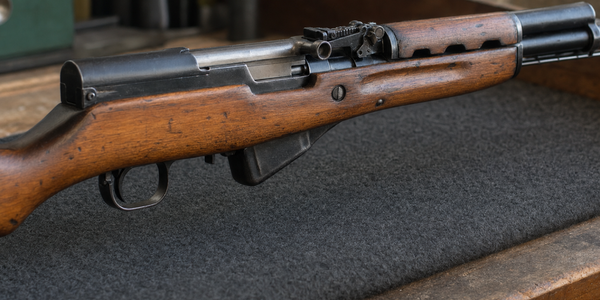
The prize list is the *point*
CCFR's Raining Guns contest worked because it made lawful Canadian firearms ownership visible as regulated property, business support, and ordinary gear culture.

Update, June 9, 2026. Public Safety Canada has extended the relevant amnesty period. The old the former fixed deadline date referenced below is no longer the operative expiry; the amended expiry is 90 days after the Supreme Court of Canada renders its decision.
Opinion. CCFR gave away 100 guns and somehow the most interesting part is the paperwork.
That is not the line the internet will prefer. The internet prefers volume, because volume is easy. A hundred firearms. A national draw. Winners from coast to coast. A contest title built to annoy exactly the people it was meant to annoy.
Fair enough. The bluntness is part of the point.
But the useful part of CCFR's May 6 Raining Guns winners post is not only that 100 names were drawn. It is that the whole thing forces Canadian firearms ownership back into the real world: non-restricted firearms, business donors, PAL holders, eligibility rules, reference numbers, forms, receipts, closed cases, and owners who exist inside one of the most regulated hobby cultures in the country.
Ottawa likes categories. Owners live with objects.
The prize list made the objects visible.
The useful word is non-restricted
The contest rules say the prizes consisted of 100 non-restricted firearms, with an approximate total retail value of $90,000. They also say each $20 donation to CCFR gave one entry, with a no-purchase route through a hand-written 1000-word essay on how to bring about change in firearm regulation and legislation in Canada.
That last detail is beautiful in the driest possible way. Only in Canadian firearms advocacy could a 100-gun giveaway include the sentence: write a long essay about regulatory reform by hand.
The rules also say entrants had to be legal residents of Canada, 18 or older, and that a winner had to possess a valid firearms licence or possession and acquisition licence, as applicable, while complying with federal, provincial, and municipal statutory and regulatory requirements.
So no, this was not a pile of rifles thrown from a parade float.
It was a contest built around lawful possession, lawful eligibility, and lawful transfer. That matters because "non-restricted" is not a vibes category. It is a legal classification. It means the firearm is not restricted or prohibited, but it does not mean "unregulated", "casual", or "anyone can have it."
The RCMP says a firearm may only be transferred to an adult with a PAL valid for that class of firearm, a licensed business or organization, or a public service agency. For a non-restricted transfer, the transferor must obtain confirmation from the Registrar that the buyer holds, and remains eligible to hold, the appropriate licence. The transfer can happen only after a reference number is issued.
This is the part that disappears in public debate.
The word "gun" does all the emotional work. The lawful process gets cropped out of the photograph.
The contest was a stunt. Good.
There is a respectable criticism of a 100-gun contest, and it should be stated properly.
To people outside the shooting community, the whole thing can look deliberately provocative. Canada is still arguing over gun violence, the federal government is running its assault-style firearms compensation programme, and a national advocacy group announces a contest with a title designed to travel. A critic can say serious advocacy should not lead with spectacle.
That argument is not silly.
It is also incomplete.
The firearms side has spent six years being described through abstractions it did not choose. "Assault-style." "Military-style." "Weapons of war." "No place in our communities." The words are built to do moral sorting before anyone looks at the owner, the licence, the classification, the use case, the transfer history, or the fact that a great many affected people were simply sport shooters, collectors, competitors, hunters, and newer owners who bought lawful property.
Sometimes the answer to abstraction is not another policy paper.
Sometimes the answer is a prize list.
The contest was blunt because the federal argument has been blunt. Ottawa prohibited first, explained later, compensated much later, and left ordinary owners trying to understand what property, accessories, ammunition, platform support, and future use were still worth after a regulation changed the room.
CCFR's contest took the opposite route. It put tangible property in public view and attached it to the regulated culture around it.
That is why it worked as advocacy.
Ottawa argues in categories
Public Safety Canada's current Assault-Style Firearms Compensation Program page says the federal government has banned more than 2,500 makes and models of assault-style firearms since May 2020. It says the individual declaration period has ended, collection and compensation are expected to run from spring to early fall 2026, and owners must dispose of or permanently deactivate affected firearms before the SCC appeals + 90-day amnesty endpoint or risk criminal liability.
That is the federal frame: category, prohibition, compliance.
The May 1, 2020 Canada Gazette notice used the earlier number of approximately 1,500 models and described the government's view that the prescribed firearms were not reasonable for hunting or sporting purposes. Later federal changes expanded the lists. The argument has remained recognizably the same: these firearms are categorically unsuitable, and the state will decide the path out.
Holdover's position is different.
The serious question is not whether government can regulate firearms. Canada already does that heavily. Training, licensing, storage, transfer verification, registration for restricted and prohibited firearms, transport rules, and continuous eligibility screening are the Canadian model. Serious owners know this because they live in it.
The question is whether policy aimed at public safety keeps choosing the most visible lawful population because it is easier to administer against.
That is why a 100-gun contest matters more than it first appears to.
It shows the lawful side as a living market and culture, not as a residue left over after Cabinet writes a schedule. Business members donated. Licensed adults entered. Winners now move through the rules. The firearms are not rhetorical symbols floating in a ministerial sentence. They are specific items with value, donors, recipients, paperwork, and legal requirements.
Policy dislikes specificity when specificity complicates the speech.
The business support matters
CCFR thanked the business members who made the contest possible. That detail deserves more attention than the title.
Canadian firearms retailers, importers, ranges, trainers, gunsmiths, clubs, and accessory suppliers live in the same pressure field as owners. They deal with changing classifications, frozen categories, inventory risk, payment friction, shipping constraints, public misunderstanding, and customers trying to make rational decisions in a market where the legal weather can change faster than the component supply.
When businesses donate to an advocacy fundraiser, they are not only moving product.
They are saying the market still exists.
That matters for newer shooters. A new owner sees politics first because politics is loud. What they often do not see yet is the ecosystem underneath the first purchase: the shop that answers the classification question, the range that handles new members, the business that knows transfer timing, the importer trying to keep non-restricted options available, the club volunteer who has heard the same beginner question 400 times and somehow still answers it like a human being.
The community is not an internet comment section. It is infrastructure.
That infrastructure is harder to dismiss when it shows up as donors, prizes, rules, and winners.
New shooters should learn from it
For newer PAL holders, the Raining Guns contest is a useful object lesson.
Not because contests are the centre of the sport. They are not. The centre is still the range day, the rifle that turns out to be better than expected, the .22 that humbles everyone, the optic that tracks, the notebook that catches your lies, and the slow realization that "good enough" is doing a suspicious amount of work in your groups.
The lesson is that Canadian firearms ownership is always gear plus system.
You are not only buying a rifle. You are buying into a classification category, a transfer process, a storage obligation, an ammunition supply chain, a retailer relationship, a range culture, and a political file that can reach into the safe years after the receipt fades.
That should not make new shooters anxious. It should make them literate.
Know what you are buying. Keep documents. Understand the class. Learn which parts of the process are law, which are store policy, which are range policy, and which are forum folklore with a hat on. Pay attention to the difference between a firearm that is lawful to own, a firearm that is sensible to buy, and a firearm whose future depends on the next regulatory imagination exercise in Ottawa.
The Raining Guns contest puts that whole lesson in one package.
It looks loud from the outside. From the inside, it looks familiar: paperwork, eligibility, businesses, transfers, and people excited about ordinary firearms because ordinary firearms are still worth defending.
A prize list is not a loophole
The lazy read will be that CCFR found a way to make guns rain across the country.
The better read is that the contest depended on the existing lawful system from start to finish.
That is not a loophole. That is the point.
Canadian firearms owners are not asking to be invisible. Most of them are already visible to a degree that would surprise any normal person outside the sport. Their licences renew. Their eligibility is screened. Their restricted firearms are registered. Their non-restricted transfers require licence confirmation. Their clubs keep records. Their ranges have rules. Their businesses hold licences. Their purchases leave receipts. Their mistakes are expensive.
That is the world the contest moved through.
The public-safety argument against lawful gun culture often relies on flattening all of that. It takes the most regulated version of civilian firearms ownership in North America, crops out the regulation, and then presents the remaining object as if it arrived in the mail by magic.
It did not.
It arrived through a system.
That system is imperfect, irritating, slow, sometimes arbitrary, and frequently designed by people who appear to believe that users are a rumour. But it is real. It is not a fantasy of unregulated ownership. It is not an American import wearing a Canadian hat. It is the Canadian model, with all of its forms and all of its frictions.
So when an advocacy group says, loudly, "Here are 100 lawful non-restricted firearms," the answer should not be theatrical fainting.
The answer should be: show me the rules.
CCFR did.
The thing Ottawa keeps missing
The contest will not change the federal firearms file by itself. A prize list is not a court decision. It is not a regulation. It is not a parliamentary vote. It does not solve the compensation programme, the amnesty deadline, the OIC problem, the FRT problem, or the habit of writing policy at the level of slogan and fixing the consequences later.
But it does one thing very well.
It reminds people that lawful firearms ownership in Canada is not an abstraction waiting to be managed by people who dislike it.
It is a culture of objects, records, businesses, range bags, club nights, family hand-me-downs, new purchases, first rifles, borrowed advice, mediocre groups, better groups, handwritten notes, components, optics, safes, and receipts. It is annoying, expensive, regulated, and still somehow full of people who will line up to support a legal fight because the alternative is to be politely regulated out of public visibility.
That is why the prize list is the point.
Ottawa keeps trying to make the gun disappear into a category.
CCFR put it back on the table.
A hundred lawful firearms is not chaos.
It is evidence of a community that still knows what it is.
Sources
- Canadian Coalition for Firearm Rights, Raining Guns Contest Winners, published May 6, 2026, accessed May 7, 2026.
- Canadian Coalition for Firearm Rights, 2026 It's Raining Guns Contest, accessed May 7, 2026.
- Canadian Coalition for Firearm Rights, Contest Rules - It's Raining Guns, dated January 2026, accessed May 7, 2026.
- RCMP, Licensing information, date modified March 7, 2024, accessed May 7, 2026.
- RCMP, Buying and selling (transferring) firearms, date modified November 5, 2025, accessed May 7, 2026.
- Public Safety Canada, Assault-Style Firearms Compensation Program, date modified April 21, 2026, accessed May 7, 2026.
- Canada Gazette, SOR/2020-96, Regulations Amending the Regulations Prescribing Certain Firearms and Other Weapons, published May 1, 2020, accessed May 7, 2026.
The amnesty file is still moving.
If this piece sent you back to government pages, do not wait for the next portal, Gazette, or court move to find you by accident.
The Dispatch follows Public Safety, RCMP, Canada Gazette, court, compensation, collection, and amnesty updates so the next change comes with the source that moved.
Safety note: the tracker is a worksheet for source hygiene, not legal advice or a substitute for current official guidance.