At Canada's Steel Challenge Nationals, the fifth plate stops the clock
Canada's Steel Challenge Nationals put eight stages and a 195-round minimum into half a day. Five plates make each string, and a miss adds three seconds.

Five white plates stand in front of every Steel Challenge shooter. Four can be hit in any order. The fifth ends the string.
That last target is the stop plate. Canada's National Steel Challenge Championships are running August 15-16 at the Buffalo Target Shooters Association's Homestead Range in Kananaskis, Alberta. The organizer has all eight standard stages packed into four half-day sessions. The official Steel Challenge Shooting Association listing puts the clean minimum at 195 rounds.
Clean is doing a lot of work in that sentence. A missed standard plate adds three seconds, and the shooter still needs another round for the correction.
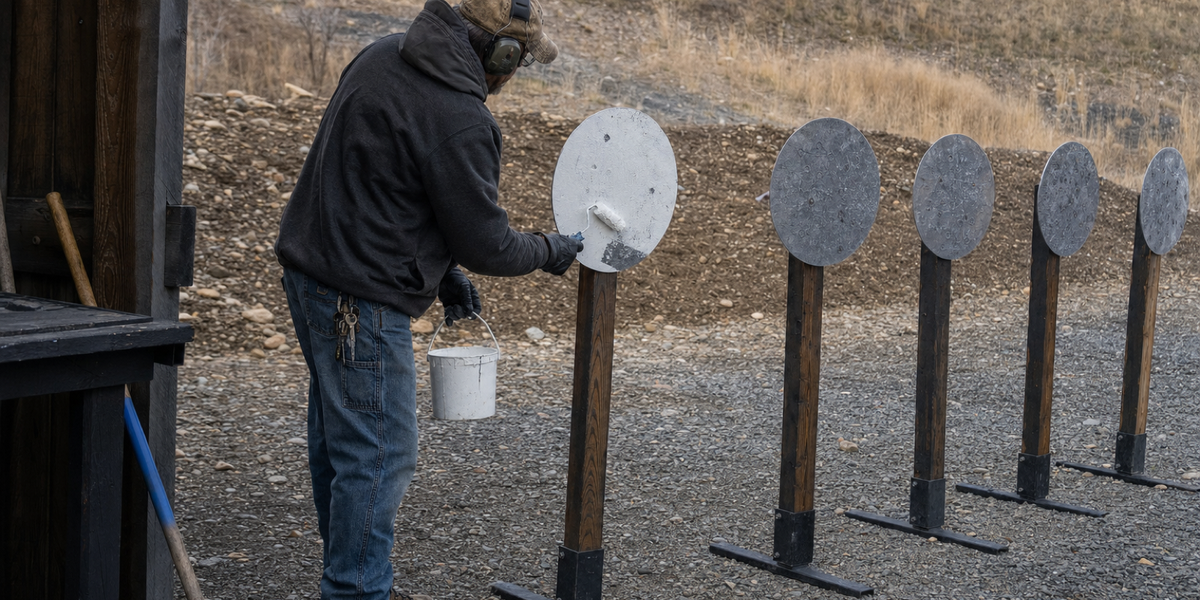
The feature is a representative generated plate-maintenance scene supplied by Steve Coppola. The volunteer, range, plates, and session are fictional and separate from Homestead Range, BTSA, and the 2026 championship.
Five plates make one string
Steel Challenge has a useful scoring engine because a new spectator can understand it before the next shooter steps into the box.
Each stage presents five static steel plates. Four are available in any order. The stop plate comes last and ends the recorded time. A clean string is simply the elapsed time required to hit all five in that sequence.
The penalty turns a visible mistake into a blunt number. Each standard plate left unhit before the stop plate adds three seconds to the raw time. An incomplete string receives 30 seconds. The lowest combined time wins.
Seven of the eight standard stages are shot as five strings. The best four times become the stage score, which gives the shooter one string to discard. Outer Limits uses four strings and keeps the best three. It is also the one standard stage with movement, roughly three metres between shooting boxes in the organizer's explanation.
The discarded string helps. The first four still carry pressure. A shooter who spends three seconds on a miss has to decide whether that string becomes the throwaway or whether a later run will cost even more.
The clean minimum is 195
The arithmetic explains the official round count.
Seven stages at five strings and five required hits consume 175 rounds when every shot finds steel. Outer Limits adds four strings of five for another 20. That produces 195 rounds per gun.
The organizer tells competitors to bring extra and recommends double the minimum. That advice sounds extravagant until one missed plate turns into one more shot, one longer string, and three seconds on the score sheet. A reshoot or equipment problem can make the clean arithmetic even less useful as a packing number.
The current championship charges $35 per gun. Shooters can enter as many as two guns in one session, with a separate entry for each gun or division. The match is a Level 3 championship, so entrants need current USPSA/SCSA membership or membership in their home IPSC region.
Those details put a boundary around the beginner-friendly scoring. The format is easy to understand. A national championship still expects current membership, safe gun handling, enough magazines or loaders, and enough ammunition to finish the day.
Half a day still needs a squad
Homestead's schedule offers Saturday morning, Saturday afternoon, Sunday morning, and Sunday afternoon sessions. One gun takes one session to complete all eight stages. A shooter can run two guns in the same session.
That is an efficient event. It is also a volunteer machine.
The organizer says squads are self-ROed. The match director manages squadding so each group has enough experienced people to keep stages moving. Someone has to run the timer, confirm hits and penalties, record scores, reset the range, and repaint plates. The half-day promise rests on that work repeating cleanly for every entry.
This is where the feature photograph belongs. Plate paint is ordinary range maintenance, yet it keeps the next hit visible and the next score credible. The timer attracts attention. The person with the roller protects the evidence.
My range clock runs the other way
My usual range day takes four to six hours with three precision rifles. The work is deliberate: breathing, rifle level, barrel heat, and enough space between shots to notice when a decision starts getting loose. Steel Challenge is outside my own match experience.
Its scoring still makes immediate sense to me because every string preserves something a casual range session can hide. Time records the hesitation, the correction, and the plate that needed another look. The score keeps the whole sequence instead of preserving only the best hole on the target.
The discipline runs faster than my normal range rhythm, while the useful habit is familiar. One repeatable process has to survive pressure. A miss needs a specific cost. The next run shows whether the correction held.
The stop plate makes the score honest
A timer can reward speed only after the course defines an ending. Steel Challenge gives that job to one physical target.
Hit it early and every untouched standard plate adds three seconds. Hit it after the other four and the time reflects a complete string. Repeat the stage, discard the slowest run, and carry the best four forward. Outer Limits does the same work with its best three.
The Canadian championship makes the format unusually visible this weekend: eight stages, four half-day sessions, 195 clean rounds, and enough squad labour to keep the plates white and the timer moving.
The fifth plate ends the string. The other four decide what the ending costs.
Sources
- Canadian National Steel Challenge: 2026 championship information
- Canadian National Steel Challenge: new-shooter and scoring guide
- Steel Challenge Shooting Association: major-match listing
- Steel Challenge Shooting Association: official rules
- USPSA/SCSA: March 2026 online Steel Challenge rulebook
Keep the range notes worth reading later.
If this piece has you thinking about range time, keep the notes useful enough to read later.
Use the Holdover Range Bench Log Card to record rifle, optic, ammunition, distance, weather, zero, group notes, correction, and next test without turning a range trip into a memory test.
Safety note: the card is a note-taking worksheet, not shooting instruction, load data, legal advice, or a substitute for range rules, official guidance, manufacturer manuals, or qualified instruction.