Inside the *211,000-record table* behind your rifle's class
Canada's firearm table is administrative, enormous, and practically decisive. A promised classification review should make its reasoning visible.

Opinion / Canadian Context. Every time I check a rifle for Holdover's Ban-Risk Tracker, three records have to agree: the current Firearms Reference Table entry, the governing legal text, and the model information in the market. That routine reveals the awkward centre of Canadian firearm classification.
The RCMP's new 2025 report puts a scale on it. The Firearms Reference Table holds more than 211,000 individual records. During 2025, staff added 3,382 and updated 1,491. The public PDF alone is 231 MB. Its latest posted version was updated July 16, 2026.
This is a vast technical system behind an ordinary question at the gun counter: what class is this rifle?
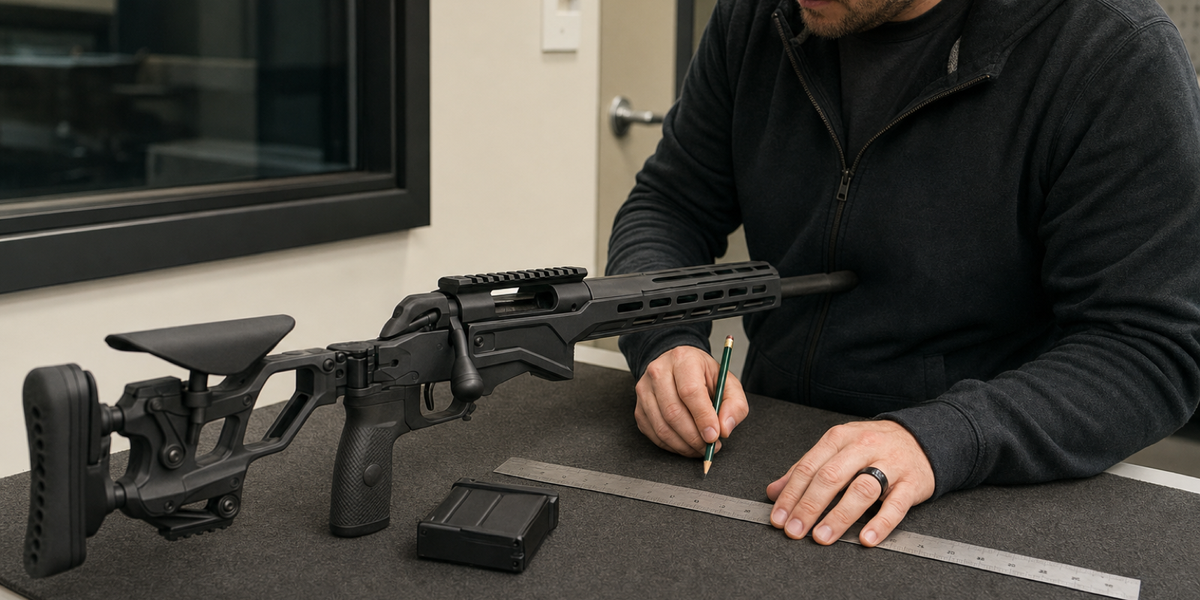
Holdover produced the feature as a fictional Canadian importer inspection scene, reference-grounded to current Cadex manufacturer views for generic modern chassis-rifle geometry. It does not depict an RCMP facility, an official classification decision, an exact product, Steve's rifle, or an actual event.
The law and the table do different work
The RCMP's own public guidance draws the line clearly. A firearm's class comes from subsection 84(1) of the Criminal Code and corresponding regulations. Parliament and the Governor in Council change those criteria.
RCMP firearms experts maintain the FRT as an administrative document. They conduct technical assessments under those legal definitions so police, customs officers, firearm verifiers, and regulatory officials can identify and classify firearms consistently.
The legal hierarchy is clear. The practical experience is more complicated. Owners, businesses, importers, verifiers, and police still need a usable answer for a specific make, model, variant, and design. The FRT is where much of that answer gets organized.
The RCMP also explains why an answer can move. A manufacturer's information may prove incomplete after inspection. Authorities may discover that a design can be modified in a way that affects classification. A later shipment can contain a design change that puts the newer version in a different class.
Those are legitimate technical problems. They also create real consequences for someone who purchased through a licensed business using the information available that day.
The strongest government case starts earlier
The federal government's best response is to move the technical review ahead of the sale.
A December 2024 Canada Gazette Part I proposal would require domestic manufacturers and importers to give the Registrar technical information before manufacturing a batch or importing a shipment. The proposed fields include make, model, action, calibre, capacity, barrel length, overall length, stock type, magazine details, markings, and design evidence.
That is a sensible direction. Better information before rifles reach the counter could protect the owner as much as the regulator. It could catch an incomplete description, a new variant, or a material design change before a good-faith buyer relies on an old answer.
The Gazette source located for this article is a Part I proposal after a 45-day consultation. Its measures stay labelled as proposals here. The proposal also says it would leave classification criteria unchanged. It improves the input to the system; it does not settle how the system explains an output or corrects one.
Simplicity requires visible reasons
In December 2025, Public Safety Minister Gary Anandasangaree said the government would launch a comprehensive classification review built around "simplicity and consistency." He promised an expanded advisory group and dedicated First Nations, Inuit, and Métis consultations, including on the SKS.
A January 17, 2026 government release repeated that future-tense commitment. The July 25 currency search for this article found no newer official launch notice. The promise therefore remains the current public benchmark I can find.
Simplicity means more than compressing 211,000 records into a cleaner download. For an owner or business, a classification system earns trust when four things are visible:
- Criteria. Link the material technical finding to the exact legal
definition or prescribed listing.
- Reasons. Publish a plain-language explanation for a new entry or a
material change, with the evidence relied upon.
- Correction and review. Provide a documented route to fix factual errors
and seek independent review of a disputed technical conclusion.
- Service and notice. Set timelines, preserve version history, and directly
notify affected businesses and known owners when a material answer changes.
The CFP's own 2025 report says the program supports lawful ownership, fair treatment, clear reporting, and service that is modern, efficient, and simple. Those commitments fit this work exactly.
Give the owner the file behind the answer
Canada needs capable technical assessment. Importers should provide complete design information before a shipment reaches the market. Inspectors should be able to correct an answer when the physical firearm proves the original description wrong.
The owner should also be able to see how the conclusion was reached.
That is the useful standard for the promised review. Keep the legal criteria where Parliament and regulation place them. Make the technical reasoning auditable. Give factual corrections a defined path. Announce material changes with enough time and detail for licensed people to comply.
A table with 211,000 records can help deliver consistent answers. Visible reasons determine whether those answers deserve confidence.
Sources
- Royal Canadian Mounted Police, 2025 Commissioner of Firearms Report, published 2026.
- Royal Canadian Mounted Police, Firearms Reference Table, modified July 21, 2026.
- Royal Canadian Mounted Police, Classifying and re-classifying firearms, modified October 25, 2024.
- Canada Gazette, Part I, Regulations Amending the Firearms Licences Regulations, December 28, 2024.
- Public Safety Canada, Statement by Minister Anandasangaree on strengthening firearms regime, December 5, 2025.
- Public Safety Canada, Government opens the compensation program to all individual firearms owners, January 17, 2026.
Keep the score changes close.
If this piece put Ban-Risk on your radar, get the update note when the index changes.
The Dispatch is the low-noise path for Ban-Risk score changes, source updates, amnesty timeline changes, and the Canadian firearms policy notes that move the file.