8,589 declared firearms are in the *footnote*
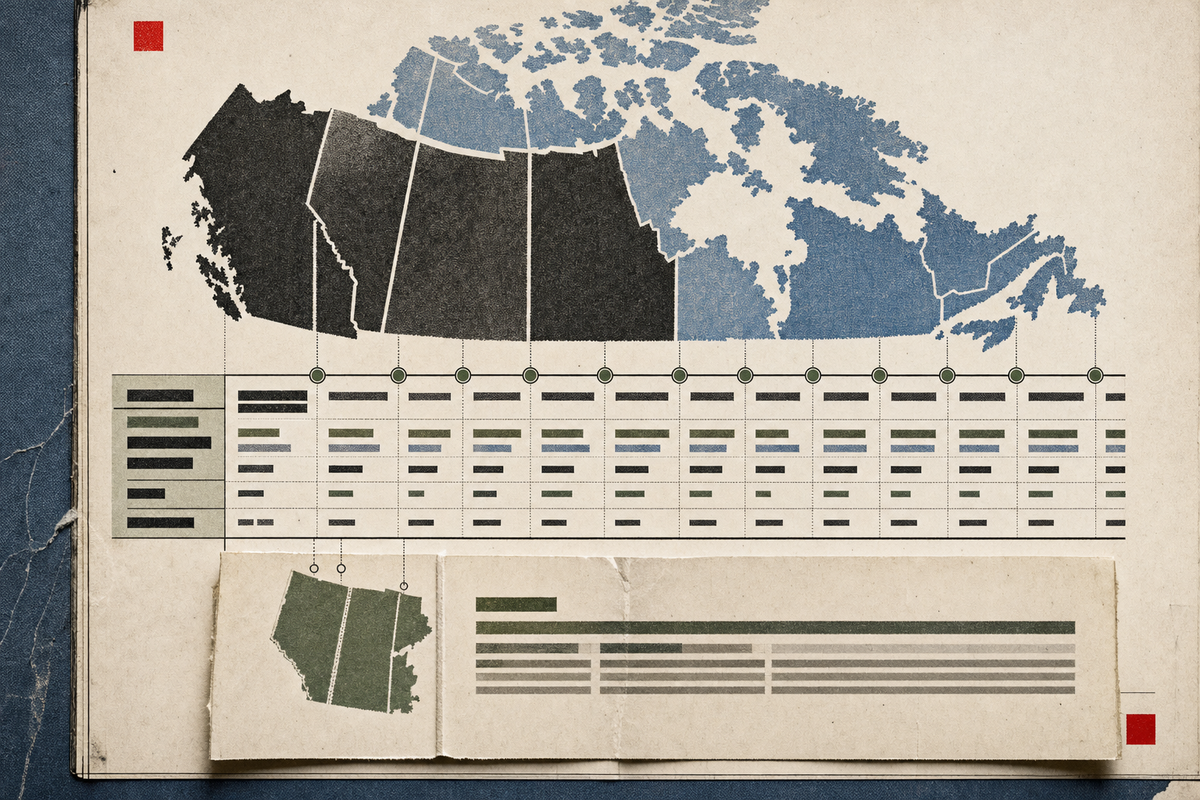
Public Safety posted the ASFCP collection timeline. Alberta and Saskatchewan are not in the table, even though 8,589 declared firearms sit there.

Opinion. Public Safety Canada's new collection timeline is most revealing where it stops listing provinces.
Update, June 9, 2026. Public Safety Canada has since announced that the 2020, 2024, and 2025 Amnesty Orders have been extended and are set to expire 90 days after the Supreme Court of Canada renders its decision, expected next year. The collection-map problem described below still stands, but the old fixed the former fixed deadline amnesty date is no longer the operative expiry.
The page is supposed to tell Canadians when and where firearms declared under the Assault-Style Firearms Compensation Program will be collected. British Columbia gets May to September. Ontario gets June to October. Quebec gets June to September. Prince Edward Island, somehow, is still listed as April to June, which is a brave thing to say on June 8.
Alberta and Saskatchewan are not in the table.
They appear under the asterisk, in a note telling residents to consult their provincial governments for laws or regulations that may impede or limit participation in the program. Public Safety's own declared-firearms table puts 7,334 declared firearms in Alberta and 1,255 in Saskatchewan. That is 8,589 declared firearms sitting outside the schedule.
If a reloading record had a missing column that obvious, no serious person would call it complete.
A schedule is supposed to reduce uncertainty
The strongest version of the federal argument is easy to understand. This is a complicated national logistics problem. Public Safety is trying to move prohibited firearms through appointments, transport kits, verification, validation, destruction, and payment, while dealing with different police services and provincial rules. The June 5 collection page says owners are supposed to wait for notification, accept a funding agreement, book an appointment, receive a transportation kit, and bring PAL plus photo ID to the confirmed appointment.
Fine. Curbside recycling this was never going to be.
But that is exactly why the schedule matters. If the program needs the owner to follow the sequence precisely, the sequence has to be precise enough to follow. Public Safety's own page says collection locations are assigned by postal code, appointment availability may be limited in a given area, and all collected firearms are to be destroyed before the amnesty expires. As of June 9, that expiry is no longer the former fixed deadline; it is 90 days after the Supreme Court of Canada renders its decision.
That is a lot of deadline pressure to put on a table with two provinces under the asterisk.
Footnotes are where confidence goes
Alberta and Saskatchewan have not vanished. Their declared firearms are counted on the April 1 page. Their owners were eligible to declare during the national window. Their provinces are central to the political and legal fight over the buyback. Public Safety knows they exist.
That is why the footnote is so useful.
Government pages are usually written to avoid drama. They do not pound the table. They move discomfort into passive sentences, neutral headings, and small notes below the part most people read. In this case, the main table says where collection is expected to occur. The note says, in effect, that two provinces require their own source check.
Saskatchewan's own materials make the conflict visible. The Saskatchewan Firearms Office says participation in the federal program remains available, while also pointing residents to its Firearms Verification and Appraisal Service for appraisals, certificates of exemption, and storage options. Saskatchewan says compensation remains uncertain and first-come, first-served. Ottawa says consult the province.
That is not a tidy national collection pathway. That is federal policy meeting provincial resistance and leaving the owner to read both pages.
The wrong people get the hard homework
This is where the policy loses me.
The person reading these pages is the regulated owner, not the criminal supply chain. He took the course, got the licence, bought inside the system, stored inside the system, read the prohibition lists, declared through a federal portal, and is now being told to understand a national table, a provincial footnote, a funding agreement, a transport kit, a postal-code assignment, and an amnesty clock.
The RCMP's 2024 Commissioner of Firearms Report counted 2,425,627 firearms licence holders in Canada. It also describes a regulatory system of licensing, continuous eligibility screening, CFO oversight, range approvals, business inspections, licence revocations, authorizations, registration, transfer checks, and portal messaging.
Canada already knows how to find licensed owners. That has always been the easy part.
The hard part is showing why loading more uncertainty onto that population is a serious public-safety strategy. The federal government says the program removes dangerous "assault-style" firearms from communities. That is the argument Ottawa chose. But when the operational page turns 8,589 declared firearms into a footnote, the administrative machine starts arguing against its own confidence.
I spend enough time around range bags, online orders, load notes, optics choices, and source checks to know the type. Serious owners ask boring questions before doing expensive things. What exactly does this page say? What date was it modified? Which number is current? Which claim came from a source and which came from a comment thread? Annoying questions, yes. Also the questions that keep you from doing something stupid because a confident stranger was typing quickly.
What a new owner should learn from this
If you are newer to Canadian firearms ownership, this is part of the sport now.
Your first year should be mostly about courses, range etiquette, storage habits, optic choices, ammunition cost, recoil reality, and why your first five-shot group looked better before you fired shot six. It should require far less time reading Public Safety page details.
But the country we have is the country we shoot in.
The lesson is not panic. Panic is how people confuse comments with sources and predictions with facts. The lesson is source literacy. Read the page. Read the date. Read the table. Read the footnote. Compare it with the province. Then decide what the official record actually supports.
The new timeline supports one plain finding: the buyback has entered its collection stage without a clean national collection map. That matters whether you own an affected firearm or not, because it tells newer shooters something about the regulatory environment around every future purchase. A lawful firearm can become a policy problem. A policy problem can become a portal row. A portal row can become an appointment. An appointment can become a footnote.
Rows would have been clearer
Public Safety could have listed Alberta and Saskatchewan in the table and written a plain status beside each one. It could have said collections are not currently scheduled in those provinces, or pending provincial-law resolution, or available only through some future federal route. It could have given affected owners a direct operational status in the same place it gave Ontario a five-month window.
Instead, the two provinces sit below the table, in softer language.
That is the problem with the whole OIC and buyback era in miniature. Licensed owners are expected to be precise. The state reserves the right to be approximate.
If the programme had the answer, Alberta and Saskatchewan would be rows.
The table is the message. The footnote is the admission.
Sources
- Public Safety Canada, Firearm collection timeline in Canada: Assault-Style Firearms Compensation Program, date modified June 3, 2026.
- Public Safety Canada, Collection and other disposal options, date modified June 5, 2026.
- Public Safety Canada, Number of assault-style firearms declared by province and territory, date modified April 1, 2026.
- Public Safety Canada, Firearms Buyback Program - Assault-Style Firearms Compensation Program, date modified June 3, 2026.
- Public Safety Canada, Firearms compensation program for businesses closes - Amnesty period extended due to the Supreme Court of Canada process, June 9, 2026.
- Government of Saskatchewan, Firearms Verification and Appraisal Service, accessed June 8, 2026.
- RCMP, 2024 Commissioner of Firearms Report, accessed June 8, 2026.
- Reddit r/canadaguns, ASFCP: new page showing collection schedule by province; AB and SK excluded, June 7, 2026.
The amnesty file is still moving.
If this piece sent you back to government pages, do not wait for the next portal, Gazette, or court move to find you by accident.
The Dispatch follows Public Safety, RCMP, Canada Gazette, court, compensation, collection, and amnesty updates so the next change comes with the source that moved.
Safety note: the tracker is a worksheet for source hygiene, not legal advice or a substitute for current official guidance.