An American label, an Australian origin
Finance Canada's new counter-tariff list works by tariff item and origin. Its current table has no 36.01 propellant-powder entry, while Hodgdon says H4350 is made in Australia.

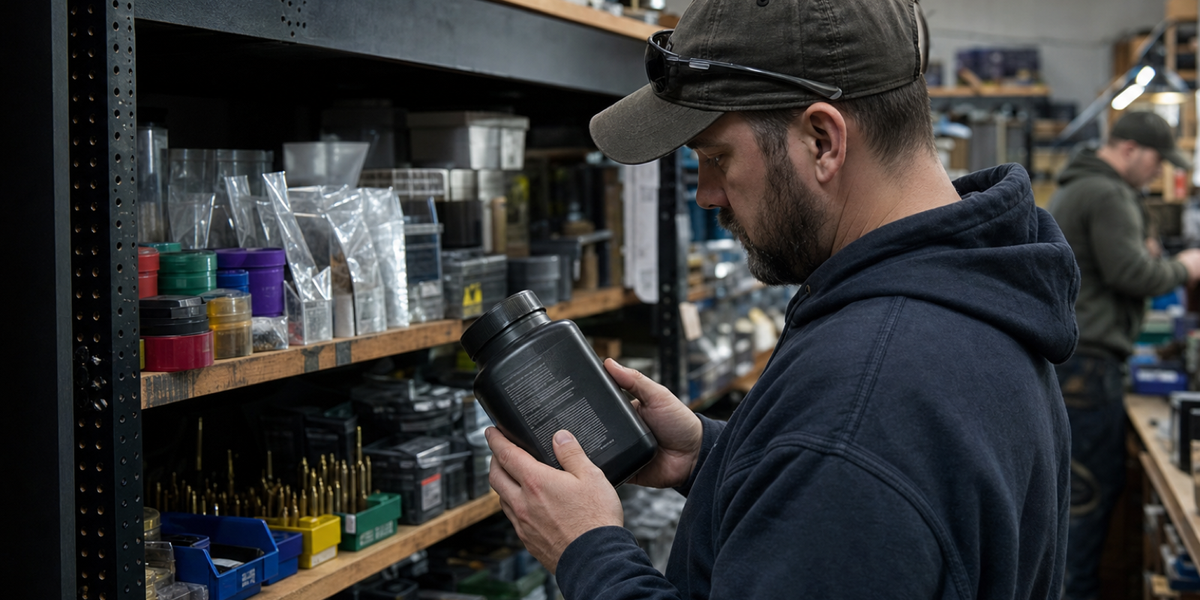
Handloading. Finance Canada has published the tariff items for the counter-tariffs due to start at 12:01 a.m. on September 8. For a handloader, that table is more useful than a brand biography.
The new measure applies to goods that originate in the United States under the CUSMA marking-origin rules. Finance also published the tariff items rather than a broad catalogue of brand names. That leaves the first supply-chain question in a very ordinary place: country of origin, then classification.
Hodgdon's own material supplies a useful example. The company says its Extreme line, including H4350, H4831, H1000, and Varget, is manufactured in Australia. A bottle may carry a familiar American brand while the underlying manufacturing story reaches somewhere else.
That distinction has just become practical reading.
The table comes first
Finance Canada's August 25 backgrounder says the September 8 counter-tariffs will carry 15, 25, or 50 per cent rates, matching the applicable American rate for the same goods. The department says the measures cover $27.6 billion in U.S. imports and directs readers to the tariff-item table.
The current published table has no entry for heading 36.01, the heading for propellant powders. That gives a Canadian handloader one immediate, bounded conclusion: the list itself has not placed that heading among its new entries.
The conclusion ends there. A specific shipment still depends on its own tariff classification and origin treatment. A retailer or importer can answer that question from the product and import record; a photograph of a front label cannot.
This is why the item table matters. It tells readers where to look before a guess turns into a price forecast.
A familiar name can travel
Hodgdon's article about Winchester StaBALL Match says the company's Extreme powders are manufactured in Australia. It names H4350, H4831, H1000, and Varget. Those names show how much supply-chain context can sit behind a familiar label. A label alone leaves the route unfinished.
I have heard that shelf-side shortcut often enough to recognize it: a familiar name becomes an instant answer about where the component came from. A component can pass through a brand owner, a producer, a distributor, a Canadian importer, and a retailer before it reaches a shelf. Every stop may matter to availability and price. The tariff rule asks a narrower question: whether the goods qualify as originating in the United States under the applicable origin rules.
The brand owner, retail shelf, and origin rule each answer a separate question. The gap between them is usually invisible until a new tariff schedule makes it expensive to ignore.
Origin has a rule behind it
Canada's Marking of Imported Goods Regulations require marking that indicates a good's country of origin to the ultimate purchaser or recipient. The CUSMA origin regulations set out the tests used for goods imported from a CUSMA country. Depending on the goods, those tests involve where they were wholly produced, domestic materials, or an applicable change in tariff classification.
Finance uses that marking-origin framework for this counter-tariff measure. That makes "American" a term with more work behind it than a corporate mailing address.
Nobody needs to turn a routine powder purchase into a customs seminar. The useful habit is simple: treat a headline, label, and shelf rumour as leads. Then find the tariff item and the origin answer that applies to the actual product.
For a purchase that hinges on the September change, a serious question for the retailer is: what tariff item and declared origin apply to this item? A retailer may need to ask the importer. That is still a better answer than pretending a brand name settles it.
Keep the arithmetic last
The September 8 announcement will generate plenty of component speculation. Some of it will prove right. The current list already gives readers a better order of operations.
Start with the tariff item. Check the origin rule. Ask the importer or retailer for the product-specific answer when the purchase matters. Then count the dollars.
Every label tells part of a supply-chain story. The tariff item and origin rule tell the part that Finance Canada is using.
Sources
- Department of Finance Canada, List of products from the United States subject to counter-tariffs effective September 8, 2026, August 25, 2026. Source of the effective date, rates, item-level table, scope, origin language, and 36.01 table check. Retrieved August 26, 2026.
- Department of Finance Canada, Canada announces targeted countermeasures and substantive support for workers and businesses in response to U.S. tariffs, August 25, 2026. Context on the announced measure and remission framework. Retrieved August 26, 2026.
- Justice Laws Website, Marking of Imported Goods Regulations, section 3, current to June 21, 2026. Source of the general country-of-origin marking rule. Retrieved August 26, 2026.
- Justice Laws Website, Determination of Country of Origin for the Purpose of Marking Goods (CUSMA Countries) Regulations, sections 3-4. Source of the CUSMA marking-origin framework. Retrieved August 26, 2026.
- Hodgdon Powder Company, Winchester's Brand-New StaBALL Match Powder. Manufacturer statement that the Extreme line, including H4350, H4831, H1000, and Varget, is manufactured in Australia. Retrieved August 26, 2026.
Keep the component change in the record.
The Load Development Worksheet gives you a clean place to record a component lot, conditions, and the next verified test.