In an apartment, an eight-pound jug leaves three pounds
Section 302 gives a non-detached dwelling a 20 kg smokeless-powder limit until any one container holds more than 1 kg. Then the total ceiling is 5 kg.

Handloading / Canadian Context. Natural Resources Canada's page on buying, selling, and storing smokeless powder carries an August 7, 2026 date-modified stamp. The page gives four storage figures for an unlicensed user: 25 kg, 20 kg, 5 kg, and 75 kg.
Only one of them governs the powder on a particular shelf. The building and the container decide which one.
For a Canadian handloader living in an apartment, the container question can change the total by 15 kg. A nominal eight-pound jug is enough to do it.
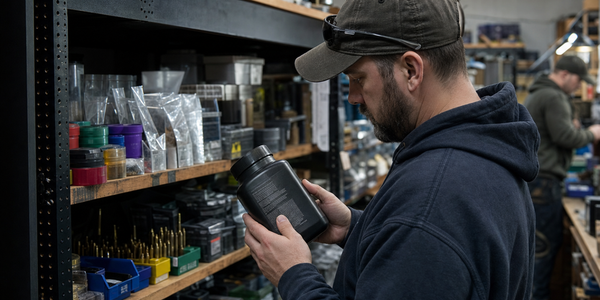
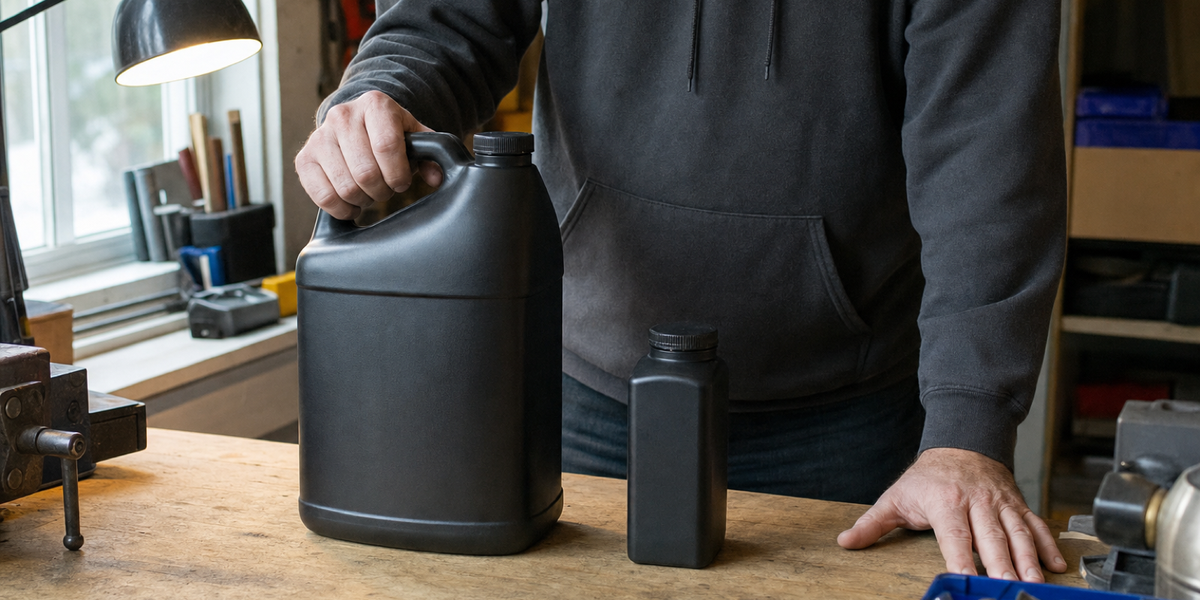
Holdover produced the feature as a fictional handloader comparing two sealed factory powder containers. The person, bench, and containers are representative and show no named product or actual purchase.
Section 302 has two branches
The Explosives Regulations, 2013 use dwelling other than a detached dwelling. NRCan translates that category for readers as an apartment, condominium, or townhouse.
Section 302(1)(a) allows up to 20 kg of smokeless powder when every container holds no more than 1 kg. That is about 44.1 pounds in total.
Section 302(1)(b) sets a 5 kg total when any of the smokeless powder is in a container holding more than 1 kg. That is about 11 pounds.
The regulation measures powder mass, so the metric figures govern every one of these comparisons.
The larger container changes the ceiling for all the smokeless powder stored there. It does not create a separate allowance for the jug.
That distinction is easy to miss because both branches appear inside the same subsection and both apply to the same kind of powder.
The common nominal sizes make the effect plain. A one-pound bottle contains about 454 grams, which stays under the 1 kg container threshold. An eight-pound jug contains about 3.63 kg, which crosses it.
One eight-pound jug plus three one-pound bottles contains about 4.99 kg. That combination comes within 11 grams of the 5 kg ceiling. The jug leaves roughly three pounds of room.
The other figures belong to other places
Section 301 sets a 25 kg ceiling for propellant powder in a detached dwelling, or in a storage unit attached to one. No more than 10 kg of that total may be black powder. A handloader keeping only smokeless powder could reach the full 25 kg, about 55 pounds, without the container-size branch used in section 302.
Section 303 covers storage units that are not attached to a dwelling. It allows up to 75 kg of smokeless powder and 25 kg of black powder. The regulation aggregates the amount across all such units, so a second shed does not double the allowance.
Those four numbers describe different storage conditions. A retailer's 75 kg detached-storage figure says little about the legal room in a customer's apartment.
The store records the container
The regulation already treats container size as a material fact at the counter. Section 295 requires a seller to keep a two-year record of each propellant-powder sale. The record includes the product name, container size, quantity, date, buyer's name, and the number of the credential used for the purchase.
Section 292(2) also says a seller must not sell an unlicensed buyer more powder than the buyer is authorized to store.
NRCan's current page repeats that duty. Its seller section then says the maximum quantity authorized for smokeless powder is 75 kg. That sentence gives the largest of the four figures. It does not put the customer's dwelling or the 1 kg container threshold beside it.
The seller cannot see the powder already at home or establish a building type from a licence card. The buyer has to bring those facts to the counter.
Original containers keep the math visible
Section 299 says smokeless powder must remain in its original container or in small arms cartridges. That rule preserves the manufacturer's container size and keeps the section 302 calculation legible.
My bench has a dedicated humidity-controlled locked storage box. The rule that surprised me lives outside that box: for a non-detached dwelling, one large container changes the total allowed inside it.
The practical inventory needs only three columns: location, container size, and powder mass. Record every unopened jug as well as the bottle in use. Convert the nominal pounds to kilograms because the regulation is written in kilograms. Recalculate before buying a container over 1 kg.
For an apartment handloader, switching from one-pound bottles to an eight-pound jug can reduce the ceiling from 20 kg to 5 kg before the cap is opened.
A limit many benches will never reach
Canadian powder supply and price may keep most hobby inventories well below either ceiling. A handloader buying one or two bottles at a time can treat the figures as remote. The detached-storage allowance of 75 kg sits far beyond a typical bench.
The section 302 trigger still matters because it works at ordinary retail scale. One bulk jug can change the applicable total while the buyer remains far below 20 kg. The legal consequence comes from packaging, not from a room full of powder.
The current Justice Laws consolidation says it is current to June 14, 2026, and last amended May 3, 2024. NRCan's page was modified August 7 and presents the same user thresholds. The regulation is the useful checklist because it keeps every number attached to its condition.
Before a bulk price settles the purchase, read the line that governs the building. In an apartment, the eight-pound jug leaves room for about three more pounds, not another 36.
Sources
- Explosives Regulations, 2013, sections 295 to 305
- Explosives Regulations, 2013, sections 276 to 294
- Explosives Regulations, 2013, full consolidation
- Natural Resources Canada: Buying, selling and storing smokeless powder
- Canada Gazette: SOR/2024-77
Keep the range notes worth reading later.
If this piece has you thinking about range time, keep the notes useful enough to read later.
Use the Holdover Range Bench Log Card to record rifle, optic, ammunition, distance, weather, zero, group notes, correction, and next test without turning a range trip into a memory test.
Safety note: the card is a note-taking worksheet, not shooting instruction, load data, legal advice, or a substitute for range rules, official guidance, manufacturer manuals, or qualified instruction.