Inside the *180,000-firearm* buyback estimate
Reading federal buyback figures takes care. Owners deserve clear dates, useful definitions and an honest account of what each number measures.

Opinion
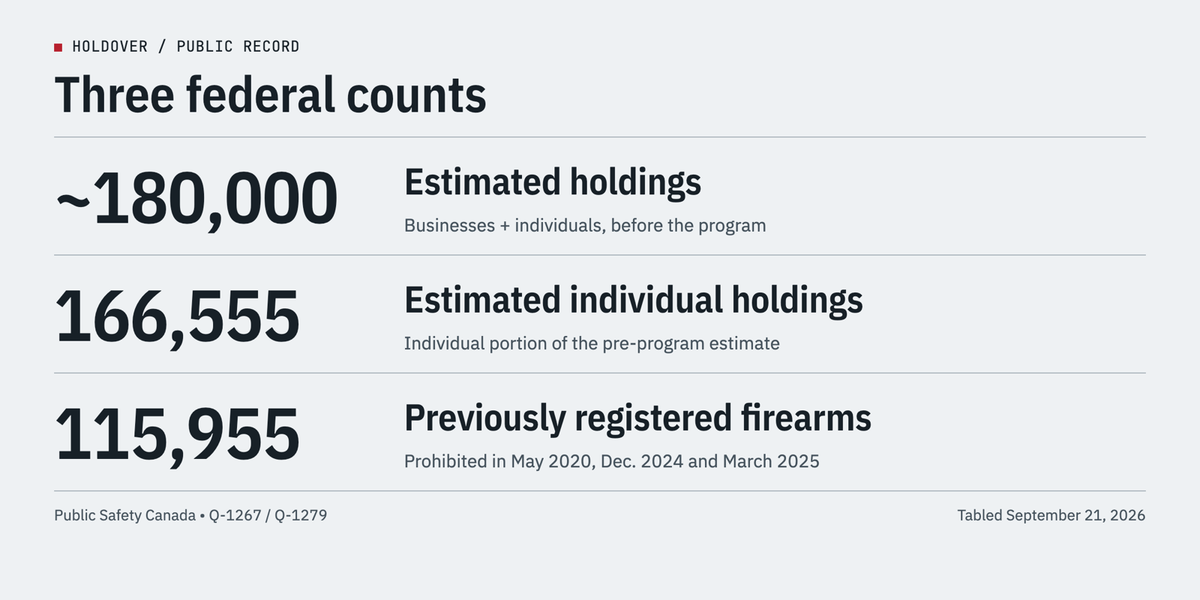
Public Safety Canada estimates pre-program holdings at about 180,000 firearms, including 166,555 with individuals, in a written answer tabled September 21. Those figures give readers a clearer starting point for examining Ottawa's buyback, provided the definitions stay attached.
The answers improve the public record. They still leave several steps between a national estimate and a reliable account of completed collections.
For licensed owners, those steps matter. We are expected to know the status of our property, supply the right identifiers and follow the required process. I expect comparable care in the figures used to describe what the government has accomplished.
A declaration snapshot from June
Bob Zimmer's Q-1267 reports 68,793 firearms declared by June 22: about 41 per cent of estimated pre-program individual holdings.
Calling that a current compliance rate would require evidence about what happened afterwards and how owners used other lawful disposal routes. Counting completed destruction would require a different record again. A percentage can look finished long before the reporting behind it is.
The public provincial declaration table still displays 68,717 firearms as of June 8. The parliamentary answer's later snapshot is 76 higher. The dates explain why readers should resist treating two different totals as an automatic contradiction. Neither figure measures completed September disposals.
Public Safety should make this reading easier. Put the measurement date next to the number, identify the population, and distinguish an application from an accepted claim and a completed disposition. Those ordinary reporting choices would save owners from reconstructing the program across web pages and parliamentary replies.
Previous registration has a separate meaning
Alex Ruff's Q-1279 reports 115,955 previously registered firearms, without a business/individual split or common-date reconciliation with the estimate. Subtraction cannot establish an unregistered population.
That restraint cuts both ways. An unexplained relationship deserves a question. It does not establish a mathematical scandal. Publishing a neat remainder would add precision the source has not earned.
I remember explaining the distinction between licence verification and a firearm registry during a private-sale conversation. The paperwork matters, but each record answers a particular question. That experience makes me fussy about what a database can actually establish. A count becomes useful when I know what qualified an entry to be included.
The government could publish a short definitions note beside these figures: reference date, included prohibition waves, treatment of business inventory and treatment of firearms already disposed of. Readers could then compare the measures without guessing which assumptions the department used.
How the two systems exchange information
Ruff's follow-up adds detail to the earlier answer behind Holdover's report on missing participant statistics.
Registry information flows to the program system; synchronization follows recorded destruction or deactivation of a declared, previously registered firearm. The reply also describes separate screening and police sharing.
Further statistical matching raises privacy and collection-purpose concerns in the reply.
Privacy deserves serious treatment. Owners supplied identifying information for defined administrative purposes. Public reporting should protect that boundary. The practical challenge is to design useful aggregate reporting into the program, with appropriate safeguards, instead of leaving Parliament to request another custom count whenever it wants to assess progress.
A target still needs its result
In Q-1396, Kelly DeRidder asked how many firearms Waterloo Regional Police had physically collected. The response describes collection over June and July with a target of about 800. It supplies no achieved collection count. The question was asked June 17; the answer was tabled September 21.
That is a specific reporting gap in this reply. A target helps plan staffing and appointments. An achieved total tells Parliament whether that work happened. A later local report could answer the question, but readers cannot extract that answer from a target.
Public Safety's business progress page requires the same attention to labels. It reports 74,073 firearms claimed across two claim periods, with results dated June 8. Comparing that figure with an implied business share of the earlier estimate would require an explanation of their coverage and dates. I would rather ask for that explanation than publish an invented reconciliation.
What owners can use now
The current individual next-steps page, modified September 23, says participants must receive their notification and accept or sign the funding agreement before deactivating or turning in a firearm for compensation. It still expects the program to finish in 2026. Owners following that process have a concrete instruction to work from.
Parliament should be able to follow a published sequence from declared inventory to completed work. A reporting schedule would help: say when the next update is due, retain earlier snapshots, and explain any changed definition alongside the new total. Those are modest expectations for a program that requires owners to keep track of their own obligations.
The public deserves an equally usable account of progress: dated totals, defined populations and clearly separated stages. Ottawa already asks owners for precision. The reporting should make the same effort.
The Dispatch follows the next verified developments in Canada's firearms policy file.
Sources
- House of Commons, Q-1267 response, asked June 8 and tabled September 21, 2026; read September 26.
- House of Commons, Q-1279 response, asked June 9 and tabled September 21, 2026; read September 26.
- House of Commons, Q-1396 response, asked June 17 and tabled September 21, 2026; read September 26.
- Public Safety Canada, individual declarations by province and territory, snapshot dated June 8, 2026; read September 26.
- Public Safety Canada, business progress, results dated June 8, 2026; read September 26.
- Public Safety Canada, next steps for individuals, modified September 23, 2026; read September 26.
The amnesty file is still moving.
If this piece sent you back to government pages, do not wait for the next portal, Gazette, or court move to find you by accident.
The Dispatch follows Public Safety, RCMP, Canada Gazette, court, compensation, collection, and amnesty updates so the next change comes with the source that moved.
Safety note: the tracker is a worksheet for source hygiene, not legal advice or a substitute for current official guidance.