Docket 41859: five corrections
A July 28 firearms article turned a federal response into a Court decision. The public docket corrects five claims.

Opinion / Canadian Context. Five minutes with docket 41859 corrects five claims in a July 28 story about Canada's firearms appeal.
The story is More Problems For Canada's Gun Seizure Program from The Firearm Blog. Its broader concern is legitimate: Ottawa's firearms compensation programme and the legal challenge around the 2020 prohibition deserve close scrutiny. The Supreme Court section still conflicts with the public record on the hearing date, applicant status, Ontario premier, Canadian Taxpayers Federation result, and source of two quoted positions.
Owners make a stronger public case when our own side fixes errors plainly. The primary file is public, current, and much harder to argue with than a hot take.
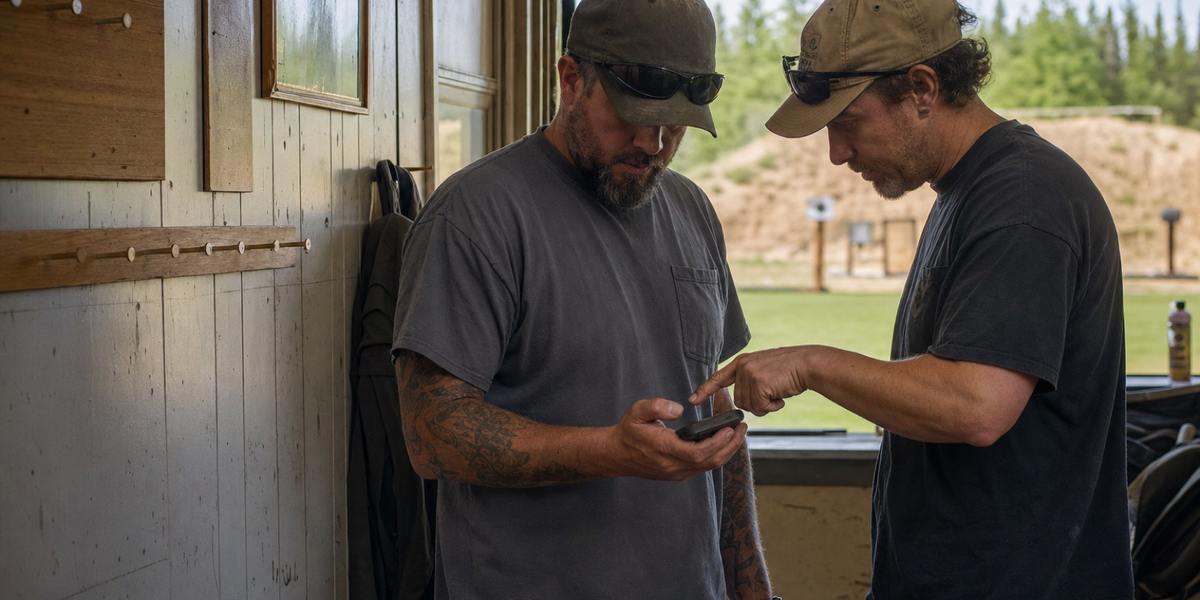
Holdover produced the feature as a fictional source-checking moment at an unnamed Canadian range club. The people and setting do not depict the article's writer, a commenter, a court participant, or a real event.
The five corrections
1. The hearing is scheduled for November. The article says the Court date is in October 2026. The Supreme Court's scheduled-hearings page places the four related firearms appeals on November 9 and 10. Docket 41859 lists its hearing start as November 9.
2. The nine private applicants remain pending. The article says interveners have joined the case. The docket separates three active provincial interveners, the Attorneys General of Saskatchewan, Alberta, and Ontario, from nine private organizations whose motions for leave remain Pending.
The file advanced after the article appeared. Canada's National Firearms Association completed its reply on July 29. The Canadian Coalition for Gun Control completed its reply on July 31. The other listed replies were complete by July 28. A completed reply closes a filing step. The Court still decides admission and terms.
3. Ontario's premier is Doug Ford. The article attributes the premier's public remarks to Rob Ford. Ontario's official premier page identifies Doug Ford.
4. The Canadian Taxpayers Federation has not been refused by the Supreme Court in this file. Docket 41859 still lists the Federation as pending. The refusal discussed in the federal response belongs to the earlier Federal Court proceeding below, where the Federation and Canadian Constitution Foundation had sought intervention.
5. The quoted positions came from federal counsel. The article says the other applicants were told they could not raise new issues or add evidence. It also presents the argument-balancing rationale for the Canadian Coalition for Gun Control as something the Supreme Court said.
Both points appear in the Attorney General of Canada's July 23 response. The federal respondent proposed standard limits and argued that a gun-control perspective could help balance the applications. The same response says the Attorney General does not oppose any of the nine motions. The Court has published no intervention order in docket 41859.
Read who filed the words
A response is advocacy submitted by a party. A reply gives an applicant its answer. An order records what the Court decided.
Those documents can sit close together in a docket while doing different jobs. The federal response can decline formal opposition and still point out reasons to narrow an applicant's contribution. An applicant can complete every filing step and still wait for leave. A Court order can grant leave while setting page limits, oral time, and subject boundaries.
The Supreme Court's own notice on interventions explains the governing idea. Interveners offer useful perspectives distinct from the parties' submissions. They cannot introduce new evidence, expand the case, or take over the dispute. The Court retains control over balance and fairness.
That framework may eventually produce terms resembling the ones federal counsel proposed. Today, the proposal and the decision remain separate entries.
Accuracy belongs to the argument
Holdover is pro-ownership. That position raises the standard for our evidence. Licensed owners already face a federal programme that reduces lawful property to declarations, compensation rows, collection windows, and disposal choices. The related appeal will examine the limits of Cabinet's regulation-making power. Sloppy reporting gives critics an easy way to dismiss the larger issue without engaging it.
I have learned the same lesson in a quieter place. My range work improved after I stopped bringing six or seven rifles and narrowed the session to three. The slower rotation gave breathing, level, barrel heat, and shot pace enough attention. Fewer claims, checked in sequence, helps publishing for the same reason.
The practical source routine takes little time:
- confirm the court, file number, and current hearing date;
- identify who filed each document;
- separate an application, response, reply, and order;
- read the status column before describing participation; and
- verify every current officeholder at an official page.
This routine does not soften the pro-owner case. It removes avoidable misses.
Correct it and keep going
The Firearm Blog article can still make its broader programme argument. Its Supreme Court section needs these five corrections first.
Docket 41859 now shows all listed replies complete. It still shows nine private applicants as pending. The hearing remains scheduled for November 9 and 10. The intervention decision remains with the Court.
The strongest pro-owner argument is the one that survives the link beside it.
Sources
- Supreme Court of Canada: docket 41859
- Supreme Court of Canada: scheduled hearings
- Supreme Court of Canada: notice on interventions
- Attorney General of Canada: response to motions for leave to intervene, July 23, 2026
- Ontario: Doug Ford, Premier
- The Firearm Blog: More Problems For Canada's Gun Seizure Program
- r/canadaguns discussion and source correction
The amnesty file is still moving.
If this piece sent you back to government pages, do not wait for the next portal, Gazette, or court move to find you by accident.
The Dispatch follows Public Safety, RCMP, Canada Gazette, court, compensation, collection, and amnesty updates so the next change comes with the source that moved.
Safety note: the tracker is a worksheet for source hygiene, not legal advice or a substitute for current official guidance.