Your scope needs its own answer
Public Safety Canada says accessories submitted outside the individual firearm list will be destroyed without compensation. Its collection instructions also require a firearm to be complete and fully assembled. Get the answer about attached gear in writing before an appointment.

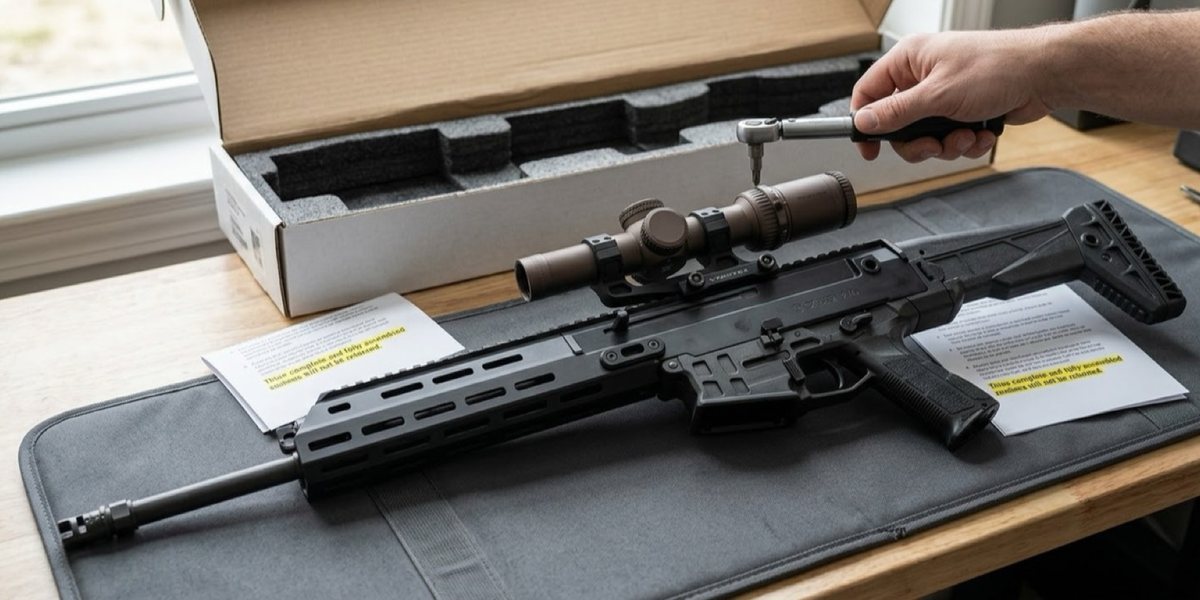
Gear. Public Safety Canada has written two sentences that ought to sit next to each other on the same page. One says individual firearms must be complete and fully assembled to qualify for compensation. The other says any item turned in outside the individual firearm list will not be returned and will be destroyed without compensation.
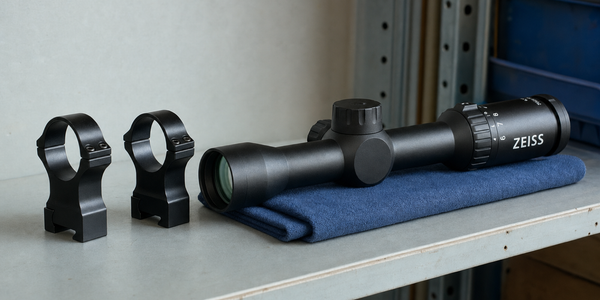
An owner with an accepted declaration and a collection appointment has a very ordinary question: what happens to the scope, rings, bipod, light or other attached gear? The current pages never answer it directly. They set out the two sides of the problem and leave the owner to bridge the gap before a box is sealed.
That is a poor place for guesswork. Ask the program for a written answer about the specific attached equipment before the appointment.
The compensation page has a narrow job
The federal compensation model says individual amounts are based on the average retail price of listed makes and models of prohibited firearms. It says the amounts are for fully assembled firearms. It also gives a bare lower receiver a flat $550 rate when the relevant firearm value is $550 or more.
The next paragraph narrows the boundary further. Upper receivers, firearms parts and components are ineligible for individual compensation. The page then says that items turned in that are outside the individual firearm list will not be returned and will be destroyed without compensation.
That language is clear about the program's purpose. It compensates the listed firearm. It does not offer a separate individual line for the things an owner may have added around it. A scope is an obvious example because it can be an expensive piece of useful equipment, yet it has no separate place in that individual compensation model.
The wording also creates a consequence worth taking seriously. An item that reaches the program and sits outside the list is not waiting on a shelf for an appeal. The public page says it will not be returned.
The collection page leaves the hinge undefined
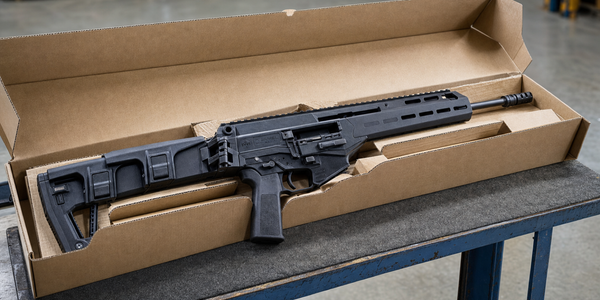
The collection instructions tell an approved claimant to accept the Funding Agreement, provide payment information and book a collection appointment. The program then mails one transportation kit for each declared firearm.
Step 3 says each firearm must be complete and fully assembled to be eligible for compensation. It does not define either word. It does not identify which attached accessories are part of that condition. It does not cross-reference the exclusion for parts, components and unlisted submitted items.
That omission matters more than a semantic quarrel. The collection officer will verify each declared firearm and issue a receipt. The page says later validation can find a discrepancy in make or model and that a discrepancy may affect the estimate in the Funding Agreement. The owner is handing over an item inside a process that is designed to carry it forward to validation and destruction.
The sensible question is therefore exact: “If my declared firearm has a scope and mounts attached, may I remove them and still meet the program's complete-and-fully-assembled requirement?” Add the particular accessory and firearm configuration. Ask through the portal if possible, or ask the contact centre how the answer can be recorded against the claim. Keep the response with the Funding Agreement and appointment information.
The purpose of that question is clarity, not an argument with the person at the collection site. The program owns the definition that governs its claim. An owner deserves to see that definition before handing over equipment that the program may never return.
Write down the useful details while they still mean something
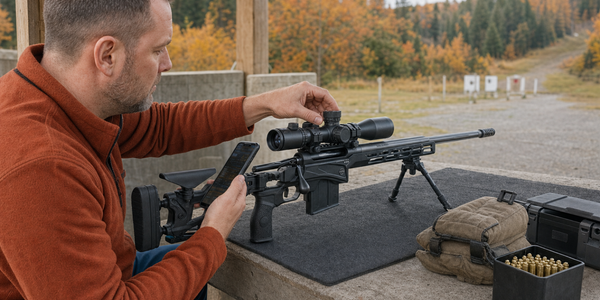
There is another practical reason to slow down. A removed optic is only useful later if the information that made it fit is still around. A ring height, base pattern, mounting position and torque figure can turn a future remount into an afternoon at the bench instead of a small archaeological dig through old receipts.
That is the level of paperwork this deserves: a short note, a few photographs of the setup, and the program's written answer. It is boring work. Boring work is often what separates a recoverable equipment change from an expensive one.
The federal pages already require the claimant to wait for notification, accept the Funding Agreement and follow the assigned appointment process. Ontario's collection period is currently listed as June to October 2026, with dates described as approximate. There is time to ask a precise question. There is no value in waiting until a transportation kit is open on the kitchen table.
The department has a reasonable administrative problem
The government's side of the line is understandable. Paying separate values for every optic, mount, bipod, sling, light and accessory would turn a firearm-compensation system into an appraisal business. It would require a process for condition, proof of ownership, individual compatibility and value disputes across thousands of configurations.
The current model avoids that. It pays for the listed firearm and sets separate rules for individual parts and components. Businesses receive a different structure, including a $250 per-firearm handling amount and a limited allowance for eligible parts/components under specific conditions. That distinction does not make an individual owner's question disappear. It makes the answer more important.
Public Safety Canada can resolve this with a sentence that ties the two current instructions together. Until it does, the owner should get the answer in writing before any attached gear enters a one-way box.
Sources
- Public Safety Canada, Compensation model for the Assault-Style Firearms Compensation Program, page details May 26, 2026. Source for individual compensation, the $550 lower-receiver rate, excluded parts/components, destruction-without-compensation language, and business handling/parts rules. Accessed August 23, 2026.
- Public Safety Canada, Collection and other disposal options, page details August 10, 2026. Source for funding agreements, appointments, transportation kits, complete-and-fully-assembled wording, receipt and validation process. Accessed August 23, 2026.
- Public Safety Canada, Next steps for individuals, page details August 21, 2026. Source for the current collection/deactivation/compensation sequence. Accessed August 23, 2026.
- Public Safety Canada, Firearm collection timeline in Canada, page details June 3, 2026. Source for Ontario's estimated June-to-October collection period and the approximate-date warning. Accessed August 23, 2026.
Keep the setup details worth finding later.
Use the Holdover Range Bench Log Card to record rifle, optic, ammunition, distance, weather, zero, group notes, correction and the next test without turning a range trip into a memory test.
Safety note: the card is a note-taking worksheet, not shooting instruction, load data, legal advice, or a substitute for range rules, official guidance, manufacturer manuals, or qualified instruction.