June 6 answers the *speech*
The Prime Minister's June 5 statement told one firearms story. National Range Day shows the licensed Canadian community the speech leaves out.

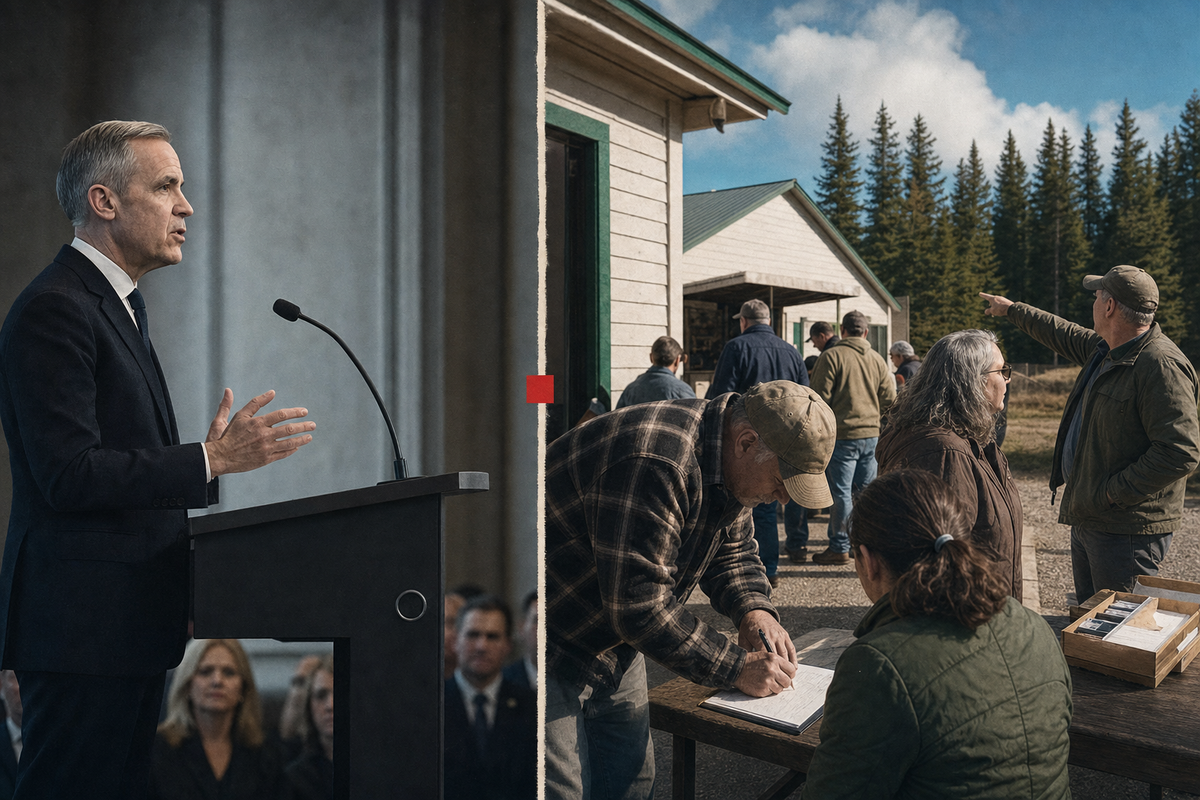
Opinion. On June 5, Prime Minister Mark Carney gave the statement Canada expects on gun violence. On June 6, ranges across the country answered in the only way that really matters: they opened the property.
The mourning in the June 5 statement deserves its place. Lives have been taken by criminal violence, and families live with that absence long after the press language has moved on. No serious firearms owner should be glib about that.
The problem is what happens next.
In the same statement, the Prime Minister placed border enforcement, gun trafficking, repeat violent offenders, red-flag laws, CBSA seizures, new police hiring, and the Assault Style Firearms Compensation Program into one clean public-safety story. Some of that belongs together. Some of it does not.
That is where June 6 matters.
Two true days in a row
The official statement said the government had introduced legislation to secure the border and crack down on gun trafficking. It said the government is hiring 1,000 new CBSA officers and 1,000 new RCMP personnel. It said CBSA seized more than 830 firearms last year.
Fine. Aim the state at trafficking. Aim it at organized crime. Aim it at the repeat violent offender who should not be collecting bail decisions like range brass.
But the statement also said the government has removed prohibited assault-style firearms from communities through the compensation program. That phrasing is doing more work than it admits. It takes regulated property held by licensed people and drops it into the same sentence structure as trafficking and violent crime.
The next morning, National Range Day put another fact on the table. The official site frames June 6, 2026 around 2.3 million licensed Canadian gun owners. The RCMP's 2024 Commissioner of Firearms Report counted 2,425,627 firearms licence holders in the year-in-numbers section, plus 935 range facilities and 760 shooting clubs across Canada.
That is not a fringe. That is a regulated national community with doors, clubhouses, sign-in tables, range officers, volunteers, and enough paperwork to make even the most enthusiastic bureaucrat briefly emotional.
What the range shows
I shoot mostly at Stittsville, usually for 4-6 hours on a weekend. The useful parts of those days rarely feel like politics. They feel like listening when the line is called cold, checking the rifle twice, realizing the thing I forgot is exactly the thing I needed, and watching a target correct an opinion I was quite fond of.
That is the part the official speech keeps missing.
A range is where lawful ownership becomes visible as behaviour. People sign in. People ask questions. People stop when the range officer says stop. Someone helps a new shooter with the first awkward step, which is usually not trigger control or wind. It is admitting they do not know how the place works yet.
BC Wildlife Federation's National Range Day page says clubs will host family-friendly events, invite elected officials, and have qualified members teach, run competitions, and answer questions. Local listings from Algoma Rod and Gun Club and Waterford Sportsman's Club show the same shape: public events, supervised introductions, vendors, demonstrations, range tours, and open doors.
That is not a rebuttal written in all caps. It is better than that. It is the community letting the country inspect the thing.
The strongest version of the speech
The strongest version of the government's case is simple. Criminal gun violence is real. Smuggling matters. Violent offenders should be kept away from firearms. People at risk of harming themselves or others should be dealt with before the tragedy, not after the statement.
Holdover has no quarrel with the seriousness of those problems.
The quarrel is with the habit of sliding from those problems into licensed ownership as if the same tool solves both. Canada already has a heavy firearms regime: training, licensing, background screening, continuous eligibility, storage rules, transport rules, classification rules, registration for restricted and prohibited firearms, and Chief Firearms Officer oversight. The people at the range on June 6 are already inside that system.
Treating them as the easy public-safety object is politically convenient. It is also lazy.
If the country wants to understand firearms in Canada, it should spend less time admiring the sentence "we removed firearms from communities" and more time asking which communities, which owners, which records, which evidence, and what public-safety result followed.
Community-building is not soft
The live community signal this morning was not a policy paper. It was a r/canadaguns thread from June 5 floating a friendly idea: track how many new people Canadian shooters have brought into the sport. The poster described getting five people in their own circle moving toward PAL/RPALs or first firearms.
I am not treating a Reddit thread as sociology. I am treating it as a useful little pressure reading.
The healthiest version of Canadian firearms culture is not a bunker. It is a member bringing a cautious friend to a club open house. It is a spouse deciding the PAL course is less mysterious than expected. It is a new shooter walking out of the first visit with fewer fantasies and better questions. It is the small business that survives because beginners keep becoming participants.
That is advocacy, whether anyone calls it that or not.
Advocacy does not always need another speech about rights. Sometimes it needs one more normal person to stand safely behind the line, see how regulated the environment already is, and realize the political caricature has been doing a lot of unpaid fiction work.
What a newer shooter should take from this
If your PAL has been sitting in a drawer, June 6 is not just a calendar item. It is the low-friction day to become visible.
Go to the club. Ask the boring questions. Ask what membership costs. Ask what a first range visit looks like. Ask what you need to bring and what you should leave at home. Ask the question you think is stupid. Somebody has already asked a worse one, and there is comfort in knowing the national standard for early embarrassment remains robust.
Do not turn every conversation into a 20-minute monologue about Ottawa. Nobody came to the open house to be trapped beside the coffee urn by a man with five acronyms and no mercy. Let the place make the first argument.
The political argument can come later. It will land better once the visitor has seen the people.
June 5 had the microphone. June 6 has the line officer, the volunteer, the sign-in table, the first cautious visitor, and the licensed owner patient enough to explain the routine without making it weird.
Canada needs both facts in the same frame.
The country heard the speech. Now it should meet the people the speech keeps flattening.
Sources
- Prime Minister of Canada, Statement by Prime Minister Carney on the National Day Against Gun Violence, June 5, 2026.
- National Range Day, official site, accessed June 6, 2026.
- B.C. Wildlife Federation, National Range Day, accessed June 6, 2026.
- Royal Canadian Mounted Police, 2024 Commissioner of Firearms Report.
- SooToday, National Range Day - Algoma Rod and Gun Club, updated June 4, 2026.
- 104.7 Heart FM, National Range Day - Waterford Sportsman's Club, published June 6, 2026.
- Reddit r/canadaguns, Community Building Comp?, June 5, 2026, used as community signal only.
The amnesty file is still moving.
If this piece sent you back to government pages, do not wait for the next portal, Gazette, or court move to find you by accident.
The Dispatch follows Public Safety, RCMP, Canada Gazette, court, compensation, collection, and amnesty updates so the next change comes with the source that moved.
Safety note: the tracker is a worksheet for source hygiene, not legal advice or a substitute for current official guidance.