New South Wales handed Canada a *dealer warning*
A current Australian buyback story is not Canadian law. It is still a useful warning: the dealer counter is part of the regulated system, not spare scenery.

Opinion. A buyback is abstract until the dealer is trying to keep the lights on with ammunition sales.
That is the useful Canadian lesson in the July 6 report out of New South Wales. The Daily Telegraph described firearms businesses facing severe losses after Australia's post-Bondi political response turned into ownership limits, a promised buyback, delayed details, and a frozen market. One dealer family estimated lost sales between $250,000 and $500,000. The Shooting Industry Foundation of Australia said some regional dealers were down as much as 80 per cent. A report commissioned by Shooters Union Australia and SIFA put the direct compensation cost for a 20 per cent NSW buyback at $416.2 million, with broader economic and social costs near $950.6 million.
Australia is not Canadian law. That sentence matters.
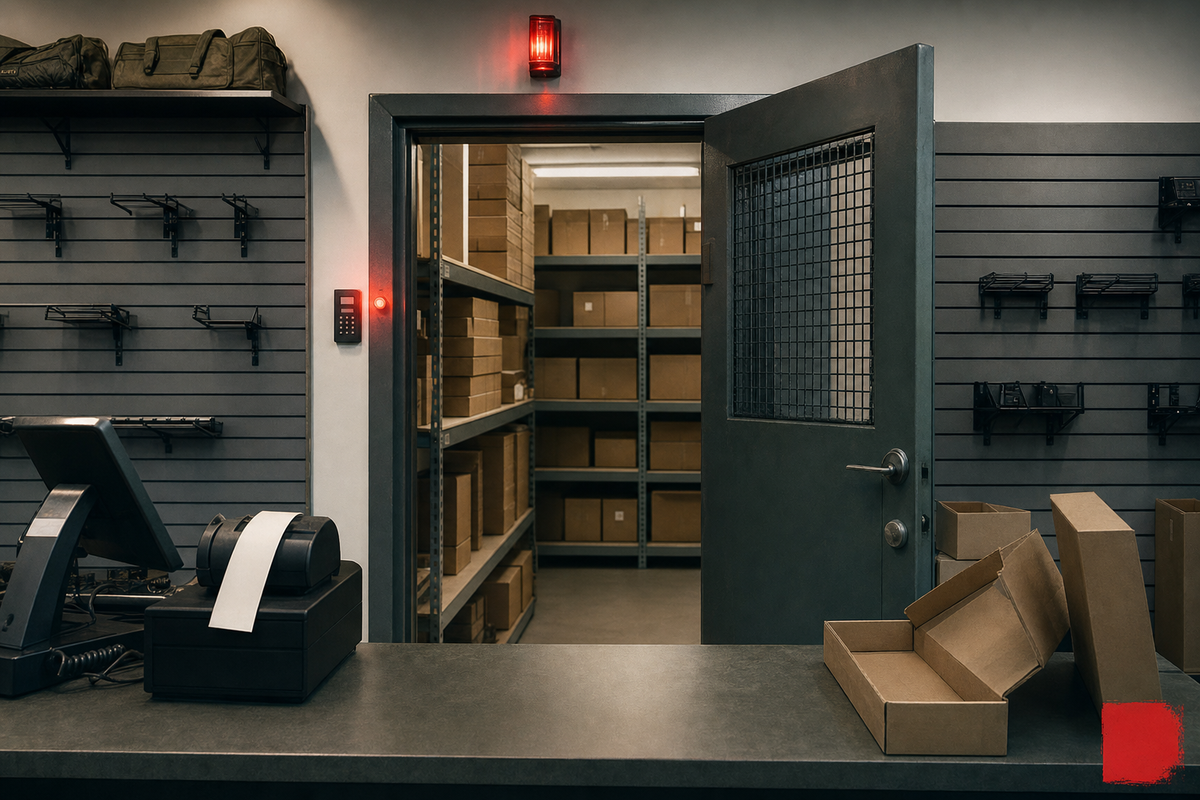
It is still a useful warning flare. The dealer counter is not scenery in a firearms system. It is where the regulated world becomes practical: proof checks, ammunition sales, transfers, advice, storage expectations, special orders, warranty problems, range rumours being corrected by someone who has heard them all before, and the quiet embarrassment of realizing the thing you thought was simple is, in fact, Canadian.
The dealer counter is not scenery
Canadian firearms policy often talks as if the licensed owner and the dealer are merely the end point of a decision made somewhere else. Ottawa bans, the owner complies, the dealer adjusts, and the file moves along.
The real system is less tidy. I have bought enough firearms and gear through Canadian shops, both online and across local counters, to know that the store is part of the compliance layer. It is the place where a new owner learns that PAL details matter, transfer language matters, shipping limits matter, and "in stock" is not the same as "in my hands before Saturday."
The same is true on the policy side. A dealer is not just a business selling objects. It is often the alarmed room, the staff knowledge, the transport habit, the owner-verification muscle, and the phone number people call when the government page reads like a committee wrote it during a power outage.

Canada already has the pressure
Canada does not need an Australian headline to know the compensation file is operationally heavy.
Public Safety Canada's June 9 release says more than 142,000 assault-style firearms have been declared, collected, or destroyed under the Assault-Style Firearms Compensation Program. That total includes more than 61,900 firearms claimed in the second business phase, more than 12,000 collected and destroyed in the first business phase, and more than 68,000 firearms declared by individual owners.
The same release says individual and business collection and compensation will continue through early fall 2026. It also says the amnesty has been extended because the Supreme Court of Canada agreed to hear the challenges to the May 2020 prohibition, and that the Amnesty Orders now expire 90 days after the Court renders its decision, expected next year.
That is the official version at its strongest: a legal pathway, compensation, collection, validation, and time for the Supreme Court process.
The practical questions are still the ones that make or break trust. Where does the firearm go? Who handles it? How is it secured in transit? What happens at the physical collection point? How much has actually been paid out? How does an owner appeal a price they believe is too low?
Those are not forum questions. They appear in the House of Commons written-question record.
Chain of custody is a real object
The NSW report landed hardest where it left the slogan world and entered the storage room.
SIFA's argument, as reported, was not only that dealers are losing sales. It was that dealers provide secure storage capacity the police already rely on for seized or surrendered firearms. If those businesses disappear, police stations inherit the storage problem. The buyback does not eliminate logistics. It moves them to a weaker part of the system and calls that progress.
Canadian owners should recognize the shape.
Public Safety's June 9 release says the amended Amnesty Orders will allow shipping for individual ASFCP disposal in exceptional situations, such as where travel distances make an in-person collection appointment difficult. That detail is sensible, and it also proves the point. Once the program leaves the press conference, it becomes locks, boxes, distance, appointments, signatures, validation, transport, storage, and people.
You cannot solve that with a slogan. You solve it with capacity.
The strongest case still has a weak counter
The strongest argument for a compensation program is simple enough to state fairly. If Parliament and cabinet have prohibited a class of firearms, then the state will say compensation is the orderly way to remove them from civilian possession without forcing every affected owner into uncompensated loss.
That is the best version. It is also incomplete.
Compensation still leaves the hard questions standing. These firearms were bought legally, stored legally, and owned by people already known to the state. The public-safety gain still needs evidence, while criminal supply lines, repeat violent offenders, smuggling networks, and illegal handguns keep demanding police work far away from a vetted owner waiting for a collection appointment.
And it does not make the dealer disposable.
When policy weakens lawful businesses, it weakens the lawful system. The Canadian dealer is where normal, boring compliance actually happens. If that counter becomes less available, more expensive, or more risk-averse, the file gets thinner.
Canada's warning is practical
The CSSA's Ontario petition language points at the same practical problem from a different angle. Ontario owners want one clear answer from the Chief Firearms Office on whether licence revocation could follow non-participation in the federal confiscation program. CSSA's line was blunt: owners should not be left with "fifty different local interpretations."
That is the whole story in Canadian dress.
The people most likely to ask the question are the people the system can already see. They are licensed, known, reference-checked, screened, and trained enough to worry about what the CFO might do. They are calling the dealer, reading Public Safety, watching the Supreme Court file, and trying not to step wrong.
New South Wales adds one more thing to the Canadian checklist: what happens to the lawful counter while all of this runs?
If a policy depends on compliant owners, secure storage, knowledgeable dealers, police logistics, appointment systems, and compensation validation, then those are not side effects. They are the system.
Canada does not need to copy New South Wales to learn from it.
It only needs to notice where the strain lands first.
Sources
- Daily Telegraph,
Firearms industry pushed to the brink by chaotic $950 million buyback delay: https://www.dailytelegraph.com.au/newslocal/wagga/firearms-industry-pushed-to-the-brink-by-chaotic-950-million-buyback-delay/news-story/4e7640cc8195845575eeccbd8227455e - Public Safety Canada,
Firearms compensation program for businesses closes - Amnesty period extended due to the Supreme Court of Canada process: https://www.canada.ca/en/public-safety-canada/news/2026/06/firearms-compensation-program-for-businesses-closes--amnesty-period-extended-due-to-the-supreme-court-of-canada-process.html - Public Safety Canada,
Firearms: https://www.publicsafety.gc.ca/cnt/cntrng-crm/frrms/index-en.aspx - House of Commons, written questions on
Firearms Buyback Program: https://www.ourcommons.ca/written-questions/questions?parlsession=45-1&text=topic%3A%22Firearms+Buyback+Program%22&view=list - Canadian Shooting Sports Association,
CSSA Supports Ontario Petition Calling for Province-Wide Protection for Law-Abiding Firearms Owners: https://cssa-cila.org/cssa-supports-ontario-petition-calling-for-province-wide-protection-for-law-abiding-firearms-owners/ - Calibre Magazine,
OIC Challenge Advances to Supreme Court: https://calibremag.ca/news/
The amnesty file is still moving.
If this piece sent you back to government pages, do not wait for the next portal, Gazette, or court move to find you by accident.
The Dispatch follows Public Safety, RCMP, Canada Gazette, court, compensation, collection, and amnesty updates so the next change comes with the source that moved.
Safety note: the tracker is a worksheet for source hygiene, not legal advice or a substitute for current official guidance.