Reading *eye relief* across two Vortex price brackets
Two Canadian Vortex listings pair C$679 with 3.9 inches and C$4,699 with 3.5. The manufacturer figures show the limits of comparing optics by one specification.

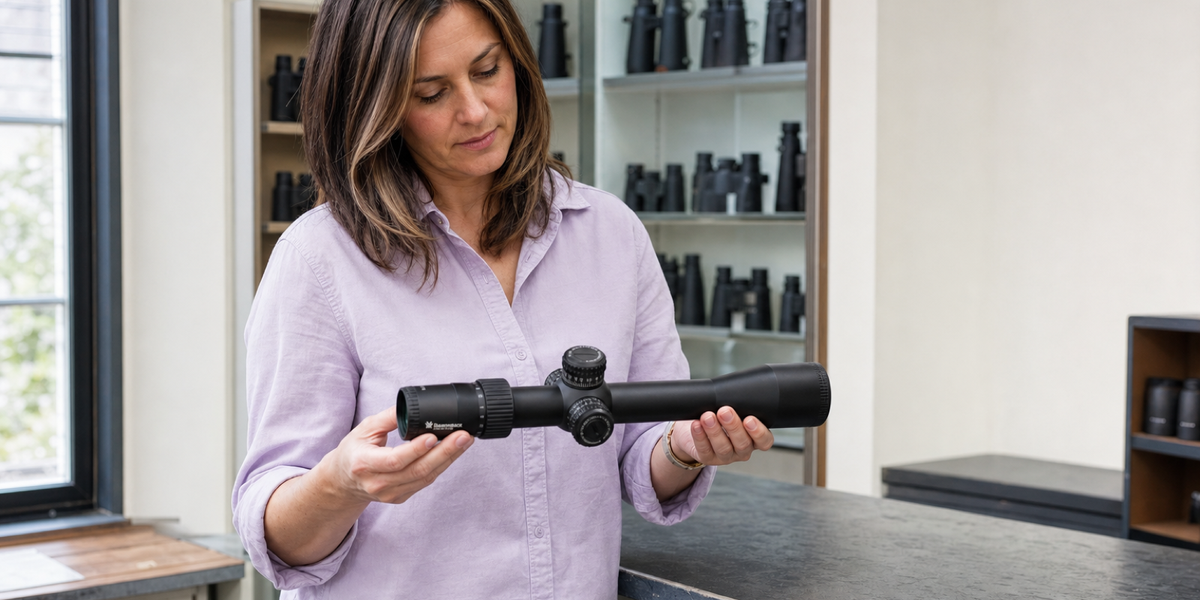
Vortex publishes 3.9 inches of eye relief for the Diamondback Tactical 6-24x50 FFP and 3.5 inches for the Razor HD Gen III 6-36x56. The Canadian listings checked on September 12 put them at C$679 and C$4,699 respectively. Spend another C$4,020 on this pair and the published eye-relief figure gets smaller.
That caught my attention because the two Vortex models I own, the Strike Eagle 5-25x56 and Diamondback Tactical 4-16x44, both list 3.8 inches. I have plenty of reasons to read the rest of a scope's specifications. This particular row offers very little help sorting them by price.
Eye relief describes the distance between your eye and the rear lens at which you see the full image. The number has a physical meaning. Turning it into a score for the whole optic asks it to do a different job, and these current pages show how quickly that comparison runs out of useful information.
Two prices, with the stock status attached
Firearms Outlet Canada lists the Diamondback Tactical 6-24x50 FFP with the EBR-2C MRAD reticle at C$679. Rangeview lists the Razor HD Gen III 6-36x56 with the EBR-7D MRAD reticle at C$4,699, marked out of stock when checked.
Those are two retailers' listed Canadian prices on one date. The Razor's price remains visible while the item is unavailable. Anyone comparing an order they can place with a page they can bookmark needs that qualification beside the dollar figure.
The C$4,020 difference gives the comparison some scale. It does not tell us what either retailer will charge next week, what a sale might change, or what another seller has on the shelf. I would be wary of turning these two listings into a claim about the cheapest scope in Canada.
The manufacturer figures are narrower evidence. Vortex assigns 3.9 inches to the 6-24x50 Diamondback and 3.5 inches to the 6-36x56 Razor. Both product pages publish a single eye-relief value. The gap is four tenths of an inch. Overall optical quality, durability, and personal comfort each need their own evidence.
Two familiar models share the same row
My Diamondback Tactical 4-16x44 and Strike Eagle 5-25x56 make the point without the flagship price comparison. Vortex publishes 3.8 inches for each. The models have different magnification ranges and objective sizes, right there in their names, yet this one specification is identical.
I can report that from the current manufacturer pages and my own equipment list. I have not measured those distances for this article or conducted a comparison of the two sight pictures. Ownership supplies a reason to ask the question; a published specification supplies the answer in this column.
A buyer could still have good reasons to prefer either model. The identical number leaves those reasons open. Reading one decimal is quick, which makes it tempting to give that decimal more authority than the rest of the evidence allows.
Leupold supplies the magnification labels
Leupold prints the information differently on two current Mark 4HD pages. Its 6-24x52 M5C3 FFP PR2-MIL lists 3.8 inches at low magnification and 4 inches at high magnification. The 4.5-18x52 version lists 3.6 and 3.9 inches under the same respective labels.
Those labels matter when copying figures into a comparison. Choosing only the larger number would discard the lower-magnification condition Leupold took the trouble to print. Quoting both preserves what the source says.
The two pages also give us a reason to resist a universal rule about how eye relief changes with magnification. These are the values Leupold publishes for these exact models. A separate claim about how all variable scopes behave would need broader evidence and clear measurement conditions. Vortex's single-value format does not, by itself, tell us how that value was selected.
I prefer the additional context in Leupold's table. That is a judgement about the information available to the buyer. Establishing which optic provides the better experience would require a different piece of work.
TACCOM runs September 12 and 13 in Mississauga, so Canadian shoppers have a timely reason to compare product information this weekend. I would take the exact model names and the manufacturers' wording along with any price comparison. Four tenths of an inch and C$4,020 make an interesting pair of numbers. The rest of the purchase still deserves a proper explanation.
Sources
Manufacturer specifications and Canadian retailer listings linked above, checked September 12, 2026. Prices are Canadian dollars as listed, not completed-sale prices. This is commentary on published information, with no comparative product test or measured eye-relief result.
Keep the range notes worth reading later.
If this piece has you thinking about range time, keep the notes useful enough to read later.
Use the Holdover Range Bench Log Card to record rifle, optic, ammunition, distance, weather, zero, group notes, correction, and next test without turning a range trip into a memory test.
Safety note: the card is a note-taking worksheet, not shooting instruction, load data, legal advice, or a substitute for range rules, official guidance, manufacturer manuals, or qualified instruction.