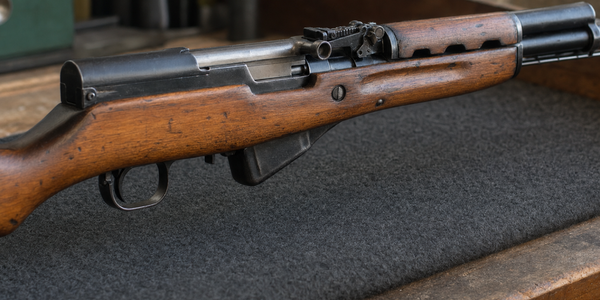
10,353 signatures chose the harder *target*
E-petition e-7232 closed with 10,353 validated signatures and a better public-safety instinct: stop processing licensed owners and fund the harder problems.


Update, June 9, 2026. Public Safety Canada has extended the relevant amnesty period. The old the former fixed deadline date referenced below is no longer the operative expiry; the amended expiry is 90 days after the Supreme Court of Canada renders its decision.
Opinion. E-petition e-7232 closed today with 10,353 validated signatures and a useful instinct: stop spending public money on the easiest firearms population to process and put it toward the harder public-safety work instead.
Not because an e-petition is a revolution. Ten thousand signatures will not end the federal buyback by itself, and nobody should pretend otherwise.
But the petition did something Canadian firearms advocacy needs more often. It did not only say "no." It named the better use for the money.
What e-7232 actually did
The House of Commons petition was initiated by Lizie-Anne Perron from Bois-des-Filion, Quebec, and sponsored by Conservative MP Jason Groleau of Beauce. It closed June 4 at 11:58 a.m. EDT.
Its argument was plain: the legal firearms buyback does not deal with the root causes of violence, and public money would do more good in practical mental-health services, community organizations, psychiatric care, support for people experiencing homelessness, and help for vulnerable people.
That is a stronger public sentence than "leave us alone."
Licensed owners have earned some frustration. They did the course, filled out the forms, waited for the card, followed the storage rules, bought property legally, and then watched the rules move under their feet by regulation and order-in-council politics.
The petition was better because it pointed the public cheque somewhere else and asked: if this is really about safety, what actually buys safety?
The June 4 contrast
The timing was tidy in a way Ottawa probably did not intend.
Public Safety's current program page says the business side of the Assault-Style Firearms Compensation Program re-opened on April 23, 2026. It also says the individual declaration period has ended and that collection, deactivation, and compensation are expected to run from spring to early fall 2026. The amnesty endpoint remains the former fixed deadline.
So on the same day e-7232 closed, the federal system was still moving along with claims, compensation, collection, deactivation, and compliance pressure.
That is the contrast. One side is a program aimed at people the state can already see: PAL holders, businesses, declared owners, records, portals, deadlines, files, and forms.
The other side is the harder work the petition named: people in distress before tragedy, community organizations that know who is slipping, psychiatric care that has to exist before crisis, homelessness supports that are not a slogan, and prevention that looks boring until it works.
Government likes the first file because it is legible. It has names, addresses, licence numbers, inventories, forms, and an enforcement lever.
That does not make it the better public-safety investment.
Easy to find is not the same as dangerous
This is where newer shooters should pay attention.
The PAL system makes you visible. That visibility is part of the Canadian bargain. You take the course. You answer personal-history questions. You provide references. You wait. Once licensed, your eligibility can be screened continuously, and a Chief Firearms Officer can review concerns.
That is a real regulatory structure, and licensed owners live inside it every day.
The RCMP's 2024 Commissioner of Firearms Report counted more than 2.4 million valid PALs at the end of 2024. It also describes eligibility screening, licence refusals, revocations, business inspections, range approvals, and continuous monitoring.
In other words, lawful owners are visible because the system was designed to make them visible.
The mistake is treating visibility as guilt.
Statistics Canada's 2024 firearms and violent crime release says that in firearm-related homicides where an accused person was identified, 80% of accused persons did not have a valid licence for the class of firearm used. It also notes that most accused persons in firearm-related homicides had a criminal record involving at least one previous conviction.
Those facts do not make every licence holder perfect. No honest adult argues that a licence turns a person into a saint.
They do make the spending question more serious.
If the hard public-safety problem is violence, repeat violent contact, illegal possession, gangs, smuggling, crisis intervention, and people falling through systems until police arrive at the worst possible minute, then why is so much political energy still pointed at the easiest lawful population to process?
Because easy files feel like action.
A better way for new owners to speak
I think this matters most for newer shooters.
You come into the sport expecting to learn range commands, sight picture, safe handling, optics, cleaning, clubs, ammunition, maybe eventually reloading. Then the politics hit you before the fun part has fully arrived.
You learn PAL, RPAL, OIC, FRT, amnesty, compensation, declaration, transfer, storage, and whatever fresh acronym wandered out of Ottawa that week.
It is tempting to answer all of that with anger. Some days it is even understandable.
But the better public argument is the one e-7232 reached for: if safety is the goal, fund the work that has a chance of preventing violence before a firearm appears in the story.
At the range, when a group opens up, you do not get better by blaming the easiest thing. You identify the variable. Wind. Position. Parallax. Ammunition. Loose action screws. A tired shooter who should have stopped twenty rounds ago and gone for coffee.
At the bench, the same rule applies. If the process is messy, the result is not data. It is noise with confidence.
Policy should not get a lower standard than a range notebook.
The fair version of the other side
The best argument for the federal buyback is straightforward: the government says certain firearms are not suitable for civilian ownership, and compensation gives eligible owners a path to comply with the law.
The problem is that a compliance path is not the same thing as a public-safety plan.
You can ban more than 2,500 makes and models. You can create a portal. You can open and close declaration periods. You can publish province-by-province declaration counts. You can tell people the amnesty now runs to the SCC appeals + 90-day endpoint.
All of that might prove the state can administer a burden.
It does not prove the burden was the right investment.
The petition's real value is that it pulled the argument away from owner resentment and toward public budget discipline. If Ottawa has money to spend in the name of safety, spend it where the difficult work lives.
Fund the intervention before the crisis. Fund the supports that keep a person from becoming a headline. Fund enforcement and intelligence work aimed at illegal firearms and repeat violence. Fund the community organizations that know the street-level problem before Parliament discovers it.
And yes, if the government wants licensed owners to take public safety seriously, then government should take its own evidence standard seriously.
The easiest owner to find is not automatically the best place to spend the next public dollar.
E-petition e-7232 will not solve the firearms file. It did something more useful for the next conversation: it aimed at the harder problem.
Sources
- House of Commons, e-petition e-7232, closed June 4, 2026, accessed June 4, 2026.
- Public Safety Canada, Firearms Buyback Program / Assault-Style Firearms Compensation Program, accessed June 4, 2026.
- Public Safety Canada, Number of assault-style firearms declared by province and territory, page details April 1, 2026, accessed June 4, 2026.
- Royal Canadian Mounted Police, 2024 Commissioner of Firearms Report.
- Statistics Canada, Samuel Perreault, Firearms and violent crime in Canada, 2024, released April 21, 2026.
The amnesty file is still moving.
If this piece sent you back to government pages, do not wait for the next portal, Gazette, or court move to find you by accident.
The Dispatch follows Public Safety, RCMP, Canada Gazette, court, compensation, collection, and amnesty updates so the next change comes with the source that moved.
Safety note: the tracker is a worksheet for source hygiene, not legal advice or a substitute for current official guidance.