A .308 in boreal cover starts at *2x*
For a .308 used mainly inside 300 metres, low-end field of view, reticle visibility, and mounting fit deserve the first look.

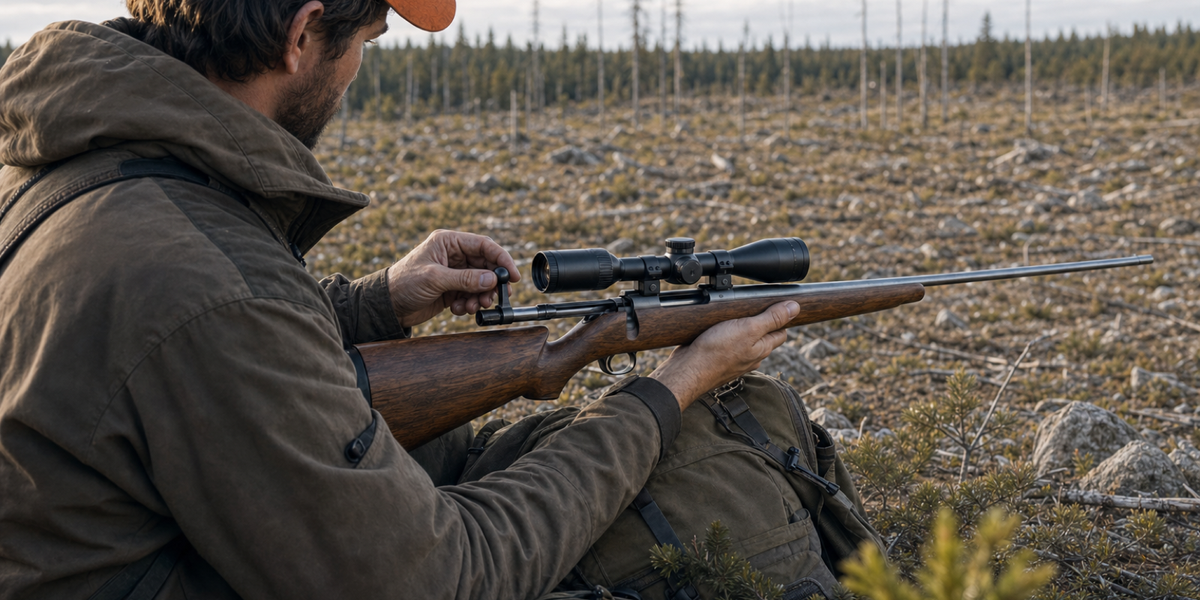
Gear. A Canadian hunter with a .308, a 300-metre ceiling, and a $2,000 optic budget has already supplied the most useful part of the scope decision.
The rifle will spend most of its time in boreal cover. Typical shots should fall inside 150 metres. A clearcut may stretch the opportunity to 200 or 250. The shortlist includes a Bushnell R7 3-15x50, a Trijicon Credo 2-10x36, and a Meopta 3-15x.
I would compare all three at the bottom of their magnification ranges first.
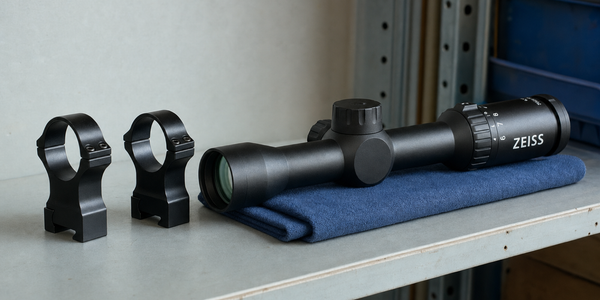
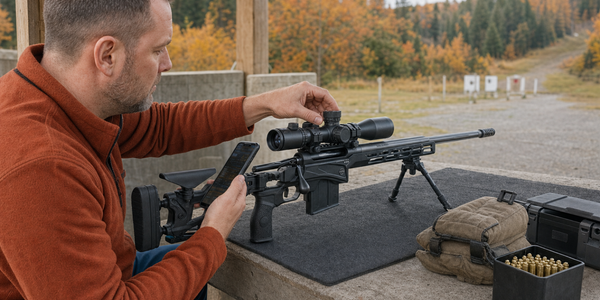
Holdover produced the feature as a fictional field scene. The rifle and scope are generic family archetypes with no exact product identity or performance claim. This article compares published specifications; it contains no hands-on verdict on the three scopes.
Start where the shot starts
Field of view is the width of terrain visible through the scope at a stated distance. More width gives the shooter more surrounding context and more room to find an animal entering or leaving cover.
The current published figures separate this shortlist.
Trijicon gives the Credo 2-10x36 a low-end field of view of 50 feet at 100 yards. That converts to roughly 16.7 metres at 100 metres. Bushnell lists the R7 3-15x50 at 13.3 metres at 100 metres on 3x. Meopta's 2026 catalogue gives the MeoHunter R5 3-15x50 12.2 metres at 100 metres on 3x.
Those figures make the Credo's low end about one-quarter wider than the R7's and more than one-third wider than the MeoHunter's. The exact perceived view will meet eye position, stock fit, and the individual scope at the counter. The spec still tells us where to look first.
Leupold's current hunting-scope guide makes the same terrain distinction. Thick timber puts more value on a 1x, 2x, or 3x low end. Open country gives higher magnification more work.
This hunt contains both settings. The common one is close cover.
Fifteen power belongs to the second pass
The two 3-15x50 candidates keep five more units of top-end magnification than the 2-10x36. That can help with target identification, checking detail, or using the same rifle at a range.
The owner has also set a 300-metre hunting limit. Ten power remains a serious amount of magnification at that distance. Leupold's magnification guide puts 3-15x in a broad 50-to-500-yard hunting envelope and warns that added magnification narrows field of view and makes movement more visible.
The useful question is how often 15x will earn its place on this rifle. A hunter who also wants to shoot small groups from a stable position may give it regular work. A rifle carried mainly through timber and over cutlines may live near 2x or 3x and visit the top end for confirmation.
The use case can settle that before brand loyalty does.
Fifty millimetres is a geometry input
A 50 mm objective sounds like an automatic twilight advantage over 36 mm. The complete optical system has more say.
Exit pupil gives one useful geometric check. Divide objective diameter by magnification. At their lowest settings, the 2x36 and both 3x50 scopes produce nominal exit pupils around 18 mm and 16.7 mm. At maximum power, the 10x36 is 3.6 mm and each 15x50 is about 3.3 mm.
ZEISS explains the limit of that arithmetic. Exit pupil describes the light window reaching the eye. Transmission through the glass and coatings determines how clear that window is, while the observer's pupil and conditions decide how much can be used.
The low-end figures are already larger than a human pupil can use in ordinary hunting light. That shifts the buying test toward actual image quality, glare control, reticle visibility, eye position, and the view against dark spruce.
First focal plane adds another check. The reticle shrinks as magnification comes down. An MOA tree that looks excellent at 10x can become fine at 2x or 3x. Illumination may help. The buyer still needs to shoulder the rifle and find the centre quickly against real cover.
The rifle has to carry the scope
All three scopes use 30 mm tubes and sit in a similar overall length class. Their published weights are also closer than the objective numbers suggest: about 652 g for the Credo, 685 g for the MeoHunter, and 710 g for the R7.
The largest gap is 58 g. Mounting height, ring position, bolt clearance, cheek weld, and the balance of the complete rifle can matter more than that number.
A 50 mm objective may require a taller setup on a particular barrel and action. A taller optical axis can change head position. The Credo's 36 mm objective offers more mounting clearance on paper. The actual rifle, base, bolt handle, caps, and preferred eye relief finish the answer.
The $2,000 total budget also needs to carry the mounting hardware. Bring the exact rifle details to the quote. Price the scope, rings or mount, any base, and the work required to install and confirm it as one system.
The shortlist has three different jobs
The Credo 2-10x36 earns the first counter look for this stated hunt. Its published 2x view is the widest here, 10x reaches the owner's intended distance envelope, and its smaller objective may simplify the mount. That is an on-paper fit. The reticle, eye box, image, controls, and Canadian price still need a live check.
The R7 3-15x50 gives up some low-end width and adds 15x, a 50 mm objective, adjustable parallax from 15 yards, an exposed locking elevation turret, and a zero stop. Those features gain value if the same rifle will spend meaningful time on the range or in more open country.
The MeoHunter R5 sits near the R7 in magnification, objective size, weight, and low-end view. The exact reticle deserves attention. The current Canadian FFP listing I found uses Meopta's BDC 3 reticle and was marked out of stock at CAD $899. An owner committed to MOA should confirm the exact reticle and SKU before leaving it on the list.
Stock is part of the decision today. Bushnell's own R7 page offered a back-in-stock notice during this check, and the Canadian MeoHunter listing was also out of stock. A current Canadian quote outranks a saved tab.
My order for this use
I would make the decision in five passes.
First, shoulder each candidate at its lowest power and compare how quickly the reticle centre appears against dark cover. Second, check the visible field and eye relief from real field positions and clothing. Third, confirm ring, base, objective, bolt, and ocular clearance on the rifle. Fourth, decide whether 10x already covers the real hunting ceiling. Fifth, price the exact FFP MOA SKU and mounting solution from current Canadian stock.
That order gives the Credo a practical first look. It also gives either 3-15x50 a clear path to win when range use, open-country travel, turret features, or the buyer's eye justify the extra top end.
A specification sheet can narrow the list. The counter and range finish it.
For this .308, the purchase starts at the bottom of the magnification ring.
Sources
- Current r/canadaguns hunting-scope question
- Bushnell R7 3-15x50 FFP MOA specifications
- Trijicon Credo 2-10x36 FFP MOA model page
- Lipsey's Trijicon Credo model record
- Meopta 2026 sports-optics catalogue
- Brandon Optics MeoHunter R5 Canadian listing
- Leupold, How to choose a hunting scope
- Leupold, Riflescope Magnification 101
- ZEISS, Exit pupil
- ZEISS, Transmission and image brightness
Keep the range notes worth reading later.
If this piece has you thinking about range time, keep the notes useful enough to read later.
Use the Holdover Range Bench Log Card to record rifle, optic, ammunition, distance, weather, zero, group notes, correction, and next test without turning a range trip into a memory test.
Safety note: the card is a note-taking worksheet, not shooting instruction, load data, legal advice, or a substitute for range rules, official guidance, manufacturer manuals, or qualified instruction.