AMP MARK II DB annealer review
After roughly 3,500 cases and eight months of weekly use, the AMP MARK II DB has made annealing a repeatable part of Steve's reloading workflow.

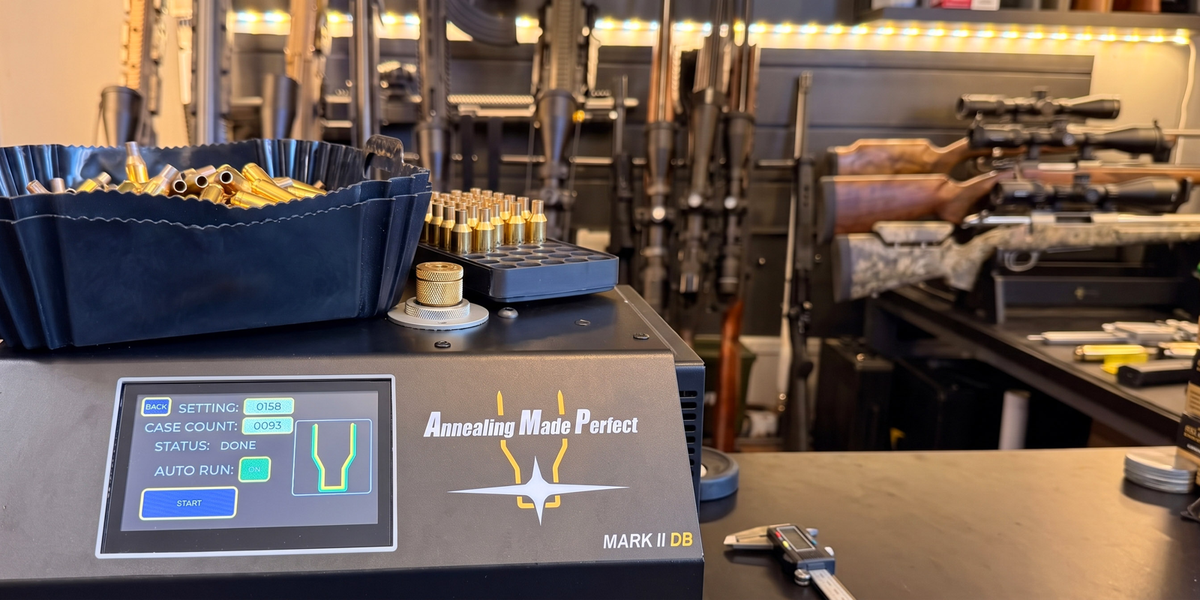
It cost me C$2,200, and I would buy it again.
Two case-head separations sent me looking for a way to make expensive brass last longer. A range officer introduced me to annealing while we were standing over the evidence.
That conversation needed a boundary. The AMP heats the neck and shoulder, plus a short section of the case body. The web and head stay outside the treated zone. A case already thinning near the head remains a retirement candidate. The separations started the search. Neck and shoulder consistency became the reason to continue.
I was starting from zero. Eight months and approximately 3,500 cases later, annealing has become a weekly step for every cartridge I reload. The AMP MARK II DB made the process approachable, repeatable, and difficult to abandon. I paid about C$2,200 before tax, and I would spend it again.
Holdover Score
Owner review · Eight months of weekly manual feeding · About 3,500 cases · Paid about C$2,200 before tax
The easiest route I know into controlled annealing for a high-volume handloader.
Five reloading-tool criteria, equal 20% weighting, whole-number criteria, overall rounded to one decimal. My personal verdict is 9/10; the scorecard grades the evidence I have today.
One sacrificial case buys a saved setting
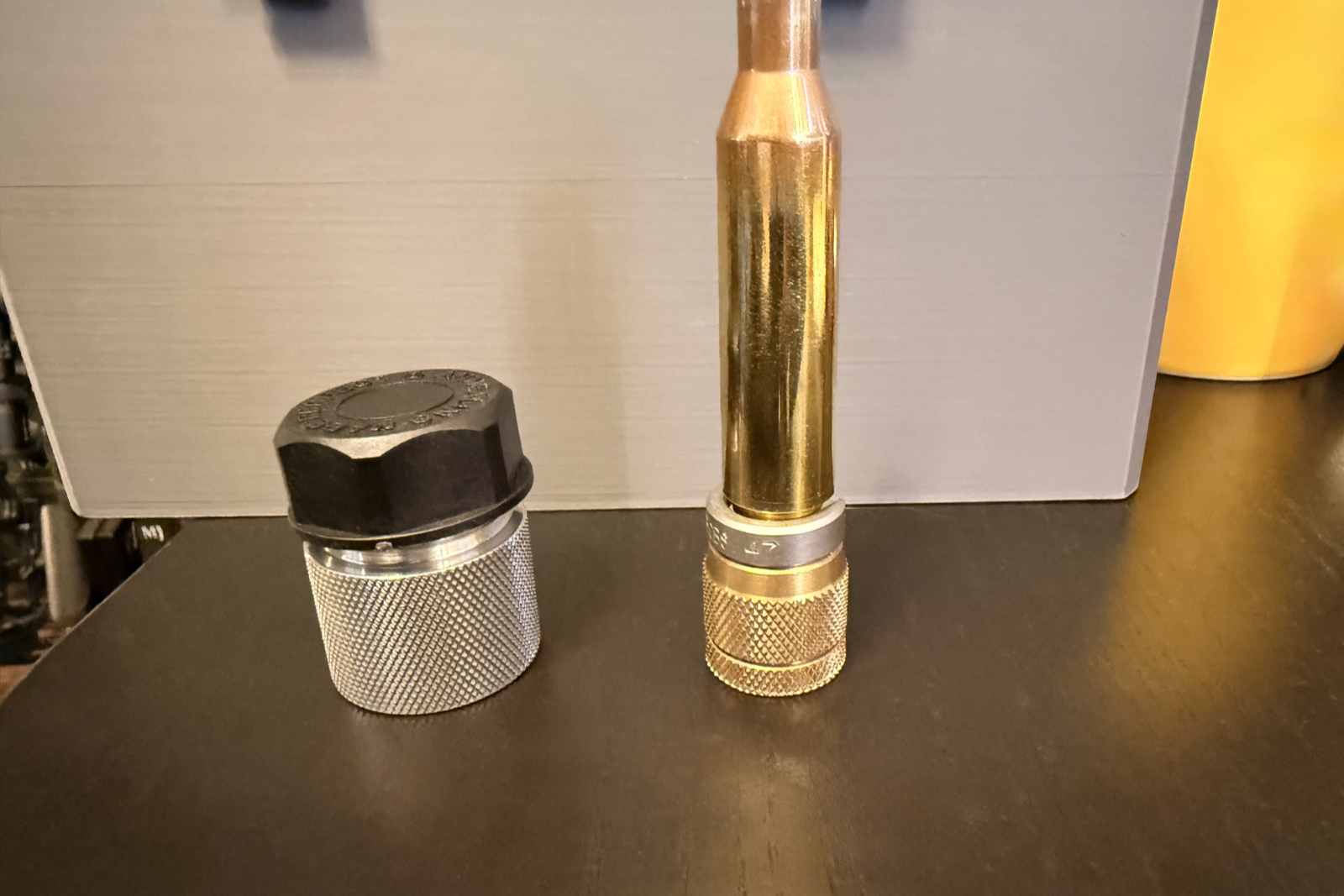
Getting started was easier than the price suggested. I watched a few videos, installed the correct pilot, and followed the AZTEC prompts. The machine includes one brass-holder grip. The depth-specific pilots are separate purchases, although some cartridges can share one. A ten-cartridge bench still accumulates extra hardware.
The machine analyses one representative, fire-formed, unsized case. That sacrificial case goes in the discard bin, and the resulting annealing setting can be named and recalled for later batches.
My first shorthand was one sacrificed case for each brand and cartridge. AMP's guidance is more exact. Brand, lot, case weight, and neck-wall dimensions can change the result, so a new lot may deserve its own analysis even when the headstamp stays the same. That costs one piece of brass. With premium Lapua cases, the sacrifice gets your attention.
The database is the DB model's central advantage. I can move among ten cartridge families without rebuilding the process from memory. The touchscreen works, although it behaves like a half-assed vehicle infotainment system following conventions from 2000 instead of 2026. Twice, a saved analysis appeared to vanish and cost me a second case. Those incidents may have been user error. The remaining settings have recalled cleanly.
3,500 cases established the rhythm
I use the AMP for 6 BR Norma, 6mm Creedmoor, 6.5 Creedmoor, .308 Winchester, .30-06 Springfield, 7 PRC, .300 PRC, .300 Winchester Magnum, .338 Lapua Magnum, and .375 EnABELR. A normal session covers 200 to 400 pieces.
The induction cycle usually takes two to five seconds. Manual feeding sets the real pace. By the time I place a case in the shell holder, drop it into the pilot, remove it, and move it to the cooling area, each piece has consumed about 15 to 20 seconds.
The workflow improves once the bench develops zones: waiting brass, the active pile, the annealer, and finished cases cooling nearby. The machine also develops heat. Its fan handles that job reliably, then announces itself at full speed with enough volume that I sometimes slow my feeding pace to delay it. The cooling system is doing useful work. Its volume still changes how quickly I feed cases.
At 11.5 by 11 by 8 inches, the unit also asks for real bench space. Mine sits on top of an industrial air purifier that I can roll forward for a batch and tuck away afterward. It is an undignified home for an indispensable tool.
The brass-life result carries several variables
Before this machine, some of my .338 Lapua cases reached five or six firings at most. My current experience has easily doubled that figure. Similar improvement across heavier cartridges is the main reason my personal score lands at nine.
I changed too many things at once to call this a laboratory result. I began using mandrels around the same time. I bought higher-quality brass. I also changed sizing practices. My records contain owner experience. They lack isolated neck-tension measurements, seating-force data, matched case batches, group comparisons, and velocity SD and ES.
AMP's published work supports improved repeatability in the neck and shoulder, which is the part the machine treats. A universal doubling of brass life sits beyond that evidence. Lapua takes a conservative official position and declines to recommend user re-annealing because it cannot guarantee the resulting dimensions or hardness. That disagreement belongs in a review involving Lapua brass.
I can defend a narrower conclusion. My brass life improved dramatically during eight months with the AMP, especially in .338 Lapua. Annealing was one of several changes. I still have measurement work ahead of me.
Who should spend C$2,200
XReload listed the MARK II DB at C$2,159.99 on sale when I checked on August 6, 2026, with a C$2,399.99 regular price. Pilots add to the total. That is a serious purchase. Casual experiments belong at a lower price.
The strongest buyer is a handloader processing substantial batches across several cartridges, especially someone already paying for premium brass and wanting a guided alternative to flame annealing. Saved programs become more valuable as the cartridge and brass list grows. My ten-cartridge use makes the machine work for its space.
Low-volume owners face harder arithmetic. A few small batches per year leave a long road to recovering C$2,200 through brass life. Other owners broadly echo the same split: AZTEC and saved profiles make the process easy, while price remains the recurring objection. Convenience carries part of the value even when a brass-cost spreadsheet remains unfinished.
Why I would buy it again
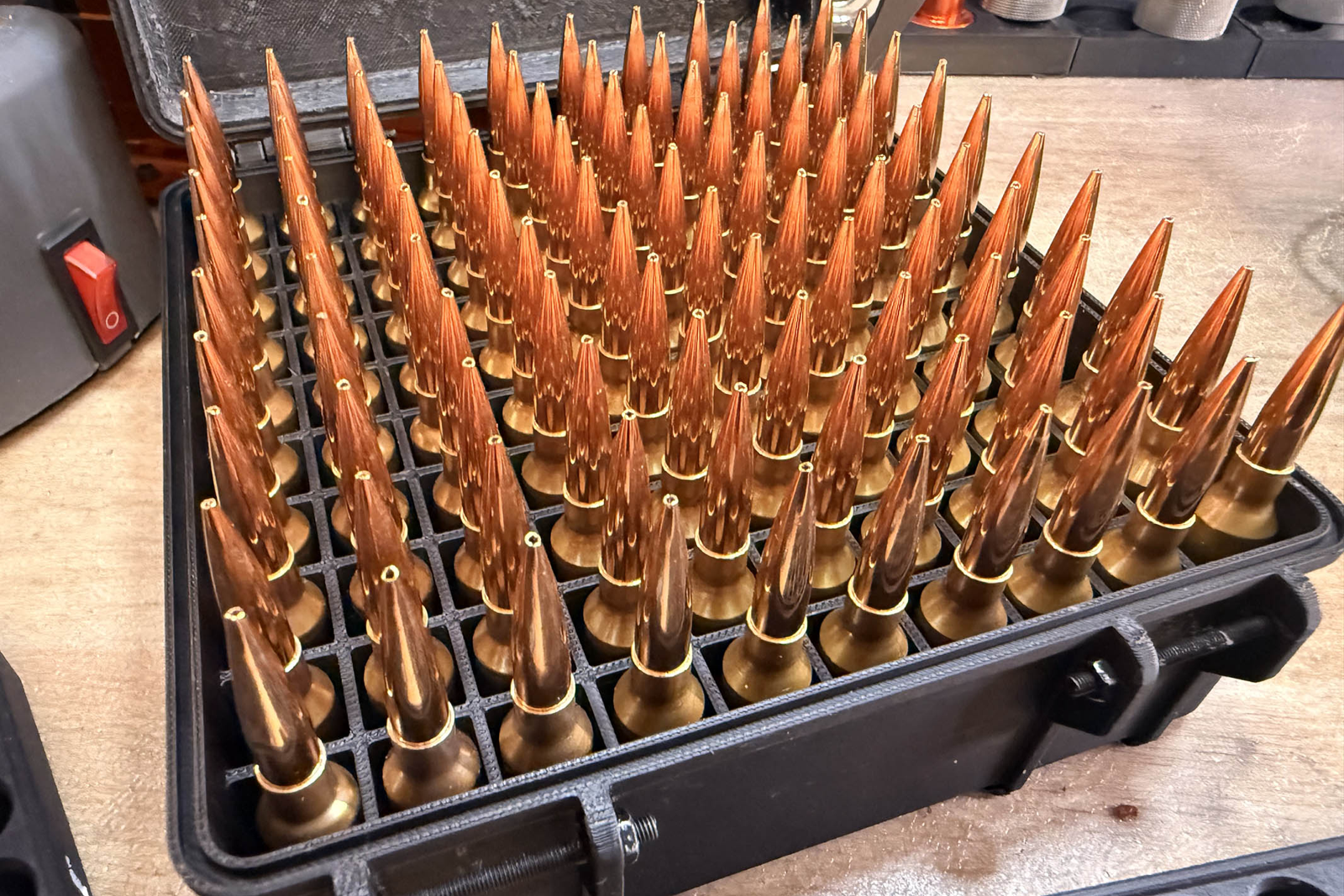
The build quality feels excellent. Every AMP component I have handled carries the same solid signature, and my unit has completed weekly work without a mechanical failure. The fan is loud. The screen feels old. The body occupies more space than I want to surrender permanently. None of those complaints has pushed annealing out of my process.
My gut score is 9/10. The Holdover scorecard lands at 8.2 because it grades the evidence I can defend today. I still need controlled neck-tension work, cleaner case-life records, and a real cost model. Either number leads to the same buying verdict.
For a serious handloader using expensive brass in meaningful volume, the AMP MARK II DB turns annealing from an intimidating extra skill into a saved, repeatable bench step. Mine will be back on the rolling air purifier next week.
Sources and review scope
This owner review reflects approximately eight months and 3,500 cases through my purchased unit. Its scope is workflow and ownership. Controlled metallurgy and operating instruction remain outside it.
- AMP, MARK II DB Annealer product page, accessed August 6, 2026.
- AMP, MARK II DB introduction, January 24, 2024.
- AMP, MARK II DB instructions and AZTEC guidance, accessed August 6, 2026.
- AMP, Annealing Under the Microscope, July 7, 2017, and follow-up testing, November 22, 2019.
- Lapua, What is the discoloration on my Lapua brass?, April 23, 2018.
- XReload, AMP MARK II DB listing, accessed August 6, 2026.
- Ultimate Reloader, AMP MARK II DB first look, May 8, 2024.
- F-Class John, AMP MARK II DB review, August 29, 2024.
- Reddit r/reloading, First-time annealing owner discussion, February 2, 2026.
- Hunting-Sport, verified-purchase owner review, July 13, 2026.
Set up the bench before the first mistake.
If this piece has you thinking about a first reloading bench, slow the buying part down and make the safety/process part visible.
Use the Holdover Reloading Bench Setup Checklist to track manuals, press, dies, scale, calipers, case prep, labels, storage, bench layout, safety routine, and what still needs an experienced second look.
Safety note: the checklist does not provide load data, recommend charge weights, teach reloading, or replace current published manuals, manufacturer instructions, qualified instruction, or applicable law.