“Assault-style”: Ottawa's label and the *missing crime count*
Ottawa says “assault-style” has no legal definition. The RCMP lacks a dedicated crime breakdown. What Q-1375 establishes, and why actual prohibitions still apply.

Opinion
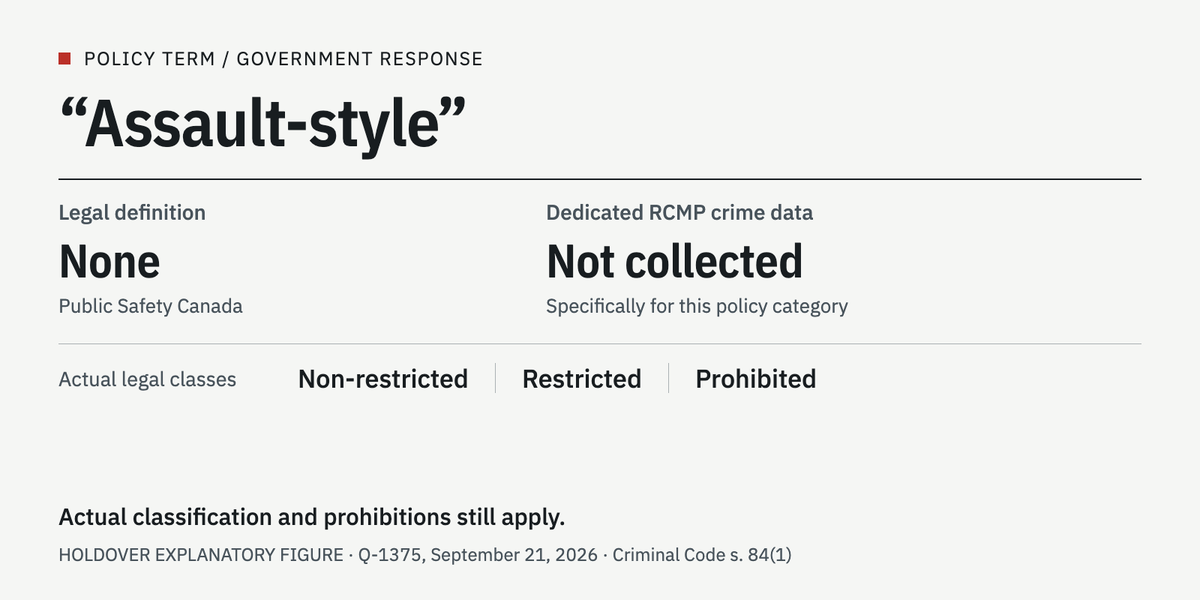
Public Safety Canada has given Parliament a plain answer about a phrase used to justify years of firearm prohibitions: "There is no legal definition of an assault-style firearm."
The department supplied that answer in its September 21 response to Conservative MP Alex Ruff's written question Q-1375. In the same government reply, the RCMP says it does not collect crime data specifically for that category. The requested breakdown would require manual work it could not complete within the allotted time.
For licensed owners, the useful question is how Ottawa connects the firearms it prohibits with the public-safety evidence it offers. Clear rules and a clear way to measure their effects should be part of the same policy.
Owners still have actual rules
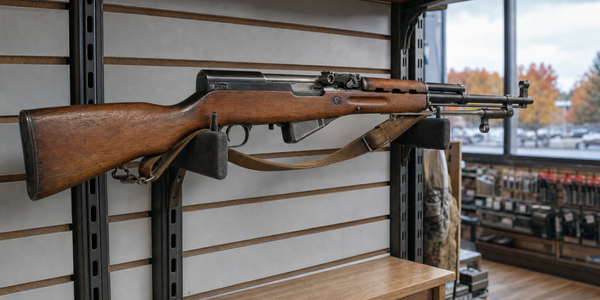
Canada's legal classifications remain non-restricted, restricted, and prohibited. Section 84 of the Criminal Code sets out those definitions. Cabinet also prescribes prohibited firearms through regulations listing firearms and other weapons.
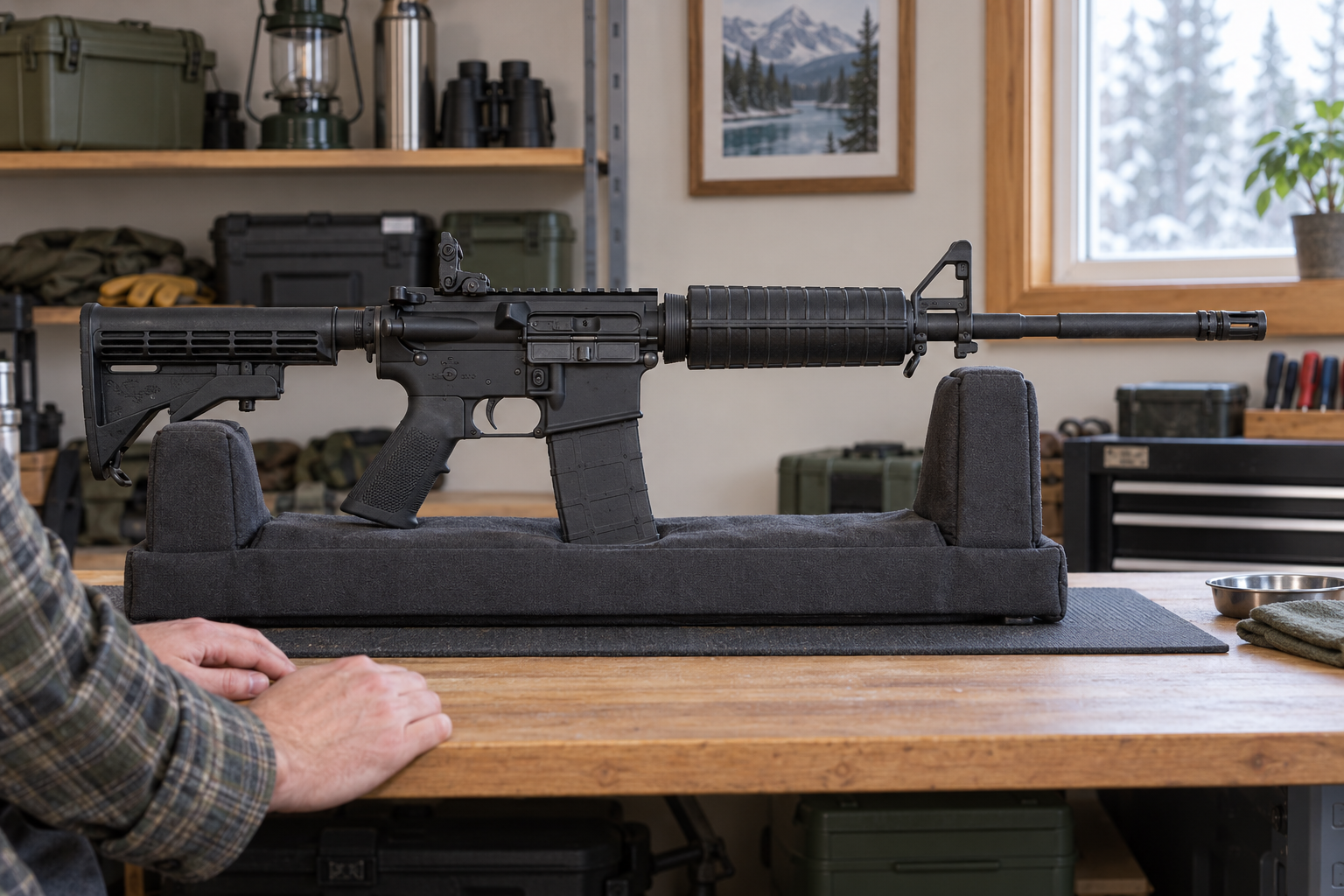
Those provisions continue to govern classification. The missing definition supplies no permission to use, sell, or transport a firearm contrary to the applicable law. An owner still needs the status of the particular firearm and the conditions that apply to it.
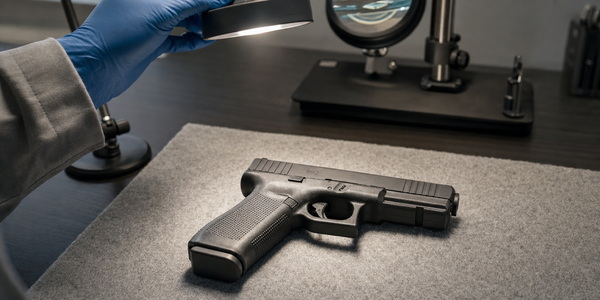
The RCMP describes its Firearms Reference Table as a technical reference for identification and classification. The table is an administrative reference; the Code and regulations supply the law. The legal basis and the reference used to identify a firearm have different jobs; readers should be able to follow the connection between them.
My day job is making complicated information usable. As a licensed owner, I have the same expectation here: a label should help me understand the rule it describes. If the government uses a broader policy term, it should explain how that term connects to the firearms and restrictions it means. Owners have enough paperwork without being handed a vocabulary puzzle.
The crime question needs a matching count
Ruff asked for traces involving the firearms prohibited in the May 2020, December 2024, and March 2025 measures, and for an assault-style breakdown by reference number, make, and model. The RCMP said the requested detail was not tracked in its existing database and could not be manually collected and validated within the response period.
That answer leaves the requested count unresolved. It does not establish zero criminal use or demonstrate that police hold no relevant firearm-level information. A department declining to produce a detailed breakdown within a deadline leaves a different question open: what work would let it produce a reliable one? Q-1375, responses (e)(iv), (h), (j), and (k).
In my view, Ottawa should publish a reproducible method for matching the firearms it targeted with the evidence it uses to defend that choice. A reader should be able to see the covered list, the period examined, and the limits of the comparison. Otherwise, the government can describe the policy population with confidence while leaving owners unable to check its crime claims against the same population.
Tracing answers a narrower question
The RCMP's 2025 Commissioner of Firearms report explains what tracing does: investigators follow a firearm from manufacture or importation through the distribution chain to identify its last known owner or business. That work can help police investigate trafficking and identify supply routes.
Statistics Canada's latest firearms and violent-crime study illustrates the limits of drawing broader conclusions. In its 2024 homicide data, recovery, submission for tracing, and successful identification of origin each narrow the set of firearms available for analysis. An origin finding describes the firearms that made it through those stages.
A trace total therefore needs its own explanation: what police submitted, what investigators could establish, and what remained outside the set. A claim about all Canadian crime guns would need evidence covering that larger population. Comparing one year's trace totals with another also requires checking whether submissions, coverage, and definitions stayed comparable.
This matters to an argument against sweeping prohibitions as much as it matters to the argument for them. A persuasive case for licensed ownership should survive a reader checking the denominator. I would rather leave a percentage out than give somebody a tidy number that answers the wrong question.
The policy case deserves a test
The government's strongest argument is about the potential severity of mass shootings. In the 2020 regulations' published rationale, it points to rapid-fire capability and other characteristics, and argues that the public-safety risk outweighs continued civilian use. Its case reaches beyond how often a particular model appears in ordinary crime statistics.
That argument deserves a fair hearing. The missing dedicated crime field alone cannot settle whether the prohibitions reduce risk. Establishing the effect would require an outcome the government intends to improve and evidence showing what changed, with the limits stated.
Licensed owners also bear a concrete consequence. Cabinet's prohibitions change the permitted use and disposal of firearms people acquired under earlier rules. Owners deserve a policy explanation that accounts for those restrictions and shows why the chosen intervention is proportionate.
I support lawful civilian ownership, and I want government effort directed where the evidence shows it can reduce harm. Q-1375 gives Parliament a useful starting point for scrutiny: ask Ottawa to connect its prescribed firearm lists, its stated public-safety objective, and a measurement method the public can examine. Owners should be able to read that explanation without having to supply the missing links themselves.
Sources
- House of Commons, Alex Ruff's Q-1375 and September 21, 2026 response
- House of Commons, full government response to Q-1375
- Criminal Code, section 84: firearm definitions
- Prescribed firearm and other weapon classifications, SOR/98-462
- RCMP, Firearms Reference Table
- RCMP, 2025 Commissioner of Firearms report: tracing
- Statistics Canada, Firearms and violent crime in Canada, 2024
- Canada Gazette, SOR/2020-96 and regulatory rationale
The amnesty file is still moving.
If this piece sent you back to government pages, do not wait for the next portal, Gazette, or court move to find you by accident.
The Dispatch follows Public Safety, RCMP, Canada Gazette, court, compensation, collection, and amnesty updates so the next change comes with the source that moved.
Safety note: the tracker is a worksheet for source hygiene, not legal advice or a substitute for current official guidance.