At $15,000, ask who will tighten the action
Five-figure clay shotguns make sense through fit, volume, and service. Price the people and parts that keep the action working.

Opinion. A Canadian thread moved from $1,000 first guns to $20,000 doubles in about 150 comments. The useful part arrived when somebody mentioned wear.
One r/canadaguns commenter described $15,000-plus shotguns as familiar equipment among serious clay shooters who expect very high round counts. That community observation carries no durability certificate. It still changes the question. A competition shotgun should be judged by the work it will do and the support that keeps it doing that work.
I understand the reflex to see two barrels, a hinge, some lovely walnut, and an invoice that escaped from a luxury-car dealership. The simple-looking mechanism carries a complicated purchase decision.
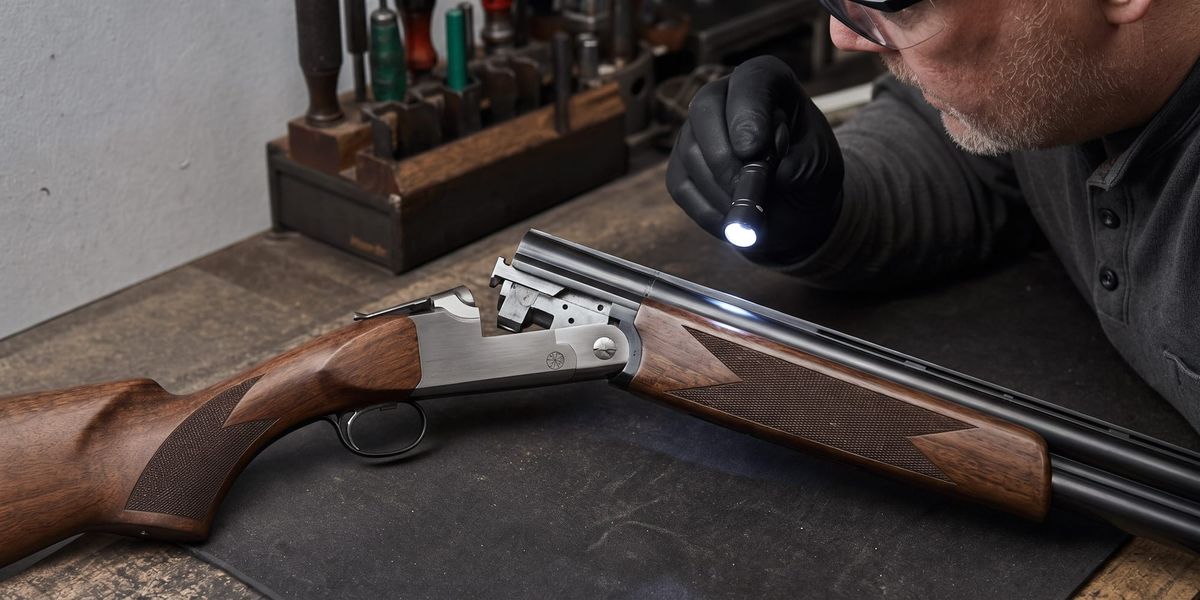
Holdover produced the feature as a fictional service-bench scene using official family-level mechanical references. The gunsmith, workshop, and unbranded over-under represent no named person, business, product, or documented repair.
Start with the schedule
The right price begins with the job. A shooter firing a few boxes each autumn has a different requirement from somebody practising weekly, travelling to matches, and opening the same action thousands of times a year.
The current Reddit discussion supplied the extreme claim: hundreds of thousands of rounds. Browning's current Citori 825 manual uses more careful language. It says hand-fitting and polishing support reliability and longevity after “many thousands of rounds.” That is still enough repetition to make bearing surfaces, springs, triggers, ejectors, ribs, stock hardware, and parts support part of the purchase.
A price tag predicts no score. It can buy dimensions, materials, fitting time, adjustment, and a design intended to be serviced. Those properties become valuable when the calendar uses them.
Write down the likely practice rounds, registered targets, travel days, and years of ownership. A vague ambition gives the invoice too much freedom. A real schedule gives it a denominator.
Fit spends the money first
A clay gun points through the shooter's body. The stock places the eye over the rib, manages where recoil arrives, and influences whether the mount repeats late in a long day.
Krieghoff's current resources describe different stock geometries for sporting, skeet, trap, ProSporter, ACS, and Parcours configurations. Adjustable combs, rib height, cast, pitch, and balance appear because disciplines and bodies ask different questions.
That makes fit a service that extends beyond a line in a specification table. Ask who will measure the shooter, adjust the comb and pad, confirm point of impact, and revisit the setup after real shooting. A beautiful stock with the wrong dimensions turns every mount into a negotiation.
The Canadian price ladder shows how quickly this gets serious. In an April Canadian Gun Nutz discussion, one member put a new Citori 825 with adjustable comb at $5,400 and focused on balance and fit. Krieghoff's official 2025 U.S. price book lists several K-80 competition configurations around US$15,695 to US$16,795, with combo configurations at US$23,495.
Those figures use different currencies, markets, configurations, and sources. They establish scale. Value still belongs to the particular shooter and use case.
The hinge comes with chores
Break-actions advertise their wear surfaces every time they open. The barrel assembly pivots on the receiver, the locking surfaces meet, and the forearm hardware carries another fitted interface.
Browning's manual tells owners to keep the broad fitted surfaces of the barrel lugs, hinge pin, and forearm bracket coated with grease. It calls for cleaning after every day of shooting and explains that care supports reliable function over a longer period. Browning's current 825 overview also describes a full-width hinge pin and a tapered locking bolt designed to adjust as wear develops.
The maintenance language matters more than the slogan. A buyer should learn which surfaces need grease, what normal tightness feels like, how the top lever changes as the action wears in, and which symptoms belong with a qualified gunsmith.
That knowledge protects a modest gun too. Price only changes the size of the mistake when it is ignored.
Buy the return address
A premium competition gun becomes easier to defend when the maker publishes a path back to working condition.
Krieghoff International's current service page describes work from maintenance through complete rebuilds. Its US$460 K-80 annual service includes complete disassembly, wear inspection, cleaning, lubrication, spring replacement as needed, timing and trigger adjustments, and tightening the barrel to the action when possible. That is a U.S. factory-service price. A Canadian owner still needs to confirm shipping, import and export requirements, insurance, turnaround, local alternatives, and current eligibility before treating it as a plan.
Ask five questions before paying:
- Which discipline and annual round count require this configuration?
- Who will fit the stock and verify point of impact?
- Which locking, spring, trigger, ejector, barrel-fit, and stock jobs can be serviced?
- Where will Canadian parts and qualified labour come from, and how long can the gun be away?
- How much of the invoice buys function, fit, support, and optional finish?
The fifth answer can include ornament. Fine wood and engraving have value to the buyer who wants them and prices them honestly. They carry no responsibility for lock-up or point of impact.
Let use set the ceiling
A low-volume shooter may answer those questions and stop far below five figures. A committed competitor may reach the other end with a coherent reason: the gun fits, the configuration matches the game, the service network is real, and the expected use makes long ownership plausible.
That is the useful distinction buried inside the price thread. Spending more becomes rational through a specific use case. Spending less becomes rational through the same test.
The right expensive gun comes with a use, a fit, and a return address.
Sources
- Reddit, What is the most you have, or would spend on a firearm purchase?: https://www.reddit.com/r/canadaguns/comments/1vkkmz0/what_is_the_most_you_have_or_would_spend_on_a/
- Browning, Citori 825 Over and Under Shotgun Owner's Manual: https://www.browning.com/support/owners-manuals/citori-825-shotgun.html
- Browning, Citori 825 Over & Under Shotgun Overview: https://www.browning.com/products/firearms/shotguns/citori-825/overview.html
- Krieghoff, Resources: https://www.krieghoff.com/resources/
- Krieghoff International, Gunsmithing: https://mbox.krieghoff.com/gunsmithing/
- Krieghoff, Competition Shotgun Price Book 2025: https://krieghoff.krieghoff.com/wp-content/uploads/Krieghoff-Competition-Shotgun-Price-List-2025.pdf
- Canadian Gun Nutz, Citori 825: https://www.canadiangunnutz.com/forum/threads/citori-825.2573627/
Keep the range notes worth reading later.
If this piece has you thinking about range time, keep the notes useful enough to read later.
Use the Holdover Range Bench Log Card to record rifle, optic, ammunition, distance, weather, zero, group notes, correction, and next test without turning a range trip into a memory test.
Safety note: the card is a note-taking worksheet, not shooting instruction, load data, legal advice, or a substitute for range rules, official guidance, manufacturer manuals, or qualified instruction.