ATF drops *NFA approvals* for suppressors. Canada keeps its ban.
ATF's October 9 suppressor policy removes specified U.S. NFA approval and registration requirements from enforcement. Canada's prohibited-device rule stays in place.

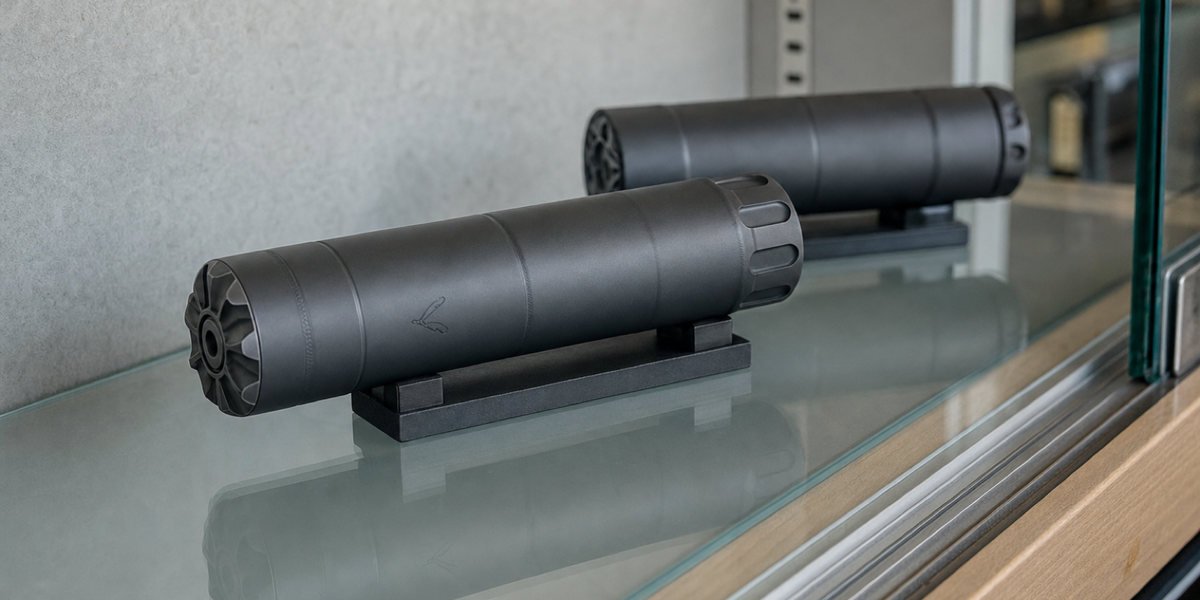
The United States has changed its federal treatment of suppressors again. On October 9, the Bureau of Alcohol, Tobacco, Firearms and Explosives said it would stop requiring advance National Firearms Act approval and registration for suppressors and several other categories of firearm. For a Canadian owner reading that announcement, the first useful distinction is geographic: Canada's prohibited-device rule remains in place.
That leaves quite a gap between two countries where shooters follow many of the same manufacturers and watch the same gear videos. My TM22 Feather wears a TNA reverse-style fake suppressor. The word “fake” does a fair amount of work in that equipment description. An American policy announcement gives me something new to read; it gives an ordinary Canadian firearms licence holder no new permission to acquire a real sound suppressor here.
I would welcome a serious Canadian discussion about allowing licensed owners to use sound moderators. This week's American change deserves an accurate explanation on its own terms, including the limits that remain south of the border.
What ATF changed on October 9
The signed ATF letter concerns items whose federal making and transfer taxes Congress reduced to zero: suppressors, short-barrelled rifles, short-barrelled shotguns and a separate statutory category called “any other weapons.” That last term is a defined category in U.S. law. It should be read in that specific sense.
A federal court had already blocked enforcement of specified requirements against the plaintiffs in a case challenging the remaining regime. ATF has now chosen to apply enforcement discretion nationwide. The agency says it will no longer require advance NFA approval for making or transferring those zero-tax items, or registration of them in the federal NFA registry.
For American buyers and businesses, the practical change reaches further than eliminating a tax payment. It removes the specified federal approval and registration requirements from ATF's current enforcement policy.
The legal mechanism matters. ATF is exercising discretion over enforcement of provisions that remain in the statute. Its current FAQ expressly addresses the possibility of enforcement resuming if circumstances change. It also says federal law provides no automatic grandfathering for unregistered items. Calling this a permanent repeal would promise more certainty than the agency itself offers.
The American rules that remain
The National Firearms Act is only one part of the U.S. framework. ATF says the Gun Control Act continues to apply, including applicable dealer records, background checks and restrictions on prohibited persons. State and local laws also remain in effect.
Businesses still have relevant occupational-tax obligations. Machine guns and destructive devices retain their existing NFA treatment. Voluntary registration remains available for the items covered by the new policy.
A Canadian reader should be able to understand the announcement without first working through American advocacy shorthand or assuming that every federal firearms requirement disappeared on Friday.
Canada keeps its own rule

Canada's Criminal Code definition of a prohibited device still includes a device designed or intended to muffle or stop a firearm's sound or report. The provision does not depend on what ATF requires for an American transfer.
For ordinary Canadian licensed owners following the American announcement, the relevant point is straightforward: Canada’s prohibited-device restrictions continue to apply to ordinary possession and acquisition licence holders. The American announcement creates no Canadian exemption. The Canada Border Services Agency's import memorandum sets out Canada's separate treatment of firearms, weapons and devices at the border.
A CBSA release published October 8 gives that distinction a concrete context. The agency says it intercepted a parcel arriving from the United States on July 23 containing two complete suppressors. It says a September 24 search at a Brampton residence recovered another suppressor attached to a firearm, along with other items. The resulting charges remain allegations.
Those events preceded ATF's October 9 announcement. They establish no consequence of the new American policy and no claim about a growing national trend. They do show why a U.S. source or a U.S. rule cannot answer the Canadian import question. The border agency applies Canadian law when the parcel reaches Canada.
A better question for Canadian policy
My interest is in whether Canadian policy can distinguish licensed sporting use from criminal misuse with rules that are workable for owners, retailers and enforcement. Sound moderators deserve to be discussed as actual equipment, with their benefits, limits and proposed controls described plainly. I would rather see that case argued openly than have Canadian shooters left to decode another country's change through a string of excited headlines.
The American decision adds a new comparison. It does not settle the Canadian policy argument, establish a Canadian timetable or tell us that our government is preparing a similar move. Any Canadian reform would need its own evidence, legal change and explanation of who could acquire and use the devices.
The free weekly Dispatch follows Canadian ownership and policy developments with the source material close at hand.
Sources
- ATF: October 9, 2026 open letter on zero-tax NFA items
- ATF: current NFA transfer guidance and FAQ
- ATF: October 9 guidance announcement
- Justice Laws: Criminal Code, section 84
- CBSA: Memorandum D19-13-2, importing and exporting firearms, weapons and devices
- CBSA: October 8 Brampton investigation announcement
The amnesty file is still moving.
If this piece sent you back to government pages, do not wait for the next portal, Gazette, or court move to find you by accident.
The Dispatch follows Public Safety, RCMP, Canada Gazette, court, compensation, collection, and amnesty updates so the next change comes with the source that moved.
Safety note: the tracker is a worksheet for source hygiene, not legal advice or a substitute for current official guidance.