18.6 inches, and the market exhaled
A CGN rifle thread says something useful about Canadian gear culture: after six years of bans and buyback pressure, non-restricted has become a feature.

Update, June 9, 2026. Public Safety Canada has extended the relevant amnesty period. The old the former fixed deadline date referenced below is no longer the operative expiry; the amended expiry is 90 days after the Supreme Court of Canada renders its decision.
Opinion. The most Canadian rifle specification this week was not the gas system, the stock, or the colour. It was 18.6 inches.
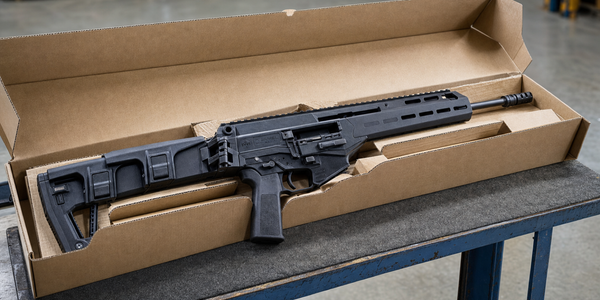
That number was doing a lot of work on Canadian Gun Nutz this week, where a North Sylva thread about the IWI Carmel CSR18 - an 18.6-inch Canadian non-restricted version - lit up quickly. A related Bullseye North pre-order thread listed the familiar modern-rifle ingredients: 5.56 NATO, semi-auto action, folding adjustable stock, STANAG magazine compatibility, adjustable gas, M-LOK handguard, and a free-floating barrel.
Useful details, all of them.
But the phrase that mattered was "Non-Restricted."
This is market commentary, not a Carmel review. The rifle still has to earn any performance judgement with real range time, real owner reports, and boring things like round count. What interests me is the reaction itself: a modern semi-auto rifle advertised as non-restricted, with an 18.6-inch barrel and an FRT note attached, made the market behave like someone had opened a window in a room stale since May 2020.
That tells us something about gear culture in Canada now.
What the thread is really about
New rifle enthusiasm is normal. Anyone who says otherwise has either forgotten the first time a tracking number ruined their workday, or has achieved a level of maturity that frankly sounds unpleasant.
The Carmel thread has the usual ingredients: people wanting one, people comparing it to other Canadian-market rifles, people arguing about looks, weight, price, timing, and whether the next federal move will make everyone regret feeling hope before lunch.
The stranger part is how much enthusiasm gathers around classification.
In a healthy market, "non-restricted" would be a legal category, not a headline feature. The rifle would stand or fall on reliability, accuracy, ergonomics, parts support, magazines, warranty, and whether it feels like a serious tool or a polymer argument. Instead, the first-order question is whether it still fits inside the remaining legal lane.
That is not the community being paranoid. That is the community being trained.
For newer shooters, this is worth understanding early. Canada does not let you shop for certain firearms by vibe. You shop through classification, model history, importer notes, retailer confidence, FRT entries, and whatever Ottawa changed while everyone was trying to have a normal hobby.
Why 18.6 inches lands so hard
The 18.6-inch detail matters because Canadian classification has made barrel length part of the consumer vocabulary.
The Criminal Code defines a restricted firearm to include a non-prohibited firearm with a barrel less than 470 mm that can discharge centre-fire ammunition semi-automatically. The RCMP explains the three basic classes: non-restricted, restricted, and prohibited.
Those exceptions are where the market now lives.
RCMP guidance on classification says criteria come from Criminal Code subsection 84(1) and corresponding regulations made by Orders in Council, and that only Parliament and the Governor in Council can change classification criteria. Public Safety Canada's buyback page says more than 2,500 makes and models have been banned since May 2020. Its current program page says the individual declaration period has ended, collection, deactivation, and compensation are expected to run from spring through early fall 2026, and the amnesty period now runs to the SCC appeals + 90-day endpoint.
Supporters of the federal approach will say the purpose is public safety: removing certain firearms from civilian circulation, providing compensation, and giving owners a way to comply. The problem is where the pressure lands. The people reading dealer descriptions for barrel length, FRT status, and classification are licensed owners, retailers, importers, and range people inside the system already.
Classification became part of the gear
When I started taking Canadian ownership seriously, I learned quickly that classification is not an abstract legal box. It sits beside the rifle in your notes. It affects the safe, the range plan, the used-market conversation, the retailer's risk, and whether a purchase feels like enjoyment or paperwork with a trigger guard.
That is why "FRT received" in a dealer post carries emotional weight. The FRT is not the law, as Holdover has argued before, but it is practical market intelligence. Buyers want to know whether the rifle has been through the system. Retailers and importers want confidence before deposits and barrel runs.
This is where Ottawa's policy choices have made the market stranger, not safer.
A modern rifle appears. The community does not only ask, "How does it shoot?" It asks, "Does this survive the current rules, and for how long?" That is a brutal question to put ahead of accuracy, handling, or reliability.
If you are new to the sport, do not mistake that caution for bitterness. Some of it is bitterness, obviously. We are Canadian, not made of decorative maple syrup. But underneath the sarcasm is competence: check the exact model, read the current source, and keep pre-order excitement in its lane.
What newer shooters should take from it
The lesson is not "buy the thing." The lesson is that Canadian firearms enthusiasm now has two layers. The first is normal: gear, price, performance, supply, comparisons, and the odd forum comment that belongs in a museum of human confidence. The second is the policy layer: classification, OIC history, FRT status, amnesty dates, compensation pathways, and whether a lawful owner can make a purchase without inheriting Ottawa's next administrative mood swing.
If you are a newer PAL holder wondering why experienced owners react so strongly to "Canadian non-restricted," this is why. The category still allows ordinary ownership, ordinary transport to the range, ordinary use, and ordinary participation in the sport without the additional restrictions and political baggage that have swallowed so much else.
Ordinary has become valuable. That may be the saddest gear-market sentence in Canada, but it is true.
Enjoy the gear, read the room
I like seeing Canadian shooters get excited about rifles. I like seeing retailers bring in new options. But the reaction around the Carmel CSR18 also shows the cost of the last six years. Federal policy did not remove the appetite. It made the legal category louder than the mechanical one.
A country that already licenses, screens, records, and regulates owners has decided to spend years making compliant people read spec sheets like court filings. Then it acts surprised when "non-restricted" becomes the feature everyone notices first.
The rifle still has to prove itself on the range. It may be excellent, mediocre, overpriced, underappreciated, or all of those things depending on the owner and the day.
But the market reaction has already proved something else.
Canadian shooters are still here. They are still interested. They are still reading the fine print. And after everything Ottawa has done to make ordinary ownership feel conditional, 18.6 inches was enough to make a lot of people look up.
Related Holdover Tools
Useful calculators and references from the same corner of the Holdover bench.
Sources
- Canadian Gun Nutz, "IWI CARMEL18.6” Canadian non restricted rifle CSR18": https://www.canadiangunnutz.com/forum/threads/iwi-carmel18-6%E2%80%9D-canadian-non-restricted-rifle-csr18.2580252/
- Canadian Gun Nutz / Bullseye North, "More Available: PRE-ORDER: IWI Carmel CSR18 Semi-Auto Rifle, 5.56 NATO, 18.6\" Barrel, Black Non-Restricted ": https://www.canadiangunnutz.com/forum/threads/more-available-pre-order-iwi-carmel-csr18-semi-auto-rifle-5-56-nato-18-6-barrel-black-non-restricted.2580321/
- Public Safety Canada, "Assault-Style Firearms Compensation Program": https://www.canada.ca/en/public-safety-canada/campaigns/firearms-buyback.html
- Public Safety Canada, "Number of assault-style firearms declared by province and territory": https://www.canada.ca/en/public-safety-canada/campaigns/firearms-buyback/number-firearms-declared-province-territory.html
- RCMP, "Classes of firearms in Canada": https://rcmp.ca/en/firearms/classes-firearms/classes-firearms-canada
- RCMP, "Classifying and re-classifying firearms": https://rcmp.ca/en/firearms/classes-firearms/classifying-and-classifying-firearms
- Department of Justice, Criminal Code, section 84: https://laws-lois.justice.gc.ca/eng/acts/C-46/section-84.html
- Department of Justice, Firearms Act: https://laws-lois.justice.gc.ca/eng/acts/F-11.6/
The amnesty file is still moving.
If this piece sent you back to government pages, do not wait for the next portal, Gazette, or court move to find you by accident.
The Dispatch follows Public Safety, RCMP, Canada Gazette, court, compensation, collection, and amnesty updates so the next change comes with the source that moved.
Safety note: the tracker is a worksheet for source hygiene, not legal advice or a substitute for current official guidance.