*1,400 yards* looks good on a rangefinder box
A first rangefinder should be chosen from its target-specific reach and the correction workflow it replaces. Current prices make the solver decision less obvious.

Gear. Leupold puts three limits on the RX-1400i product page: 1,400 yards to a reflective target, 1,200 to a tree, and 900 to a deer. The largest number gets the headline. The other two tell a shooter far more about the purchase.
My current range world is built around 100- and 300-yard lanes at Stittsville. At those distances, all three numbers are extravagant. They still show the first useful lesson in buying a laser rangefinder: find the specification for the target you expect to range, then decide how much work the device should do after it returns the distance.
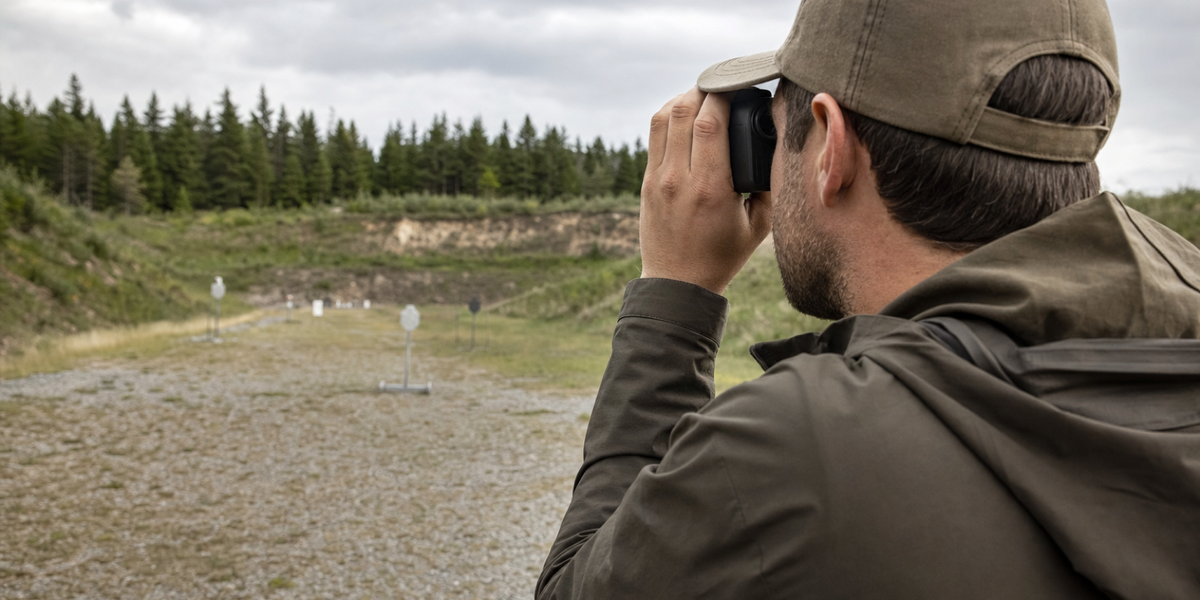
Holdover produced the feature as a fictional range scene. The person, range, and compact monocular are generic and make no exact product or measured-performance claim. The named rangefinders below are current market examples based on published specifications and prices; this article contains no hands-on verdict.
The target line earns the first look
A laser rangefinder sends a pulse toward an object, measures the return, and calculates distance. Dark, small, soft, angled, or irregular targets return less useful energy than a bright road sign or another reflective surface. Manufacturers publish different limits because the target changes the result.
Leupold's current guide tells buyers to compare deer, tree, and reflective ranges. Vortex does the same. Its Razor HD 4000 GB lists 4,000 yards to reflective material, 2,500 to a tree, and 2,200 to a deer.
Those gaps turn the box number into a ceiling under favourable conditions. A target-specific figure gives a better planning number. A steel plate can behave differently from an animal, tree, or berm, and weather adds another variable. The useful question at the counter is concrete: does this unit have comfortable margin on the least reflective target and farthest distance I expect to use?
For a 100- or 300-yard range lane, current entry and mid-tier units carry plenty of published reach. Display quality, target modes, scan behaviour, speed, warranty, and the correction workflow can take over from there.
US$150 buys a different workflow
The 2026 price gap between basic ballistic help and an onboard solver has become small enough to make the first-buy decision interesting.
Leupold lists the RX-1400i TBR/W Gen 2 at US$199.99. It ranges, compensates for angle, and uses 25 ballistic groups to show shoot-to distance, MOA, MIL, inch, centimetre, and fixed 10 mph wind values. That covers a lot of ordinary range and hunting use in a five-ounce monocular.
SIG lists the KILO3K at US$349.99. The extra US$150 adds Applied Ballistics Ultralight, onboard temperature, pressure, and humidity sensors, G1/G7 profiles, and displayed elevation and windage solutions in MOA or MIL. Its embedded BDX-U solver runs to 800 metres. A compatible external Applied Ballistics Elite device extends the workflow beyond that through BDX-X.
Vortex lists the Razor HD 4000 GB at US$1,199.99. That buys a different class of glass, reach, environmental sensing, target modes, and an onboard GeoBallistics system with custom profiles and wind tools. It also adds US$850 over the KILO3K before Canadian exchange and retail enter the room.
This is where the old advice needs care. A solver-equipped monocular has moved close to the lower tier. A shooter heading toward unknown-distance targets, hunting in angled terrain, or working against a stage clock can make a rational first purchase at the SIG price. The solver can earn its place from day one when it removes a step the shooter will use.
The solver should replace a step
A distance starts the firing solution. The shooter still needs a confirmed rifle profile, muzzle velocity, zero, bullet data, and current conditions. Every solver can produce a precise answer from optimistic inputs. That is a tidy way to miss.
At my usual 100 and 300 yards, a rangefinder paired with a range card or phone app keeps the process visible. Hornady offers a free ballistic calculator, and Applied Ballistics now offers the free-to-download Quantum app for iOS and Android. That arrangement lets a shooter see distance, profile, and correction as separate inputs.
An onboard solver compresses those steps. The value rises when time, angle, weather, or target changes make the phone routine clumsy. It also asks for profile setup and verification. The useful buying question becomes easy to say out loud: which step am I paying this device to remove?
A clear answer supports either choice. General fear of replacing a cheaper unit in a year supports an expensive receipt.
Canadian price changes the shelf
The manufacturer figures above are US dollars. A March 24 Canadian dealer list showed the Vortex Crossfire HD 1400 at CAD $319.99, the Diamondback HD 2000 at CAD $469.99, and the Razor HD 4000 GB at CAD $1,249.99. Stock and discounts move, so the exact SKU, warranty channel, and current Canadian quote belong in the final comparison.
The used market also deserves normal optics caution. Check the display, controls, laser return on several target types, lenses, seals, battery compartment, warranty terms, and model support. A laser rangefinder contains glass and electronics. Its condition deserves more than one successful button press across a store.
Licensed Canadian shooters can handle this decision without a universal answer. The person shooting known-distance steel at 300 yards has a different workflow from the hunter ranging a dark animal across a cutline or the competitor moving through unknown targets on a clock. Current gear serves all three. The price follows the amount of work moved into the monocular.
Buy the distance you can use and the workflow you understand. The hero number can stay on the box.
Sources
- Leupold, RX-1400i TBR/W Gen 2, accessed July 21, 2026.
- Leupold, How to choose a rangefinder, accessed July 21, 2026.
- SIG Sauer, KILO3K 6x22 mm, accessed July 21, 2026.
- SIG Sauer, KILO3K operator manual, accessed July 21, 2026.
- Vortex Optics, Razor HD 4000 GB, accessed July 21, 2026.
- Hornady, Ballistic calculators, accessed July 21, 2026.
- Applied Ballistics, AB Quantum, accessed July 21, 2026.
- Prairie Gun Traders, Optics for sale in Canada, March 24, 2026, accessed July 21, 2026.
Keep the range notes worth reading later.
If this piece has you thinking about range time, keep the notes useful enough to read later.
Use the Holdover Range Bench Log Card to record rifle, optic, ammunition, distance, weather, zero, group notes, correction, and next test without turning a range trip into a memory test.
Safety note: the card is a note-taking worksheet, not shooting instruction, load data, legal advice, or a substitute for range rules, official guidance, manufacturer manuals, or qualified instruction.