Four ammo increases in nine months
Four supplier increases took effect between October and June. For Canadian shooters, the useful number is the replacement cost of a full season.

Ammunition / Canadian Context. Four ammunition price increases took effect between October 1, 2025 and June 1, 2026. The percentages varied by brand and product line. Together, the notices tell Canadian shooters what to watch when a retailer replaces the stock already sitting on its shelf.
The sequence began with a Kinetic Group increase on October 1. Target Sports USA reported 5-7% on standard rifle ammunition, 7-10% on shotshells, and 3-12% on handgun ammunition, depending on the product.
Winchester followed on January 1. A dealer notice reported by USA Carry set increases of 3-8%. Federal, CCI, and Remington prices moved again on April 1, generally 2-10% across rifle, handgun, rimfire, and shotshell categories. A fourth notice added 3% to selected Federal, CCI, and Remington rifle and promotional handgun lines on June 1.
Those are supplier effective dates. A Canadian shelf can move later because a shop may still have older inventory, a distributor may have bought ahead, or a promotion may temporarily absorb part of the change. The notices still matter. They change the likely cost of the next order.
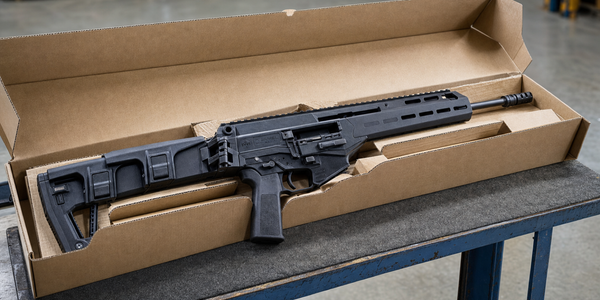
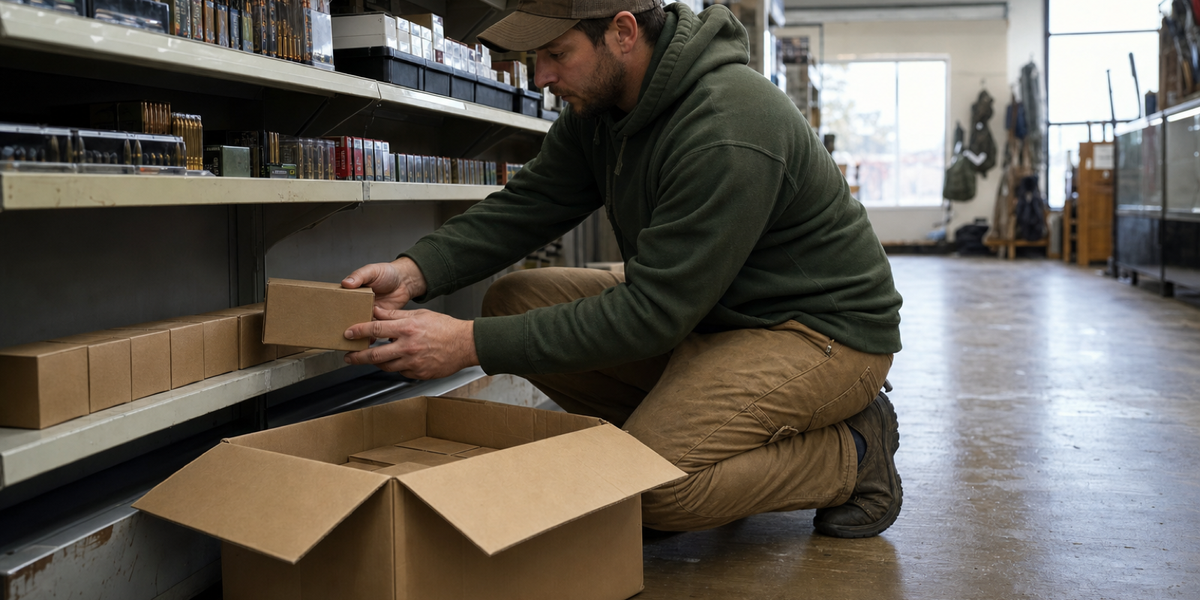
Holdover produced the feature as a fictional Canadian sporting retailer receiving replacement stock before opening. The worker, store, and products are representative. The photograph does not document a real retailer, employee, brand, shipment, or price.
The tariff explanation has an expiry date
Canada imposed a 25% surtax on a list of U.S. goods in March 2025. The list included tariff items covering shotshell cartridges and other cartridges.
That surtax was repealed effective September 1, 2025. The October increase arrived one month later. The January, April, and June increases followed after the repeal.
Inventory can preserve an old cost for a while, in either direction. Currency, freight, distributor margins, and retailer overhead also remain in the Canadian price. The repeal supplies an important boundary: Canada's 2025 counter-tariff cannot explain the later manufacturer effective dates by itself.
The manufacturers' own economics offer a stronger clue. Olin, Winchester's parent company, reported $58.1 million in higher 2025 Winchester costs, including commodity metals and propellant. It also reported $42.1 million in lower product pricing. One annual report does not explain every line on the four notices. It does show a business facing higher inputs while commercial pricing remained under pressure.
Price the rounds you will replace
My own range rotation can use 150-200 rounds in an active week. At that volume, a modest percentage across a season becomes a participation cost. The useful calculation starts with rounds, not boxes.
Write down each cartridge you expect to shoot through the rest of the year. Include practice, a match or hunt, and the rounds needed to confirm a rifle after a change. Multiply those quantities by the current replacement price from the same retailer and package size. That gives you a working season cost.
The method also shows where a change matters. A cartridge used for two careful range sessions creates a different exposure from the rimfire rifle that goes through several bricks. A sale on current stock may be worthwhile when it matches the season plan. A discounted box that does not fit the plan simply moves money from the ammunition budget to the shelf.
Handloading belongs in the same calculation. Brass life, bullets, primers, powder, equipment, and time all carry costs. A handload can deliver the performance or supply control a particular rifle needs. It should earn its place on those terms rather than through an assumed saving.
Keep the comparison clean when you check Canadian stores. Match the same cartridge, bullet weight, package quantity, and product line. Record the unit price on the same date, then add shipping or pickup costs that apply to the order. A case-price banner and a single-box promotion can look comparable while describing very different purchases.
The exercise also separates an opportunity from a warning. Older stock at a fair price can cover ammunition you already expect to use. A sparse shelf may simply reflect the retailer's order cycle. The documented signal in this article is the sequence of supplier increases. Your own quantity plan decides whether that signal calls for a purchase this month.
Domestic capacity is a longer file
Ottawa announced $1.4 billion for domestic ammunition production in April. The package includes $355.7 million for nitrocellulose production at Valleyfield, $57.9 million for propelling-charge capacity there, and $642 million for 155 mm ammunition capacity at Le Gardeur.
That is meaningful industrial capacity. The announced projects serve Canada's defence supply chain. They do not promise consumer canister powder, rimfire cartridges, shotshells, or lower retail prices for licensed owners.
The distinction matters because Canadian shooters have an immediate household question and Canada has a longer industrial question. The household question is how many rounds a season requires at the next replacement cost. The industrial question is whether Canadian capacity eventually reaches more civilian components and sporting ammunition.
Four increases in nine months give the first question some urgency. They do not require panic. Count the rounds, compare the same products on the same date, and buy against a real season.
The shelf price is today's invitation. Replacement cost is the number that plans the year.
Sources
- Target Sports USA, [Kinetic Group Inc. Announces Price Increase Effective
October 1, 2025](https://blog.targetsportsusa.com/kinetic-group-inc-price-increase/), August 14, 2025.
- USA Carry, [Winchester to Raise Ammo Prices 3-8% Starting January 1,
2026](https://www.usacarry.com/buy-now-or-pay-more-later-winchester-to-raise-ammo-prices-3-8-starting-january-1-2026/), November 5, 2025.
- Target Sports USA, [Federal, CCI, Remington Ammo Price Increase - April
2026](https://blog.targetsportsusa.com/federal-cci-remington-ammo-price-increase-april-2026/), February 13, 2026.
- Target Sports USA, [Ammo Price Increase Coming June
2026](https://blog.targetsportsusa.com/ammo-price-increase-june-2026/), April 15, 2026.
- Olin Corporation, [2025 Form
10-K](https://www.sec.gov/Archives/edgar/data/74303/000007430326000027/oln-20251231.htm), filed February 24, 2026.
- Canada Gazette, [Order Repealing the United States Surtax Order (2025):
SOR/2025-181](https://gazette.gc.ca/rp-pr/p2/2025/2025-09-10/html/sor-dors181-eng.html), September 1, 2025.
- Department of Finance Canada, [List of products from the United States
subject to 25 per cent tariffs](https://www.canada.ca/en/department-finance/news/2025/02/list-of-products-from-the-united-states-subject-to-25-per-cent-tariffs-effective-february-4-2025.html), 2025.
- Department of National Defence, [Minister Lightbound underscores investment
of $1.4 billion into domestic ammunition production](https://www.canada.ca/en/department-national-defence/news/2026/04/minister-lightbound-underscores-investment-of-14-billion-into-domestic-ammunition-production.html), April 8, 2026.
Shortlist the rifle before the checkout page.
If this piece helped you narrow the rifle question, keep the tradeoffs visible before the next tab becomes a shopping cart.
Use the Holdover Rifle Cartridge Shortlist Card to compare use case, distance, recoil, ammunition availability, rifle fit, optics plan, budget, and what you will actually practice.
Safety note: the card is a planning worksheet, not buying advice, legal advice, hunting guidance, load data, or a substitute for current manufacturer, range, provincial, federal, or qualified-instructor guidance.