Lyman Brass Smith Case Trim Xpress *review* after a year on the bench
After more than a year, two failed trimmers, and more than 2,000 cases across nine cartridges, the Lyman Brass Smith Case Trim Xpress has earned a permanent spot on my bench. It only trims. That turns out to be enough.

Handloading reference Open the guide
It cost me about C$300 for the core unit, plus a bushing for every magnum Lyman forgot to include, and I would buy it again.
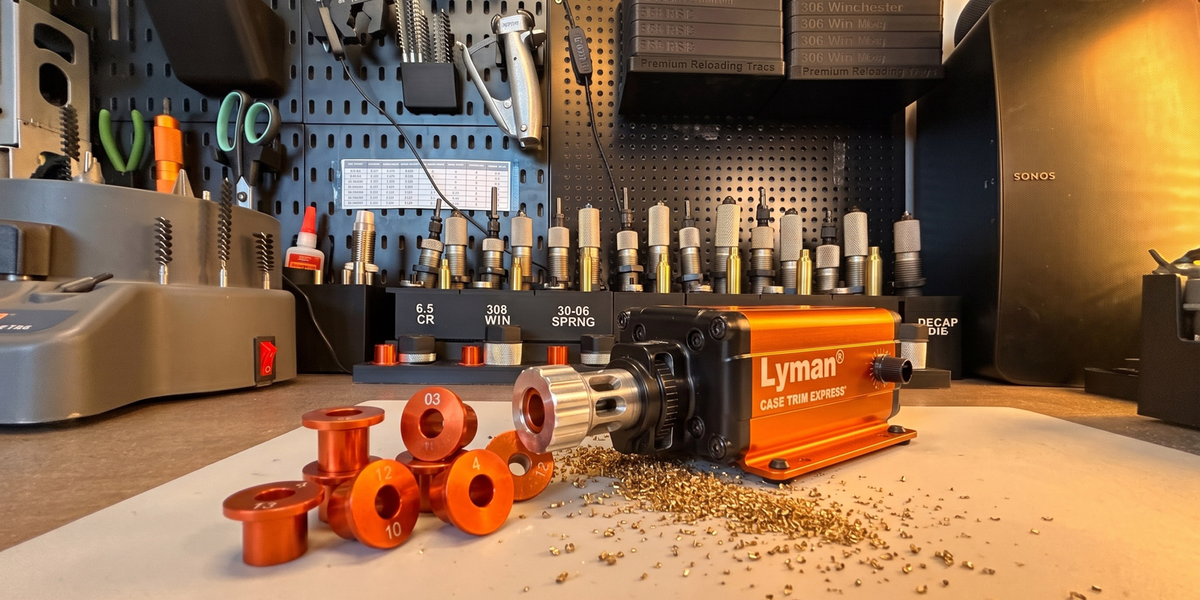
The Lyman Brass Smith Case Trim Xpress is a small, motorized, single-purpose tool. It trims bottleneck rifle brass to length. It does not chamfer, it does not deburr, and it does not care what you paid for the rifle the brass came out of. After more than a year and somewhere between 2,000 and 2,500 cases in nine cartridges, from 6 BR Norma up to .338 Lapua Magnum, it has become the part of my case prep I think about least. For a bench tool, and for a guy on his third powered trimmer, that is the highest compliment I have.
Holdover Score
Owner review · 115V case trimmer · More than one year · About 2,000 to 2,500 cases across nine cartridges · Canadian price check: September 1, 2026
For a Canadian handloader running several bottleneck cartridges, the Case Trim Xpress makes trimming repeatable and forgettable enough to justify its second station and hard-to-find bushings.
Five reloading-tool criteria, equal 20% weighting, whole-number criteria, overall rounded to one decimal.
The bushing does the centring, and that is the whole trick
Most case trimmers hold the case by the head and locate the cut from the base. The Case Trim Xpress does the opposite. A spring-loaded bushing with a conical mouth sits in front of a carbide cutter. You push the case into the bushing, the bushing seats on the case shoulder, the spring compresses, and the case mouth meets the cutter. When the spring bottoms out, the cut is done. Pull the case out, pick up the next one.
Because the bushing indexes on the shoulder, there is no pilot to fit, no collet to tighten, and nothing to clamp. Lyman claims about 15 cases a minute. Shooting Illustrated timed closer to 10. Either number is fast enough that the trimmer stops being the bottleneck and your chamfer tool becomes it.
Trim length is set with an adjustment wheel graduated in .001 inch increments. Clockwise backs the cutter off for a longer case, counter-clockwise takes more. The cutter is a carbide head Lyman describes as lifetime, replaceable through a set screw if you ever manage to kill it. The motor is a 29 volt DC unit with variable speed, and a chip guard fits over the cutter to keep most of the brass shavings out of your coffee.
Two design consequences follow from the shoulder-indexing idea, and both matter more than the spec sheet.
First, it is for bottleneck cases only. Lyman prints this with two exclamation marks, which is about as excited as an instruction manual gets. Straight-wall shooters need a different tool.
Second, the trimmer is only as consistent as your shoulder bump. It measures from the shoulder, so a case that was sized .002 inch longer than its neighbour will trim .002 inch differently. Clean and size first, every time. The manual says so, and for once the manual is right.
Two trimmers had to fail first
The Case Trim Xpress is my third powered trimmer in a few years, which says something about me and something about the category.
The first was the RCBS Trim Pro-2. On paper, the spring-loaded "universal" shell holder is the selling point: one holder, every rim, no shell holder collection to buy. In practice it is a stack of seven disc washers and a pair of chamfered jaws that grip the extractor groove, and the whole assembly is built like an afterthought. It handled magnum cases terribly. RCBS's own troubleshooting page tells you to pull a washer out for .338 Lapua and to brush the brass shavings out of the knurling when the tension goes inconsistent, which is a polite way of saying the holder needs maintenance to do its one job. The spring tension on mine wore out quickly, and I got tired of fighting a shell holder just to get a case seated. Trimming is supposed to be the boring step. The Trim Pro-2 made it the annoying one.
The second was the Frankford Arsenal Platinum Series Case Prep and Trim System. It is the better idea. It indexes on the shoulder the way the Lyman does, and it hangs the chamfer, deburr, and primer pocket tools off the same motor, so one station does the whole job. My problem with it was administrative. The trimmer covers everything from .17 Remington to .460 Weatherby with three collets, six bushings, and the occasional washer, and for nine cartridges that meant remembering which combination each one wanted. I never remembered. I had a chart. The chart and I drifted apart. Caliber changes turned into a small research project, and the trimmer started sitting.
The Lyman answers both complaints with one part. There is no shell holder at all, so there is nothing to wear out and nothing to fight. And each cartridge family gets a single bushing with its number stamped on the face, so the only thing to remember is a number, and it is printed on the part that is already in the tool.
Nine cartridges established the rhythm
I use the Case Trim Xpress for 6 BR Norma, 6mm Creedmoor, 6.5 Creedmoor, .308 Winchester, .30-06 Springfield, 7 PRC, .300 PRC, .300 Winchester Magnum, and .338 Lapua Magnum.
The trimmer ships with 10 bushings. Six of my nine cartridges are covered out of the box. The #13 bushing handles the 6 BR, 6mm Creedmoor, and 6.5 Creedmoor, since all three share the same shoulder geometry. The #12 covers .308 Winchester, the #10 covers .30-06, and the #18 covers .300 Winchester Magnum along with 7mm Remington Magnum and the .264 and .338 Winchester Magnums.
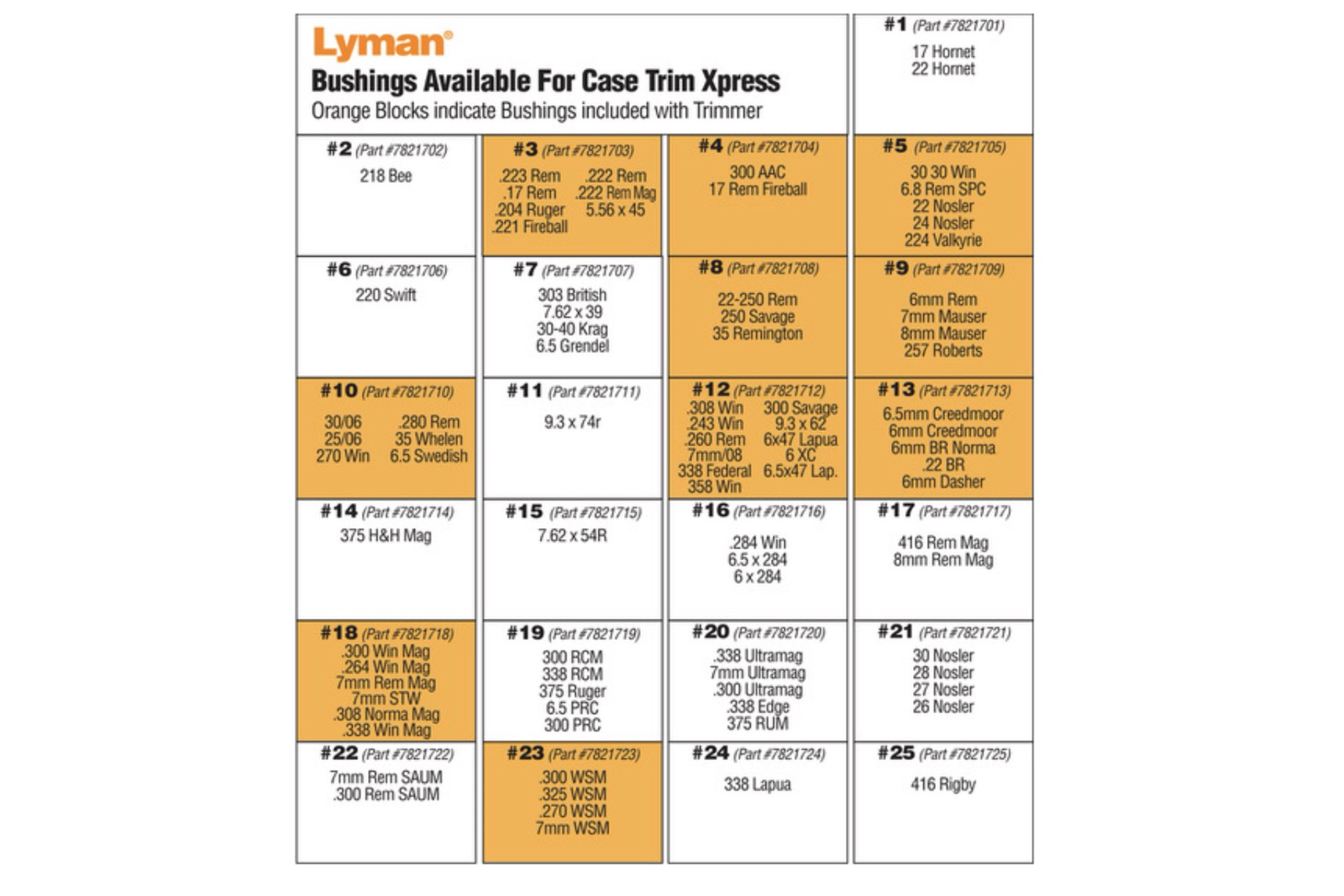
The magnums I actually shoot most were the ones Lyman left out. The .300 PRC needs the #19 bushing, which also covers 6.5 PRC and .375 Ruger. The .338 Lapua needs the #24, which covers nothing else because nothing else has that shoulder. Both were separate purchases. The 7 PRC is not on Lyman's chart at all, because the chart predates the cartridge. It shares its case head and shoulder angle with the 6.5 PRC and .300 PRC, so I run it in the same #19 bushing as the .300 PRC, and it has been fine.
This is where the Canadian part of the story goes sideways, and it is my biggest complaint about the whole system. Getting Case Trim Xpress bushings in this country is next to impossible. X-Reload carries some of the numbers and has been understocked on them for the better part of a year. Rusty Wood Trading lists nine of the twenty-five at C$18.50 each when they have them, and #19 is not one of the nine. Everyone else either does not carry them or lists them and cannot ship them. I have spent more time hunting bushings than I have spent trimming with them. If you are buying this trimmer for a cartridge Lyman did not put in the box, order the bushing first and the trimmer second, and do not be surprised when the bushing takes longer.
Caliber changes take a minute. Unscrew the bushing cap, swap the bushing with the number facing you, confirm the spring is still in there, screw the cap back on. Then the ritual the AMP taught me: sacrifice one case. Run it in with the wheel backed off until the cutter barely kisses the mouth, take one mark, trim, measure, adjust, trim again. Two or three cases gets you on the number. For 6.5 Creedmoor that is 1.910 inches. For .338 Lapua it is 2.714 inches, and the wheel has a long walk between the two, so switching from a short case to a long one is a lot of clicks. Write the wheel position down for each cartridge. I did not for the first few months, which is why I now do.
Once it is dialled in, the rhythm is push, pause, pull, next. The manual asks for hearing protection, and the sharp chips make safety glasses mandatory. The work itself is almost boring. Boring is what you want from a trimmer.
Within a thou, if your sizing is
I have not run a formal 50-case study on mine, so I will lean on the people who did. Shooting Illustrated measured under .0005 inch of variation across 50 trimmed cases. AccurateShooter's Daily Bulletin held within .001 inch through more than 80 pieces. My calipers agree with the general shape of that. A batch of sized brass goes in scattered by several thousandths and comes out inside a thou of the target length, which is better than a hand-cranked trimmer manages on a good day and roughly what a neck-turning setup needs to start from.
The variation that does show up is almost always upstream. A case with a slightly different shoulder bump trims to a slightly different length, because the tool is faithfully measuring from the shoulder you gave it. Sort your bump, and the trimmer stops being the variable.
The spring will find your thumb
Nearly every owner review of this trimmer mentions the spring, and every one of them is right. The return spring is stiff. On a short session it is nothing. Somewhere past the first hundred cases it starts winning, and by the end of a long batch of magnum brass your thumb and forefinger know exactly where the case rim was. Sniper's Hide owners recommend a thin leather glove. I recommend the same, plus not doing 400 pieces of .338 Lapua the night before you need those fingers for something.
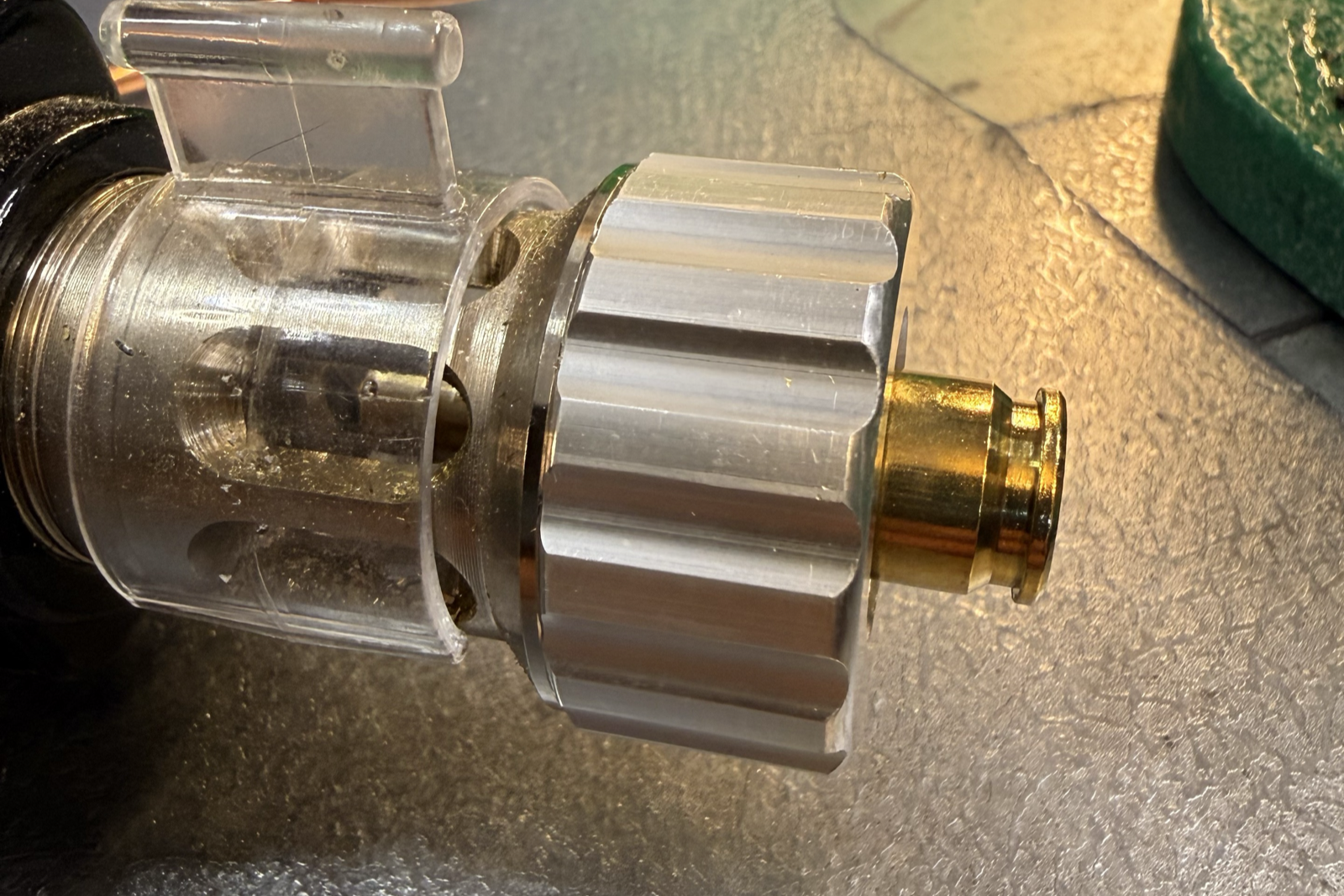
The other operating note is speed. Run the motor at its upper range. At low RPM the cutter can grab the case and try to take it out of your hand, which is unpleasant with a spinning carbide head. The manual asks for the highest speed setting for a reason. Firm, even pressure, fast cutter, no drama.
Occasionally the cutter can bind on a case with a thick mouth or a leftover burr and make a noise you will not enjoy. Back it out, check that the wheel has not moved, carry on. A Brownells reviewer reports it often enough to complain, so it is worth knowing the sound before you hear it.
It only trims, and the second station is the price
This is the real limitation. The Case Trim Xpress leaves a square, clean, burr-light case mouth that still needs an inside chamfer and an outside deburr before you seat a bullet. Every case makes a second stop. A hand tool or a powered prep centre handles it, but it is a second motion for every piece of brass, and on a big batch you feel it.
I knew that going in. The Frankford Arsenal unit did chamfer and deburr on the same motor, and I still traded it for a trimmer that does neither, because the trimming half of the Frankford was the half I could not live with. A second station I can tolerate. A caliber change I have to research, I cannot.
The bench math is where this gets funny. The trimmer itself is tiny, a fraction of the Frankford's footprint, and that is one of the things I like about it. But the second station in my shop is a Lyman Case Prep Xpress for chamfer, deburr, and primer pockets, and that thing takes up more bench than the Frankford all-in-one did by itself. So I traded one machine for two, and lost bench space in the deal. I have made peace with it, and the reason is worth spelling out: chamfering, deburring, and pocket cleaning are simple jobs that are hard for a manufacturer to get wrong. A spinning cutter at the right height is about all it takes. The trimmer is the part with all the ways to be painful, the shell holder that wears out, the collet chart, the case that will not seat. Spend the bench space and the attention on getting that part right, and let the easy jobs live wherever they fit.
The tools that skip the second stop cost real money. A Henderson Precision Gen 3 powered trimmer is C$1,599.99 at Range Sports, and each cartridge needs its own cutting head at C$124.99 to C$149.99. A Giraud Power Case Trimmer is US$575 before caliber holders and before the exchange rate does its work. Both trim, chamfer, and deburr in one pass, and both are excellent. For my nine cartridges, the Henderson route lands somewhere around C$2,800 before tax. The Lyman route is the trimmer plus the magnum bushings. Mine came in well under C$400 all in, and it stays under C$400 at the worst pricing I found. That gap buys a lot of brass.
If you run one or two cartridges in serious volume, the one-pass tools earn their price. If you run nine cartridges in moderate volume, the Lyman's per-caliber cost is the argument, and the second station is a cost of doing business.
What other owners noticed
Shooting Illustrated's 2019 review reached the same two conclusions I did: consistency under half a thou, and a spring that causes hand fatigue. AccurateShooter's review praised the speed and the carbide cutter and wished it chamfered. The Sniper's Hide thread is mostly volume shooters who like it for 5.56 by the thousand, one of whom had a unit start making a bad noise after about 18 months. Lyman replaced it at no charge. Brownells buyers average 4.4 out of 5 across a handful of reviews, with "time saver" and "very consistent cuts" doing most of the work and the occasional bind as the complaint.
None of that contradicts a year on my bench. The people who dislike this tool mostly wanted it to be a Giraud. It is not trying to be.
Who should spend C$250 to C$320
Canadian pricing on September 1, 2026 was all over the map. X-Reload listed the 115V unit at C$249.99 and out of stock. Sporteque in Drummondville had it at C$259.99 and in stock. Tenda showed C$286.99, in stock at Richmond Hill and out in Calgary. Canada Brass listed C$293.95 and sold out. Dominion Outdoors had it at C$319.99, in stock. Lyman's own MSRP is US$209.95, and American retailers run well under that. Shop the Canadian list and be patient, because the spread is worth a tank of gas.
Buy the 115V version. Lyman also makes a 230V unit for other markets, and it will not thank you for a Canadian outlet.
Budget for bushings, and budget time for them. If you shoot any of the PRC family, the Lapua, the WSMs, or anything else Lyman did not consider popular in 2019, add C$18.50 per number, then find someone in Canada who can actually ship it. That has been the hard part for a year now. Check stock before you count on it, and if a retailer shows the number you need in stock, buy it that day.
This is the right trimmer for a handloader who runs several bottleneck cartridges, sizes carefully, already owns a chamfer and deburr station, and wants trimming to stop being a chore. It is the wrong trimmer for straight-wall brass, for anyone who needs chamfer and deburr in the same motion, and for anyone whose idea of a session is a thousand cases without a break. That last person needs a glove and a Henderson. It is also a frustrating trimmer for anyone whose cartridges live outside the included ten and who does not enjoy refreshing a stock page.
Why I would buy it again
It does one thing, it does it inside a thousandth, and it takes up about as much bench as a coffee mug, which after the Frankford feels like getting a room back. I have not noticed any wear on the cutter or anywhere else on the unit after more than 2,000 cases. The adjustment wheel holds its setting between sessions as long as nobody bumps it. Caliber changes are a bushing and three test cases. Mine has not given me a reason to look at anything else, and I have a documented weakness for looking at anything else.
The complaints are real. Three of them are the same three everyone has: the spring is stiff, it does not chamfer, and Lyman's included bushing set was chosen for a different decade. The fourth is ours alone: the bushings that fix the third complaint are a scavenger hunt in Canada. None of the four cost accuracy. They cost a glove, a second station, C$18.50 a number, and the patience to find one.
Against the two trimmers it replaced, it is not close. The RCBS fought me on every case. The Frankford made me study before every caliber change. The Lyman asks for a number and a sacrificial case, then gets out of the way.
For a Canadian handloader feeding more than a couple of bottleneck cartridges, the Case Trim Xpress turns trimming from the step you put off into the step you forget about. Mine has a tray of sized brass waiting for it this week.
Sources and review scope
This owner review reflects more than a year and roughly 2,000 to 2,500 cases through my purchased unit, across 6 BR Norma, 6mm Creedmoor, 6.5 Creedmoor, .308 Winchester, .30-06 Springfield, 7 PRC, .300 PRC, .300 Winchester Magnum, and .338 Lapua Magnum. The comparisons to the RCBS Trim Pro-2 and the Frankford Arsenal Platinum Series are from my own prior ownership of both, and the Lyman Case Prep Xpress mentioned is the prep centre on my bench now. Lyman does not list 7 PRC for any bushing; the #19 pairing is my own use, not a manufacturer recommendation. Its scope is workflow and ownership. My use provides long-term owner experience rather than an instrumented consistency study; the measured figures cited are from the published reviews below. Canadian prices and stock were checked on September 1, 2026 and will move.
- Lyman Brass Smith Case Trim Xpress product page (US$209.95 MSRP, 15 cases per minute claim, bottleneck only)
- Lyman Case Trim Xpress instruction manual (setup procedure, .001 inch wheel, size before trimming, 29V DC motor, carbide cutter #7810244, hearing and eye protection)
- Lyman Case Trim Xpress bushings and the bushing chart as listed by Reloading Solutions (#10, #12, #13, #18, #19, #24 cartridge coverage)
- Brownells listing (included bushings #3, #4, #5, #8, #9, #10, #12, #13, #18, #23; 4.4/5 customer rating)
- Shooting Illustrated review, May 2019 (under .0005 inch variation across 50 cases, about 10 cases per minute, stiff spring)
- AccurateShooter Daily Bulletin review, June 2019 (within .001 inch across 80+ cases, no chamfer)
- Sniper's Hide owner thread (glove recommendation, low-RPM grab, 18-month failure replaced free)
- Ultimate Reloader, 7mm PRC vs 6.5 PRC vs 300 PRC (shared case head and shoulder angle across the PRC family)
- Canadian pricing, September 1, 2026: X-Reload C$249.99, Sporteque C$259.99, Tenda C$286.99, Canada Brass C$293.95, Dominion Outdoors C$319.99, Rusty Wood Trading bushings C$18.50
- Alternatives: Henderson Precision at Range Sports (Gen 3 C$1,599.99, cutting heads C$124.99 to C$149.99), Giraud Power Case Trimmer (US$575)
- Previous trimmers: RCBS Trim Pro-2 troubleshooting guide (seven-washer universal shell holder, washer removal for .338 Lapua, shavings in the knurling), Frankford Arsenal Platinum Series Case Trim and Prep Center (shoulder indexing, three collets and six bushings, .17 Remington to .460 Weatherby, chamfer and primer pocket stations)
Set up the bench before the first mistake.
If this piece has you thinking about a first reloading bench, slow the buying part down and make the safety/process part visible.
Use the Holdover Reloading Bench Setup Checklist to track manuals, press, dies, scale, calipers, case prep, labels, storage, bench layout, safety routine, and what still needs an experienced second look.
Safety note: the checklist does not provide load data, recommend charge weights, teach reloading, or replace current published manuals, manufacturer instructions, qualified instruction, or applicable law.