Rangefinders Have a Marketing Number and a Useful Number
The biggest rangefinder number is often the least useful. Here’s what Canadian shooters should look for instead - and why the deer number tells you far more than the box.

Outdoor Canada published its 2026 optics roundup on August 13. The first item on the list is Maven's RFZ.1 rangefinder, which the magazine describes as offering "6x to 12x zoom and accuracy out to 4,500 yards."
Maven's own specification table for that rangefinder lists the distance to deer at 1,300 yards.
Both figures are accurate. They describe different things, and the difference is the single most useful thing a newer shooter can learn about buying glass this month.
Three numbers, one box
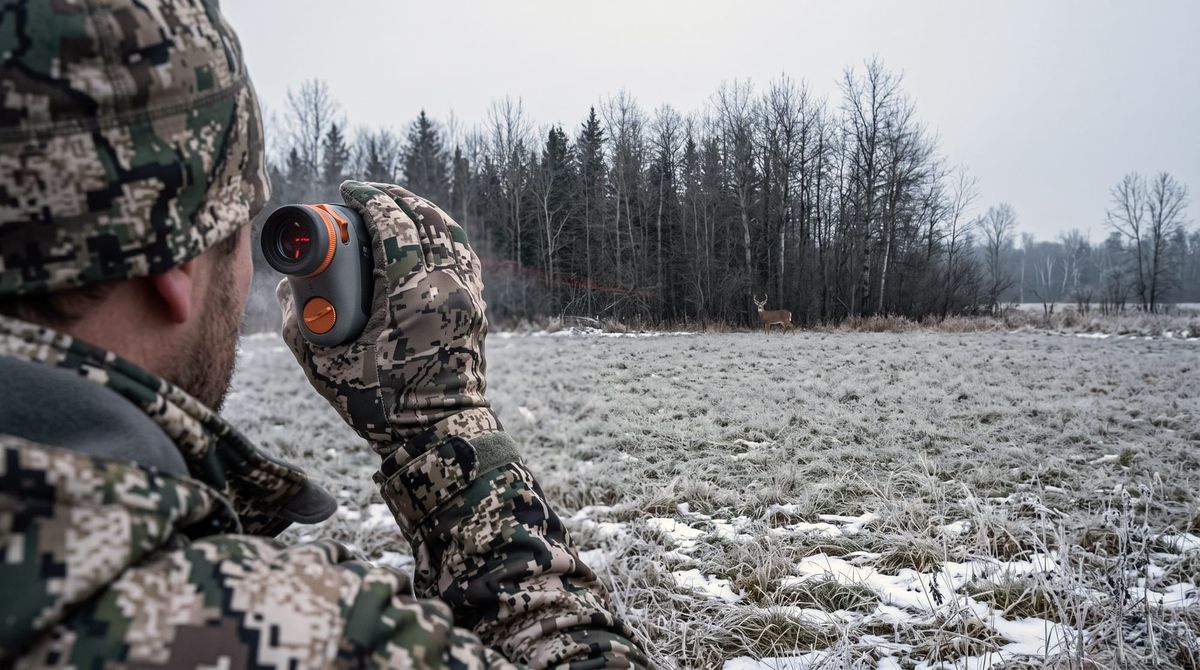
Almost every laser rangefinder publishes two or three maximum ranges, and they are not interchangeable. Reflective is the ceiling: a road sign, a metal roof, a mirror, something engineered to send light back at you. Trees is the middle. Deer is the honest one, because an animal is a dark, soft, irregular shape standing in front of more dark, soft, irregular shapes.
The laser does not weaken across those three rows. The target gets worse at returning it.
Maven publishes all three for the RFZ.1: 4,500 yards reflective, 2,000 to trees, 1,300 to deer. Leupold publishes all three for the RX-1500i TBR/W, now discontinued but still on Canadian shelves: 1,500 reflective, 1,250 to trees, 950 to deer. Vortex's Ranger 1800, one of the most common rangefinders in Canadian hunting packs, is listed by retailers at 1,800 reflective and 900 to deer.
Now run the ratios, which are my arithmetic on those published figures rather than anything the manufacturers advertise. Maven's deer number is 29 per cent of its reflective number. Leupold's is 63 per cent. Vortex's is 50 per cent.
That spread is the reason the reflective figure is close to useless for comparing two rangefinders. The Maven's headline number is three times the Leupold's. Its deer number is about 1.4 times. If you shop the big number, you are shopping a laboratory condition that almost never appears in a Canadian field.
The footnote under the table
Maven's specification page carries two asterisks. The second one is worth reading twice.
Accuracy validation completed to a 2ft x 2ft white target at a distance of 300 YDS.
The stated accuracy runs plus or minus one yard from 300 to 2,000, and plus or minus three yards from 2,000 to 4,500. That validation was performed on a two-foot white square at 300 yards.
Maven deserves credit here. Most manufacturers publish the tiers and skip the methodology entirely, which leaves the reader to assume the numbers were verified across the full range. Printing the actual test condition is the more honest choice. It also tells you plainly that the far end of the table is an extrapolation.
The number Canadians should check first
Buried further down the same table is a line almost nobody reads: operating temperature, 23 to 140 degrees Fahrenheit. Storage temperature, minus 13 to 140.
Converted, and this arithmetic is mine, that is an operating floor of exactly minus 5 degrees Celsius and a storage floor of minus 25. Retailer listings put the Vortex Ranger 1800 at 14 to 131 Fahrenheit, or minus 10 to 55 Celsius.
Minus 5 covers a September morning. It does not describe a December sit in eastern Ontario, a January range day, or most of what a Canadian actually does with optics between November and March. Electronics below their rated floor usually get slow and dim before they quit, so this is a degradation problem rather than a brick. The point is that the manufacturer stopped promising, and the roundups never mention it, because operating temperature is a boring line in a table written mostly for buyers who live somewhere warmer.
What to do with this at the counter
Find the deer number and treat it as the ceiling. Then cut it roughly in half for the conditions you will actually be in: haze, low contrast, a steep angle, a dark hide against dark timber, and your own pulse moving a handheld unit at 12x.
Check the operating temperature before you check the magnification.
Then verify the thing against a known distance. Range the 100 and the 200 on your club's line, on a paper target and on something with no reflective surface anywhere near it, and see what it tells you. A rangefinder that reads consistently at a distance you can confirm is worth more than one whose box goes to 4,500.
The case for printing the big number
The strongest argument against everything above is that the reflective maximum is a legitimate engineering specification and the only one that can be measured repeatably. Trees and deer vary by species, coat, light and season. Reflective is a controlled condition, which makes it the fairest thing to publish and the easiest to hold a manufacturer to.
A gear roundup also has a word count, and Outdoor Canada's entry is four sentences covering an entire product. Maven, for its part, publishes all three ranges openly and footnotes its validation method, which is more transparency than most of its competitors offer. And for a treestand hunter ranging a trail at 40 yards, none of this changes anything.
All of that is fair. The problem is which number travels. The reflective figure is the one that reaches the buyer, gets repeated in a roundup, gets quoted at a counter, and eventually gets used to justify a shot at a distance the unit was never rated to read on an animal.
The sentence that goes with it
I came to this sport in the spring of 2025 and I am still an amateur marksman. I own a Cadex CDX-33 in .338 Lapua Magnum, a rifle whose paper capability comfortably outruns anything I have earned behind it. Nothing about owning it makes 4,500 yards mine.
Holdover argued in July that a rangefinder is the highest-leverage purchase a newer Canadian precision shooter can make. That is still true, and the specification tables above are the reason it needs a second half.
Buy the deer number.
Sources
- Maven Outdoor Equipment Company, "RFZ.1 Specifications," including the maximum reflective range, distance to trees, distance to deer, tiered accuracy figures, operating and storage temperature, and both footnotes beneath the table. Retrieved 2026-08-16. https://mavenbuilt.com/pages/rfz-1-specifications
- Leupold & Stevens, Inc., "RX-1500i TBR/W Rangefinder," product specification table listing maximum range to deer, trees and reflective targets, and tiered accuracy. Product listed as discontinued on the page as retrieved 2026-08-16. https://www.leupold.com/rx-1500i-tbr-w
- Ken Bailey, "2026's best new hunting gear: Outstanding optics for your next great Canadian hunt," Outdoor Canada, published 2026-08-13, last modified 2026-08-14. Source of the quoted RFZ.1 description. https://www.outdoorcanada.ca/2026s-best-new-hunting-gear-outstanding-optics-for-your-next-great-canadian-hunt/
- Vortex Ranger 1800 ranging and operating-temperature figures as listed by retailers, including Cabela's and Sportsman's Warehouse. Vortex Optics' own product pages for this model returned an empty response on two retrieval attempts on the drafting date, so these figures are carried as retailer-listed rather than manufacturer-published. https://www.cabelas.com/p/Vortex-Ranger-1800-Rangefinder-with-HCD and https://www.sportsmans.com/hunting-gear-supplies/optics-binoculars-scopes-rangefinders/rangefinders-nightvision/vortex-ranger-1800-rangefinder-with-hcd/p/1493292
- Holdover, "Range it first," 2026-07-14, referenced for the earlier argument on purchase priority.