Same weight, different hole
Hornady's American Whitetail Tipped reached Outdoor Canada's 2026 gear list in twelve cartridges. Hornady's own tables put the tipped .308 load and the old one within four tenths of an inch at 300 yards. The difference that will cost you a deer is not in either table.

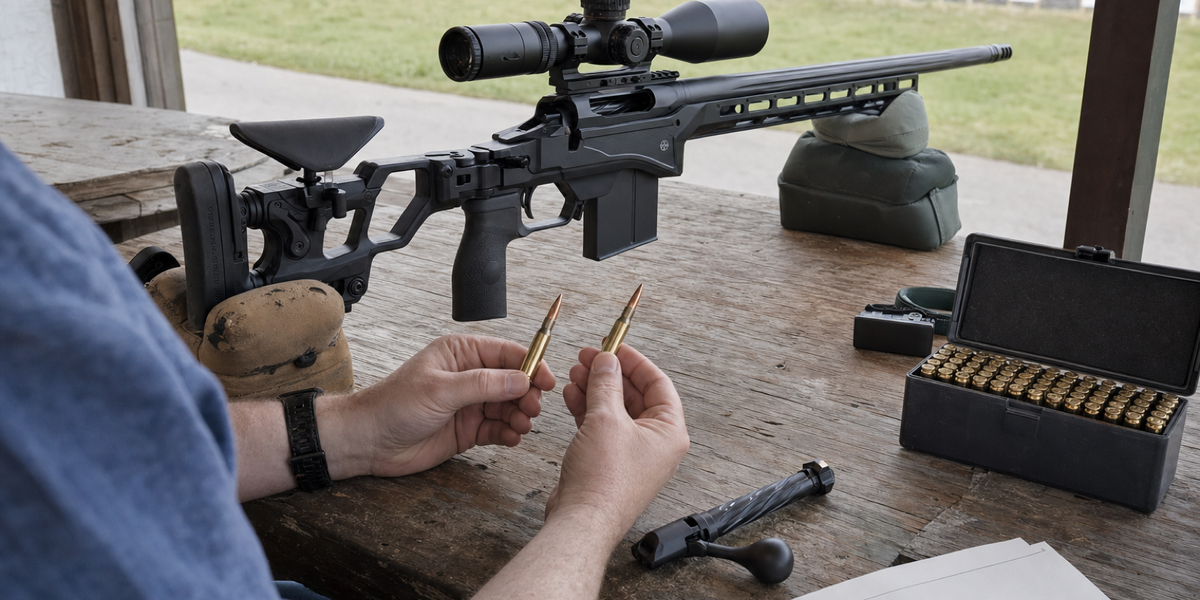
Hornady's American Whitetail Tipped reached Outdoor Canada's 2026 best-new-gear list on August 11, in twelve cartridges running from .243 Winchester to .300 PRC. Same deer-season name on the box, same bullet weights, polymer tip added. In Ontario's northwest and northeast, the rifle season for white-tailed deer opens on September 19. That leaves eighteen days.
Somebody is going to pick up a box of the new stuff this week, set it in the truck beside the rifle they zeroed in June, and treat the swap as free. The swap has a cost, and the reason is more interesting than the reason most people would give for it.
What Hornady's own tables actually say
Put the two .308 Winchester 150-grain loads side by side on Hornady's site. The original American Whitetail, item #8090, uses a 150-grain InterLock soft point. American Whitetail Tipped, item #80934, uses a 150-grain SST. Both tables are computed from a 24-inch test barrel with a 200-yard zero.
The InterLock load leaves at 2,820 feet per second. The SST load leaves at 2,810. Ten feet per second apart.
At 300 yards the InterLock is 8.4 inches low. The SST is 8.0 inches low. Four tenths of an inch separates them.
So if the pitch were that the tipped bullet flies flatter where you hunt, Hornady's own numbers would settle it. On paper, inside 300 yards, these are the same load.
The number the table cannot report
Point of impact belongs to the pairing of a specific load and a specific barrel. Change either half and the answer changes.
A barrel is a steel tube that whips when it is fired. The muzzle travels through an arc while the bullet is still inside, and where in that arc the bullet exits depends on how long it took to get down the bore and how hard it was pushing on the way out. Bearing surface, jacket construction, ogive shape, powder, pressure curve: change any of them and you change the timing. The bullet leaves at a different moment in the whip.
Ten feet per second of published muzzle velocity tells you nothing about that. Neither does a drop table, which assumes a zero and then reports what happens to a bullet already in flight. Where the group centres at 100 metres is decided before the bullet clears the crown.
A small shift at 100 metres can move a group centre enough to matter in the field. The label still says 150 grains. The barrel does not read the label.
I handload, which mostly means I have spent years watching one rifle rearrange its groups over half a grain of powder. It makes a person hard to convince that a different bullet, a different jacket and a different powder charge will land where the last box landed.
Where the polymer tip earns its money
The tip does real work. Push the two loads past 300 yards and the tables separate.
At 500 yards the InterLock has slowed to 1,667 feet per second carrying 925 foot-pounds, sitting 51.3 inches below the line of sight. The SST is still doing 1,804 feet per second with 1,084 foot-pounds, and has dropped 47.6 inches. That is 137 feet per second and 159 foot-pounds of retained performance, which is what a more efficient shape buys: it holds speed longer.
The upgrade is real, and the published tables show its advantage opening past 300 yards. That remains a sound reason to buy it. The buyer still needs to establish where the new load centres in the rifle that will carry it.
Eighteen days, and what to do with them
Put a second box into the season budget. A confirmation session has a cost, and it buys an answer the drop table cannot give you.
Confirm with the carry load. This is the step people skip, because ammunition is expensive and the practice box is right there. If the rounds in the rifle on opening morning have never been fired from that rifle, the zero is a guess with good paperwork behind it.
Confirm with more than three rounds when you can. A three-shot group can feel conclusive while leaving the group centre uncertain. Use the actual hunting load instead of sampling a shelf full of substitutes.
Confirm in the light you will hunt in. Ontario permits hunting from half an hour before sunrise to half an hour after sunset. A zero verified at eleven in the morning tells you very little about a reticle at 6:40 on an October morning.
What the confirmation costs
Range time and a second box ask something of the hunter. A published trajectory is only the starting point. The rifle's group requires range time.
Run the new load in your own barrel before it becomes your opening-day load.
Sources
- 308 Win 150 gr InterLock SP American Whitetail, item #8090 - Hornady Manufacturing, published ballistics table, 24-inch test barrel
- 308 Win 150 gr SST American Whitetail TIPPED, item #80934 - Hornady Manufacturing, published ballistics table, 24-inch test barrel
- 30 Cal .308 150 gr SST, item #30302 - Hornady Manufacturing, bullet construction and secant-ogive profile
- 2026's best new hunting gear: top ammo options for the Canadian wilds - Outdoor Canada, Ken Bailey, August 11, 2026
- Ontario Hunting Regulations Summary: General regulations - Ministry of Natural Resources, updated March 9, 2026, hunting hours
- Ontario Hunting Regulations Summary: White-tailed deer - Ministry of Natural Resources, updated March 9, 2026, season tables
Keep the range notes worth reading later.
If this piece has you thinking about range time, keep the notes useful enough to read later.
Use the Holdover Range Bench Log Card to record rifle, optic, ammunition, distance, weather, zero, group notes, correction, and next test without turning a range trip into a memory test.
Safety note: the card is a note-taking worksheet, not shooting instruction, load data, legal advice, or a substitute for range rules, official guidance, manufacturer manuals, or qualified instruction.