Stop Crediting the Buyback for *Police Work*
Recent Canadian enforcement against smuggling, drugs, and illegal firearms should be credited honestly. Do the police work, then do not sell it as buyback success.

Update, June 9, 2026. Public Safety Canada has extended the relevant amnesty period. The old the former fixed deadline date referenced below is no longer the operative expiry; the amended expiry is 90 days after the Supreme Court of Canada renders its decision.
Opinion. The useful work is the boring kind: border files, search warrants, surveillance, charge packages, and the slow work of finding people who were never waiting for a portal message from Public Safety Canada.
A Canadian firearms thread this week captured a frustration that is easy to understand. If police and border agencies visibly step up work against smuggling, drugs, gangs, and illegal firearms, will Ottawa eventually call that a win for the buyback?
That is the right worry, but it needs a disciplined answer.
Targeted enforcement is good. It is not a conspiracy because police finally do the thing lawful owners have been asking governments to fund for years. If officers stop illegal firearms, disrupt organized crime, and build actual cases, that should be welcomed. Public safety is supposed to look like that.
The problem comes later, when the credit gets laundered through politics. If firearm violence falls after border and organized-crime work improves, the honest conclusion is not that confiscating property from licensed owners worked. The honest conclusion is that enforcement aimed at the problem worked.
The hard work is not the easy target
Look at the difference between the work and the theatre.
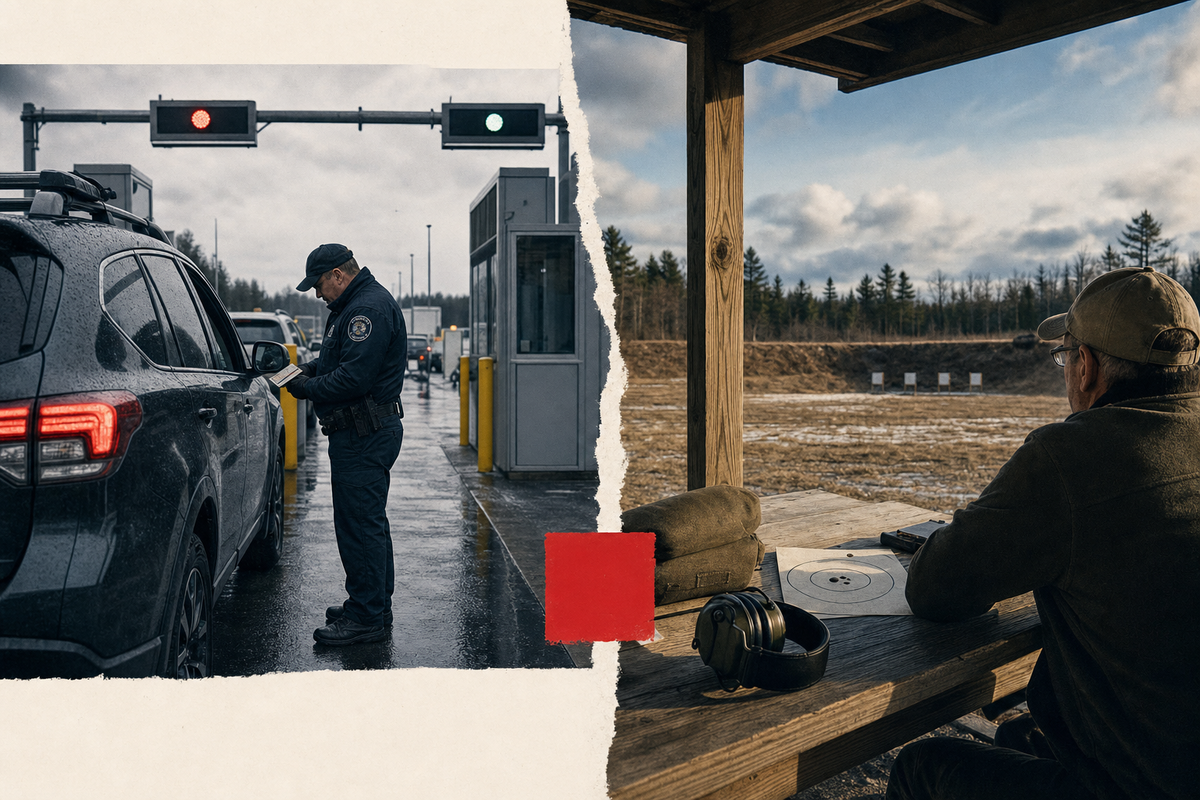
In April, the CBSA announced charges after an Ottawa investigation that began with a prohibited weapon intercepted at the International Mail Processing Centre in Mississauga. The agency said officers later seized three firearms, prohibited knives, brass knuckles, stun guns, and forged documents from an Ottawa residence. The charges have not been proven in court, but the enforcement lane is obvious: border interception, investigation, search warrant, charges.
The same release said CBSA officers in Ontario made 6,462 prohibited-item seizures in 2025, including 494 firearms and 12,874 miscellaneous parts for firearms or magazines. That is the front door of the illegal-supply problem.
In May, the RCMP said an 18-month investigation into a drug-trafficking and money-laundering operation in the GTA and Quebec led to more than 30 search warrants and seizures that included 153 kilograms of cocaine, 10 kilograms of heroin, nearly $1.6 million in cash, and one prohibited firearm. The point is the type of work: long investigation, multiple agencies, organized-crime context, drugs, money, and a firearm where the firearm is part of a criminal operation.
That is where public-safety effort belongs. It is hard, slow, and difficult to sell on a podium sign, which is probably why governments keep reaching for easier targets.
Licensed owners are already in the system
The easy target is the licensed owner because the licensed owner is already visible.
The RCMP's 2024 Commissioner of Firearms Report counted 2,425,627 valid individual firearms licences in Canada at year-end. It also describes safety courses, licence screening, continuous eligibility monitoring, transfer verification, restricted and prohibited registration, range oversight, inspections, refusals, and revocations.
New shooters learn this quickly. Before the first good range day, there is the course, the wait, the storage rules, the transport rules, the club rules, the range briefing, and the paperwork that turns a hobby into a filing cabinet with recoil.
Public Safety Canada's current buyback page says the government has banned more than 2,500 makes and models since May 2020. Owners must dispose of or permanently deactivate affected firearms before the SCC appeals + 90-day amnesty endpoint or risk criminal liability. Its April 1 release said more than 67,000 firearms were declared by 37,869 owners.
Those owners are reachable because they complied with the system in the first place. Treating that visibility as proof of public-safety relevance is the central category error of the last six years.
StatsCan points at people, not safes
Statistics Canada's 2024 firearms and violent-crime article does not read like a brief for symbolic confiscation.
Police reported 14,488 firearm-related violent crimes in 2024, representing 2.6% of violent crimes. Nearly four in 10 firearm-related homicides were attributable to organized crime or gangs. Of the people accused of firearm-related violent crime in 2024, 70% had recent police contact for a Criminal Code offence, excluding traffic offences. Nearly six in 10 had previous police contact for at least one violent crime from 2018 to 2024.
That is the shape of the problem.
The data point toward illegal possession, organized crime, repeat violent contact, trafficking, smuggling, and people already known to police. They do not point at every owner, every range, every retailer, every handloader, or every new PAL holder with the poor manners to own gear while Ottawa is trying to simplify a press release.
Canada already has licensing, screening, storage, transport, registration where applicable, and a classification system with more moving parts than a discount chronograph.
What they should not have to accept is borrowed credit.
If the government funds border enforcement and border enforcement helps, credit border enforcement. If police focus on repeat violent offenders and the numbers move, credit that. If intelligence-led investigations disrupt smuggling routes, credit that. Do not point to the licensed owner waiting for a compensation instruction and pretend his safe was the lever.
That is not evidence. That is accounting with stage lighting.
The fair credit test
At the reloading bench, this would be embarrassing.
If I change the brass prep, seating depth, powder charge, primer, and neck tension, then get a better group, I do not get to announce that the seating depth solved it because that was the theory I liked best. The target does not care about my preferred narrative.
Policy deserves at least the same humility as handloading.
If Canada changes enforcement levels, border resources, prosecution priorities, gang-investigation capacity, and the buyback at the same time, nobody gets to credit the politically convenient variable without evidence.
Measure the thing that worked
When CBSA stops smuggling, good. When RCMP and local police disrupt organized-crime networks, good. When investigators find illegal firearms connected to drugs, money, forged documents, or repeat violent offenders, good.
The demand is not "do nothing."
The demand is "aim properly."
Fund the border. Build cases against traffickers. Track repeat violent offenders. Publish clean metrics. Tell the public which intervention moved which number. Then have the decency not to use that work as borrowed credibility for a buyback aimed at a visible, licensed population.
New shooters need to understand this early because they enter the sport under a cloud of sloppy public language.
Illegal supply is one category. Repeat violent offending is another. Lawful ownership is another. A border investigation is not a range day. A compensation portal is not a gang file. A PAL holder is not a smuggling route because the state knows his mailing address.
Do the police work.
Measure the police work.
Credit the police work.
Sources
- r/canadaguns, Rash of Recent Police Actions Against Firearms/drugs/gangs, May 20-21, 2026 community thread, accessed May 21, 2026.
- Public Safety Canada, Assault-Style Firearms Compensation Program, accessed May 21, 2026.
- Public Safety and Emergency Preparedness Canada via CNW, Declaration period for the Assault-Style Firearms Compensation Program closing with more than 67,000 firearms declared for compensation, April 1, 2026, accessed May 21, 2026.
- Canada Border Services Agency via CNW, CBSA investigation results in firearms seizure and charges against two individuals in Ottawa, April 15, 2026, accessed May 21, 2026.
- Royal Canadian Mounted Police - Central Region via CNW, RCMP investigation leads to arrests and seizure of illicit drugs in the GTA worth over $4.4 million, May 5, 2026, accessed May 21, 2026.
- Statistics Canada, Firearms and violent crime in Canada, 2024, accessed May 21, 2026.
- Royal Canadian Mounted Police, 2024 Commissioner of Firearms Report, accessed May 21, 2026.
The amnesty file is still moving.
If this piece sent you back to government pages, do not wait for the next portal, Gazette, or court move to find you by accident.
The Dispatch follows Public Safety, RCMP, Canada Gazette, court, compensation, collection, and amnesty updates so the next change comes with the source that moved.
Safety note: the tracker is a worksheet for source hygiene, not legal advice or a substitute for current official guidance.