The Army Says *Assault Rifle*
Opinion. On April 17, the Canadian Army released a promotional video for a new service rifle: the Canadian Modular Assault Rifle. Six years of civilian buyback rhetoric has rested on that word. The Army just claimed it, from the same Kitchener factory.


Opinion. On April 17, 2026, the Canadian Army published a promotional video for a new service rifle. It is called the Canadian Modular Assault Rifle. That is not a paraphrase. That is the name, set in the title of the video and in the URL of the federal page that hosts it.
The same word, "assault," has carried six years of federal firearms policy aimed at licenced civilians who never possessed an assault rifle in the legal sense of the term. The Army's video does not reconcile those two uses of the word. It does not have to. The rifle is what it is. The naming convention is what it is. Canadians are capable of drawing the line themselves, and for most of the last decade they have been the only ones doing so.
What the Army said, and where it said it
The video sits at canada.ca/en/army/corporate/video/cmar-project.html, under the Canadian Army's official video gallery, dated April 17, 2026. It runs under the headline "The Canadian Modular Assault Rifle (CMAR) project." The accompanying description, in the Army's own words, calls the CMAR "a modern, precise, and adaptable weapon system to meet the demands of future operations," a "modern, two-tier system designed for Canadian soldiers," and "made in Canada for Canadian soldiers." The file includes the promise, and this is worth noting in full: "Built in partnership with Canadian industry, CMAR will deliver precision, adaptability, and innovation for the future fight."
That is the public face of the program. The underlying contract was awarded in Kitchener on March 19, 2026, through the Defence Investment Agency to Colt Canada. It covers up to 65,402 rifles across two variants: 49,207 General Service rifles for wider distribution across the force, and 16,195 Full Spectrum rifles for front-line combat. Phase 1 covers roughly 30,000 General Service rifles over three years at an initial value of approximately $307 million. First deliveries are expected in 2027. The value is real. The scale is real. The word in the name is the Army's own.
The rifle itself
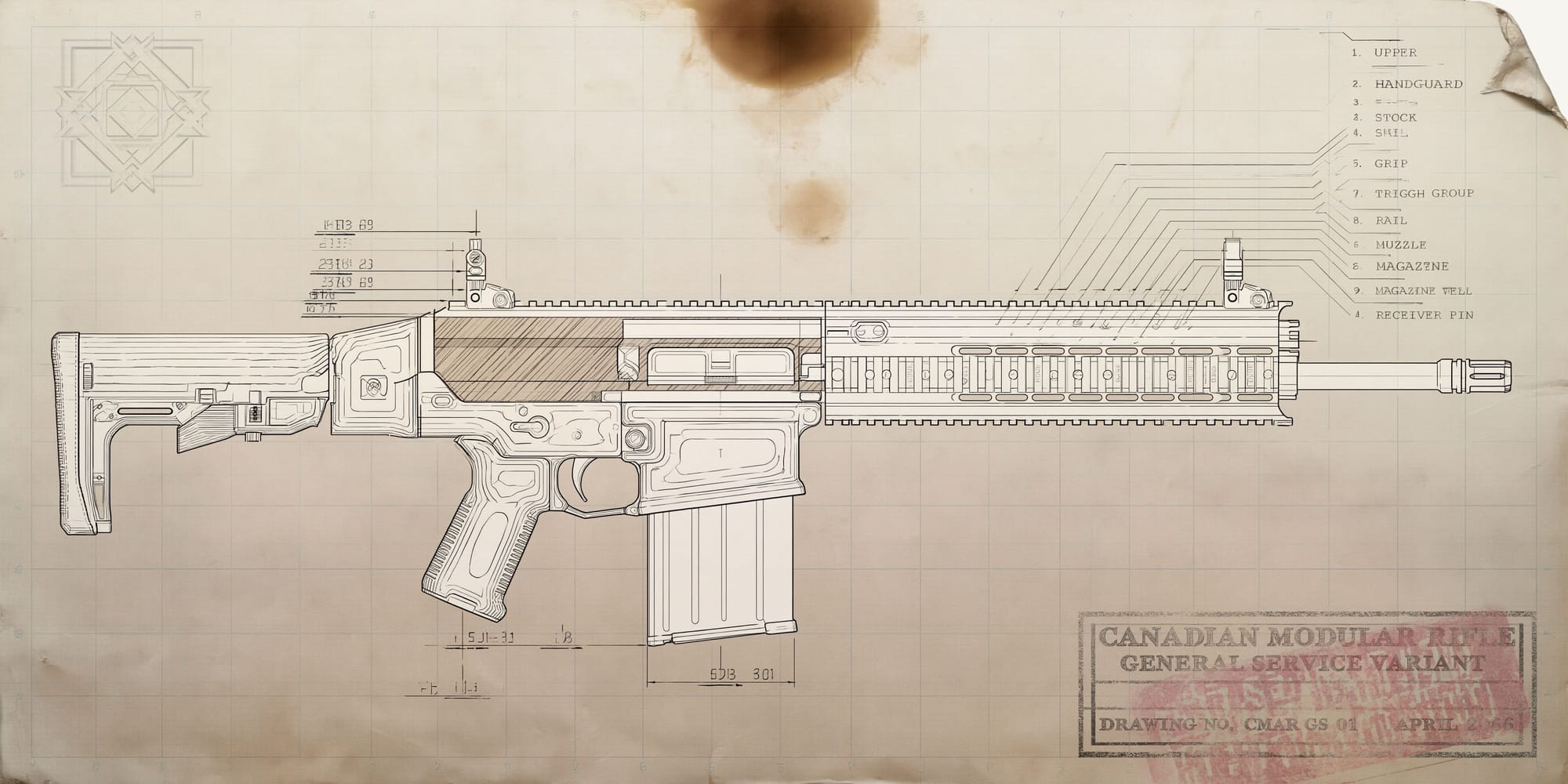
The CMAR is chambered in 5.56 by 45 mm NATO. It uses a monolithic upper receiver, a chrome-lined free-floating barrel, a full-length STANAG 4694 top rail, M-LOK accessory handguards, ambidextrous controls, and a direct gas impingement operating system. The General Service variant is projected at a 14.5-inch barrel and a weight of 3.4 kilograms. Like every service rifle in issue to the Canadian Armed Forces since the C7 entered service in 1984, it is select-fire, meaning it is capable of fully automatic operation. That capability is what makes it an assault rifle in the legal and technical sense of the term, a term with an actual definition rather than a rhetorical one.
The word doing the work
"Assault rifle" is not a marketing term. It is a functional description used consistently across the defence literature and the firearms-classification world: a selective-fire, shoulder-fired weapon chambered in an intermediate rifle cartridge. Canadian civilians have not been legally permitted to own selective-fire firearms since the prohibition regime consolidated in the early 1990s. The last civilian-accessible selective-fire firearms in Canada were grandfathered into a category that, in practical terms, no longer meaningfully exists. The population that actually owns assault rifles in Canada, in the proper technical sense, is the population currently taking delivery of the CMAR.
"Assault-style firearm" is a different term. It is not a functional description. It appears nowhere in the Firearms Act. It is a regulatory label applied by Order in Council to a list of makes and models that the federal cabinet decides, by OIC, to so label. The May 1, 2020 OIC prohibited roughly 1,500 makes and models of semi-automatic sporting rifles that had been lawfully held by licenced Canadians, some for decades. Subsequent Gazette amendments have pushed the list past 2,500 entries. None of the rifles on that list are assault rifles.
The strongest version of the government's position
The better version of the government's argument runs this way: "assault-style" is not a technical term because it does not need to be. It is a regulatory category drawn by measurable characteristics, namely semi-automatic action, detachable magazines, and certain stock and grip configurations, that together describe a class of rifle capable of rapid repeat fire at close and medium ranges. The class, the argument goes, sits operationally close enough to the military-issue class that treating it as a cousin rather than a stranger is reasonable policy. The rifles used at École Polytechnique, at the Quebec City mosque, and at Portapique were not selective-fire. They were semi-automatic. They fit the "assault-style" cluster.
That argument deserves to be taken seriously, because a version of it is the only argument holding the program up. It does not survive contact with the regulation itself. The May 2020 OIC did not prohibit all semi-automatic rifles with detachable magazines. It prohibited a specific list of makes and models. Many of the rifles on that list are functionally indistinguishable from hunting rifles that remain legal today. Many of the rifles that remain legal today are functionally indistinguishable from rifles on the prohibited list. The list was not drawn by function. It was drawn by appearance and by make-and-model enumeration. That is why it runs past 2,500 entries and keeps growing, and why no licenced owner in this country can predict with any confidence what will be added next. A category defined by appearance is a category defined by rhetoric. The word "assault" is doing the work because it is the only connective tissue the category has.
Two Kitchener assembly lines
The Canadian Modular Assault Rifle will be manufactured at Colt Canada's plant in Kitchener, Ontario. Colt Canada, which operated as Diemaco before the 2005 name change, has built the C7, the C8, and their variants for the Canadian Armed Forces continuously since 1984. The company is a Canadian industrial fixture. Its service-rifle line and its commercial line have run through the same facility, the same supply chain, and in many cases the same parts, for decades.

The civilian AR-platform rifles on the May 2020 prohibited list share the architectural lineage of the C7/C8 family. They share a receiver geometry, a cartridge, and a parts tree. What they do not share is a fire-control group capable of selective fire, because Canadian civilians have not had legal access to one. They are, mechanically, semi-automatic sporting rifles. The federal buyback program, now at roughly 67,000 firearms declared against a budgeted 136,000, is currently paying (and in Alberta, not paying) licenced owners for rifles that are functionally one step removed from the rifle the Army is now buying.
Same company. Same city. Same factory floor. Two very different standards, separated by the word in the product name.
What the video does not say
The April 17 promotional video describes the CMAR as "precision, adaptability, and innovation for the future fight." It does not mention the word "buyback." It does not mention the Assault-Style Firearms Compensation Program. It does not acknowledge that the federal government has spent six years pressing licenced Canadians to surrender civilian rifles that share a parts tree, a manufacturing lineage, and a cartridge with the service rifle the Army is now unveiling.
The video does not need to mention any of that. It is a defence procurement announcement. The Canadian Armed Forces needs a modern service rifle. The C7 platform has had a 42-year run. The CMAR, by the technical descriptions published, is a competent update on the AR-15 architecture built to Canadian Forces specifications. All of that can be true.
What is also true is that the federal government has, for six years, told licenced Canadian civilians that visually similar semi-automatic rifles are "weapons designed for the battlefield" and therefore unsuitable for any civilian use. That claim has been the rhetorical spine of the buyback. It is a claim the April 17 video does not have to engage with, because the Army is not in the business of engaging with it, and because the cabinet that made the claim was not standing at the Kitchener podium on March 19.
The standard, applied evenly
This publication's position on firearms ownership in Canada has been stated elsewhere and does not change here. PAL and RPAL holders are among the most vetted and least offending demographics in the country. The allocation of firearms-policy effort over the last decade has concentrated on that vetted population while violent firearms crime has been driven, overwhelmingly, by illicit weapons and repeat offenders. The evidence does not support the buyback. The cost-benefit does not support the buyback. The declaration numbers do not support the buyback.
What the April 17 video adds to that case is a rhetorical asymmetry the government now has to explain. A rifle with "assault" in the official name is being celebrated in an Army promotional video as a source of Canadian industrial pride. A semi-automatic sporting rifle, manufactured in the same city, sharing a receiver geometry and a cartridge, is being confiscated from the licenced accountant in Kitchener who bought it.
The federal government is welcome to argue that the distinction between a select-fire military service rifle and a semi-automatic civilian sporting rifle is a distinction with a difference. Most Canadian firearms owners, including this publication, would agree. That distinction, with a difference, is exactly why the civilian rifles were never assault rifles, and why calling them "assault-style" has always been a political act rather than a technical one.
The word "assault" is doing the work because it is the only connective tissue the category has.
The name is the admission
The buyback program survives, politically, on the rhetorical work the word "assault" performs on the public imagination. Strip the word out of the branding and the policy becomes, plainly, what the Minister of Public Safety admitted on tape last September it was: a political exercise. The word is the justification. The word is the public-safety frame.
The Army just claimed that word, unironically, for a rifle that is an entire legal category removed from anything licenced Canadians have ever been permitted to own. That is not a scandal. That is simply what the Army uses. The scandal, if there is one, is what it reveals about the other application of the word. When "assault" describes a rifle that cabinet has actually ordered, 65,402 of them, the word is plain English. When "assault-style" describes a rifle that cabinet has decided to confiscate, the word is policy theatre.
The same word. The same factory. Two very different standards, and now, as of April 17, two very different primary sources. Both of them published by the Government of Canada.
The Army said assault rifle. The Army meant it.
That is the record. That is the admission. And it is the evidence that the civilian-side use of the word, for six years and counting, was never a technical description of the rifles being taken. It was only ever the justification.That is the record. That is the admission. And it is the evidence that the civilian-side use of the word, for six years and counting, was never a technical description of the rifles being taken. It was only ever the justification.
Related Holdover References
Source-led reference pages for the terms and policy context behind this piece.
- Canadian Firearms Classification Timeline
- Canadian Firearms Storage and Transport Source Map
- Canadian Firearms Glossary
- Canadian Firearms OIC Index
- Sources and Verification
Related Holdover Tools
Useful calculators and references from the same corner of the Holdover bench.
- Holdover tools
- Ban-Risk Index
- Canadian Firearms Buyback Tracker
- Canadian Firearms Classification Timeline
- The Common Ten
Sources
- Canadian Army, The Canadian Modular Assault Rifle (CMAR) project (video), canada.ca, April 17, 2026
- Defence Investment Agency, Defence Investment Agency awards contract to replace current Canadian Armed Forces assault rifles, March 19, 2026
- Department of National Defence, Mission Ready: Equipping the Forces, March 2026
- Colt Canada Group, Colt Canada received a $273M CAD contract to modernize Canadian assault rifle fleet, March 2026
- TheGunBlog.ca, Canada Gun Rights News: Week of 2026 April 20, April 21, 2026
- CBC News, Liberals planned to buy back 136,000 banned guns. Fewer than half that many were declared, April 2026
- CBC News, Albertans who declared banned guns under Ottawa's buyback still can't get compensation, April 2026
- Canada Gazette, Part II, Orders in Council adding to the prohibited firearms list, May 1, 2020 and subsequent amendments
- Firearms Act, R.S.C. 1995, c. 39
- This piece is labelled Opinion. The factual claims are sourced; the interpretation is editorial. Corrections and counter-arguments welcomed at The Dispatch.
Source trail refreshed
This article was refreshed for accessibility and source discovery on 2026-05-20. The opinion has not been rewritten; this block keeps the source trail easier to inspect.
Primary source trail
- Canadian Army CMAR project video
- Defence Investment Agency CMAR contract news release
- RCMP classes of firearms in Canada
- Justice Laws Classification Regulations
Keep the source trail in one place.
If this piece sent you back to government pages, keep the official links, page dates, and follow-up notes together.
Use the Holdover Canadian Firearms Policy Source Tracker to record the current Public Safety, RCMP, Canada Gazette, and Justice source pages behind buyback, OIC, classification, compensation, and amnesty claims.
Safety note: the tracker is a worksheet for source hygiene, not legal advice or a substitute for current official guidance.